MCQ
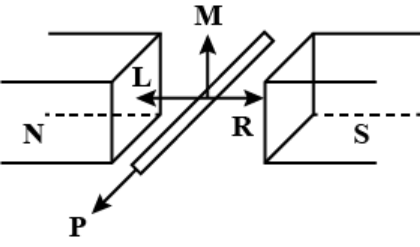
An electric potential difference will be induced between the ends of the conductor shown in the figure, if the conductor moves in the direction shown by:
- AP
- BR
- CL
- DM
Explanation:
Fleming’s Right Hand Rule gives the direction of current in the conductor whenever it is moved in any magnetic field. It states that if we stretch our right hand fingers perpendicular to each other as shown in fig, then if fore finger is in the direction of Magnetic field and thumb is in the direction of motion of conductor then middle finger gives the direction of current in the conductor.
Explanation for the correct answer:
For induction of emf in the conductor, the motion of conductor should be perpendicular to the direction of magnetic field. Thus, Option B and C are eliminated.
Now if we move conductor in P direction, the motion will be perpendicular to the direction of magnetic field but then the charge separation in the conductor will take place perpendicular to the length of the conductor. Thus, due to less space for charge separation emf can not be induced in the conductor. Thus, Option A is eliminated.
If conductor is moved in direction M then the charge separation in the conductor takes place across its length, there will be enough space for charge separation. And thus emf will be induced across the conductor.
Generate a complete, print-ready paper with questions like this in minutes — across 16+ boards, with answer keys.
The relation among u, v and f for a mirror is:
$\frac{\text{k}_1}{\text{k}_2}$
$\sqrt{\frac{\text{k}_1}{\text{k}_2}}$
$\frac{\text{k}_2}{\text{k}_1}$
$\sqrt{\frac{\text{k}_2}{\text{k}^1}}$
An infinite number of identical capacitors each of capacitance 1 μF are connected as in adjoining figure. Then the equivalent capacitance between A and B is

|
(a) 1 μF |
(b) 2 μF |
(c) |
(d) ∞ |
Eight dipoles of charges of magnitude e are placed inside a cube. The total electric flux coming out of the cube will be
|
(a) |
(b) |
(c) |
(d) Zero |
Which of the adjoining graphs represents ohmic resistance
(a)

|
(b)

|
(c)

|
(d)

|
Assertion : Heat is generated continuously is an electric heater but its temperature becomes constant after some time.
Reason : At the stage when heat produced in heater is equal to the heat dissipated to its surrounding the temperature of heater becomes constant.
|
(a) If both assertion and reason are true and the reason is the correct explanation of the assertion. |
|
(b) If both assertion and reason are true but reason is not the correct explanation of the assertion. |
|
(c) If assertion is true but reason is false. |
|
(d) If the assertion and reason both are false. |
The specific resistance of a wire is ρ, its volume is 3  and its resistance is 3 ohms, then its length will be
|
(a) |
(b) |
(c) |
(d) |
In order to increase the angular magnification of a simple microscope, one should increase:
Assertion : Magnetic moment of an atom is due to both, the orbital motion and spin motion of every electron.
Reason : A charged particle produces a magnetic field.
|
(a) If both assertion and reason are true and the reason is the correct explanation of the assertion. |
|
(b) If both assertion and reason are true but reason is not the correct explanation of the assertion. |
|
(c) If assertion is true but reason is false. |
|
(d) If the assertion and reason both are false. |


