An electric wire is connected across a cell of $e.m.f.$ The current $I$ is measured by an ammeter of resistance $R$. According to ohm's law
Easy


Download our appand get started for free
Experience the future of education. Simply download our apps or reach out to us for more information. Let's shape the future of learning together!No signup needed.*
Similar Questions
- 1An infinite ladder network is arranged with resistances $R$ and $2 R$ as shown. The effective resistance between terminals $A$ and $B$ isView Solution
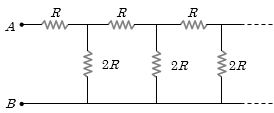
- 2View SolutionIf an observer is moving with respect to a stationary electron, then he observes
- 3In the following circuit, the battery has an emf of $2\mathrm{V}$ and an internal resistance of $\frac{2}{3}\ \Omega$. The power consumption in the entire circuit is$..... W.$View Solution
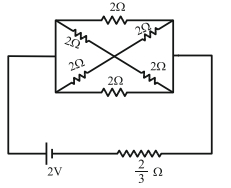
- 4In the circuit shown in the figure, the current flowing in $2\,\Omega $ resistance ............... $A$View Solution
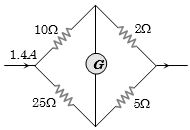
- 5In meter bridge experiment for measuring unknown resistance ' $S$ ', the null point is obtained at a distance $30 cm$ from the left side as shown at point $D$. If $R$ is $5.6 k \Omega$, then the value of unknown resistance ' $S$ ' will be $\Omega .$View Solution
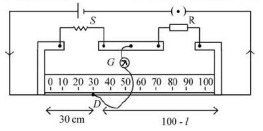
- 6You are given a resistance wire of length $50\, cm$ and a battery of negligible resistance. In which of the following cases is largest amount of heat generatedView Solution
- 7View SolutionThe colour coding on a carbon resistor is shown in the given figure. The resistance value of the given resistor is:
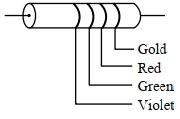
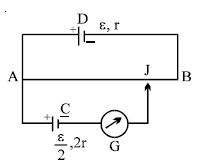
- 8In the figure, the potentiometer wire $AB$ of length $L$ and resistance $9r$ is joined to the cell $D$ of $\mathrm{emf}$ $\varepsilon$ and internal resistance $r$. The cell $C’s$ $\mathrm{emf}$ is $\varepsilon /2$ and its internal resistance is $2r$. The galvanometer $G$ will show no deflection when the length $AJ$ isView Solution
- 9If $n,\,e,\,\tau $ and $m$ respectively represent the density, charge relaxation time and mass of the electron, then the resistance of a wire of length $l$ and area of cross-section $A$ will beView Solution
- 10If the current through a resistor in a circuit increases by $3 \%$, then the power dissipated by the resistorView Solution