An electrical circuit consists of ten $100 \,\Omega$ resistors. Out of these $10$ resistors, a group of $n _1$ resistors are connected in parallel and another group of $n _2$ resistors are separately connected in parallel. These two groups are then connected in series and this combination is connected to a voltage source of $100 \,V$. If the net current though the circuit is $2.5 \,A$. The values of $n _1$ and $n _2$ are
KVPY 2021, Diffcult


Download our appand get started for free
Experience the future of education. Simply download our apps or reach out to us for more information. Let's shape the future of learning together!No signup needed.*
Similar Questions
- 1View SolutionAssertion : An electric bulb becomes dim, when the electric heater in parallel circuit is switched on.
Reason : Dimness decreases after sometime.
- 2A metallic block has no potential difference applied across it, then the mean velocity of free electrons is $T$ = absolute temperature of the block)View Solution
- 3View SolutionThe net resistance of a voltmeter should be large to ensure that
- 4Two circuits (shown below) are called ‘Circuit $A$ ’and ‘Circuit $B$’. The equivalent resistance of ‘Circuit $a$’ is $x$ and that of ‘Circuit $B$’ is $y$ between $1$ and $2.$View Solution

- 5The same mass of copper is drawn into two wires $1\, mm$ and $2\, mm$ thick. Two wires are connected in series and current is passed through them. Heat produced in the wire is in the ratioView Solution
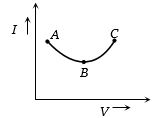
- 6View SolutionResistance as shown in figure is negative at
- 7View SolutionThe resistance of an incandescent lamp is
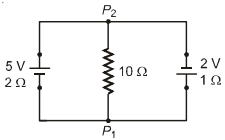
- 8A $5\ V$ battery with internal resistance $2\,\Omega$ and a $2\,V$ battery with internal resistance ln are connected to a $10\,\Omega$ resistor as shown in the figure.View Solution
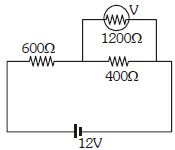
- 9Find the error in reading of voltmeter ................ $\%$View Solution
- 10Two batteries with e.m.f $12\ V$ and $13\ V$ are connected in parallel across a load resistor of $10\,\Omega$ . The internal resistances of the two batteries are $1\,\Omega$ and $2\,\Omega$ respectively. The voltage across the load lies betweenView Solution