A metallic block has no potential difference applied across it, then the mean velocity of free electrons is $T$ = absolute temperature of the block)
Easy


Download our appand get started for free
Experience the future of education. Simply download our apps or reach out to us for more information. Let's shape the future of learning together!No signup needed.*
Similar Questions
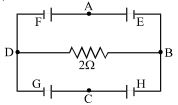
- 1In the circuit shown $E, F, G$ and $H$ are cells of $\mathrm{e.m.f.}$ $2\,V, 1\,V, 3\,V$ and $1\,V$ respectively and their internal resistances are $2\,\Omega , 1\,\Omega , 3\,\Omega$ and $1\,\Omega$ respectively.View Solution
- 2If ${R_1}$ and ${R_2}$ are respectively the filament resistances of a $200$ $watt$ bulb and $100$ $watt$ bulb designed to operate on the same voltage, thenView Solution
- 3View SolutionWhich of the following statements is false?
- 4A carbon resistor has colour strips as violet, yellow brown and golden. The resistance is .............. $\Omega$View Solution
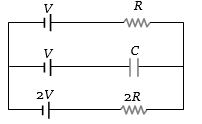
- 5View SolutionIn the given circuit, with steady current, the potential drop across the capacitor must be
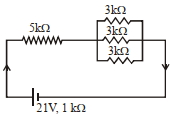
- 6In the figure given, the electric current flowing through the $5\, k \Omega$ resistor is $'x' mA.$View Solution
The value of $x$ to the nearest integer is .........
- 7In $n_e$ and $v_d$ be the number of electrons and drift velocity in a semiconductor. When the temperature is increasedView Solution
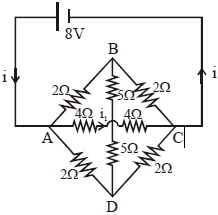
- 8The value of current $i_{1}$ flowing from $A$ to $C$ in the circuit diagram is$.......A$View Solution
- 9If two wires having resistance $R$ and $2R$. Both joined in series and in parallel then ratio of heat generated in this situation, applying the same voltage,View Solution
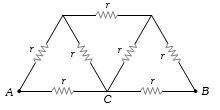
- 10In the circuit shown, the value of each resistance is $r$, then equivalent resistance of circuit between points $A$ and $B$ will beView Solution