Question
An electrical device draws 2kW power from AC mains $(\text{voltage }223\text{V}\text{(rms)}=\sqrt{50.000}\text{V})$. The current differs (lags) in phase by $\phi\Big(\tan\phi=\frac{-3}{4}\Big)$ as compared to voltage. Find,
  1. R,
  2. $X_C - X_L,$
  3. $I_M$. Another device has twice the values for $R, X_C$ and $X_L$. How are the answers affected?
Answer

Power $\text{P}=\frac{\text{V}^2}{\text{Z}}$Given, P = 2kW = 2000W,$ V_{rms} = V = 223V$
$\text{Z}=\frac{\text{V}^2}{\text{P}}=\frac{223\times223}{2\times10^3}=25$
Now, impedance $\text{Z}=25\Omega$
Impedance $\text{Z}=\sqrt{\text{R}^2+(\text{X}_\text{C}-\text{X}_\text{L})^2}$
$\Rightarrow\ \sqrt{\text{R}^2+(\text{X}_\text{C}-\text{X}_\text{L})^2}=25$
$\Rightarrow\ \text{R}^2+(\text{X}_\text{C}-\text{X}_\text{L})^2=625$
As, $\tan\phi=\frac{\text{X}_\text{C}-\text{X}_\text{L}}{\text{R}}=-\frac{3}{4}$
$\therefore\ 625=\text{R}^2+\Big(-\frac{3}{4}\text{R}\Big)^2=\frac{25}{16}$
$\text{R}^2=400$
$\Rightarrow\ \text{R}=20\Omega$
  1. Resistance $\text{R}=200\Omega.$
  2. $\text{X}_\text{L}-\text{X}_\text{C}=\frac{3\text{R}}{4}=\frac{3}{4}\times20=15\Omega.$
  3. Main current $\text{I}_\text{M}=\text{I}\sqrt{2}=\frac{\text{V}}{\text{Z}}\sqrt{2}=\frac{223}{25}\times\sqrt{2}=12.6\text{A}$.

Need a full question paper?

Generate a complete, print-ready paper with questions like this in minutes — across 16+ boards, with answer keys.

Start Generating Free

Similar questions

(II) (a) Using Kirchhoff'᾿s laws obtain the equation of the balanced state in Wheatstone bridge.
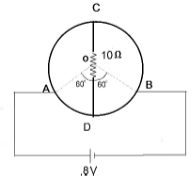
b) A wire of uniform cross-section and resistance of 12 ohm is bent in the shape of circle as shown in the figure. A resistance of 10 ohms is connected to diametrically opposite ends C and D. A battery of emf 8V is connected between A and B. Determine the current flowing through arm AD.

Image
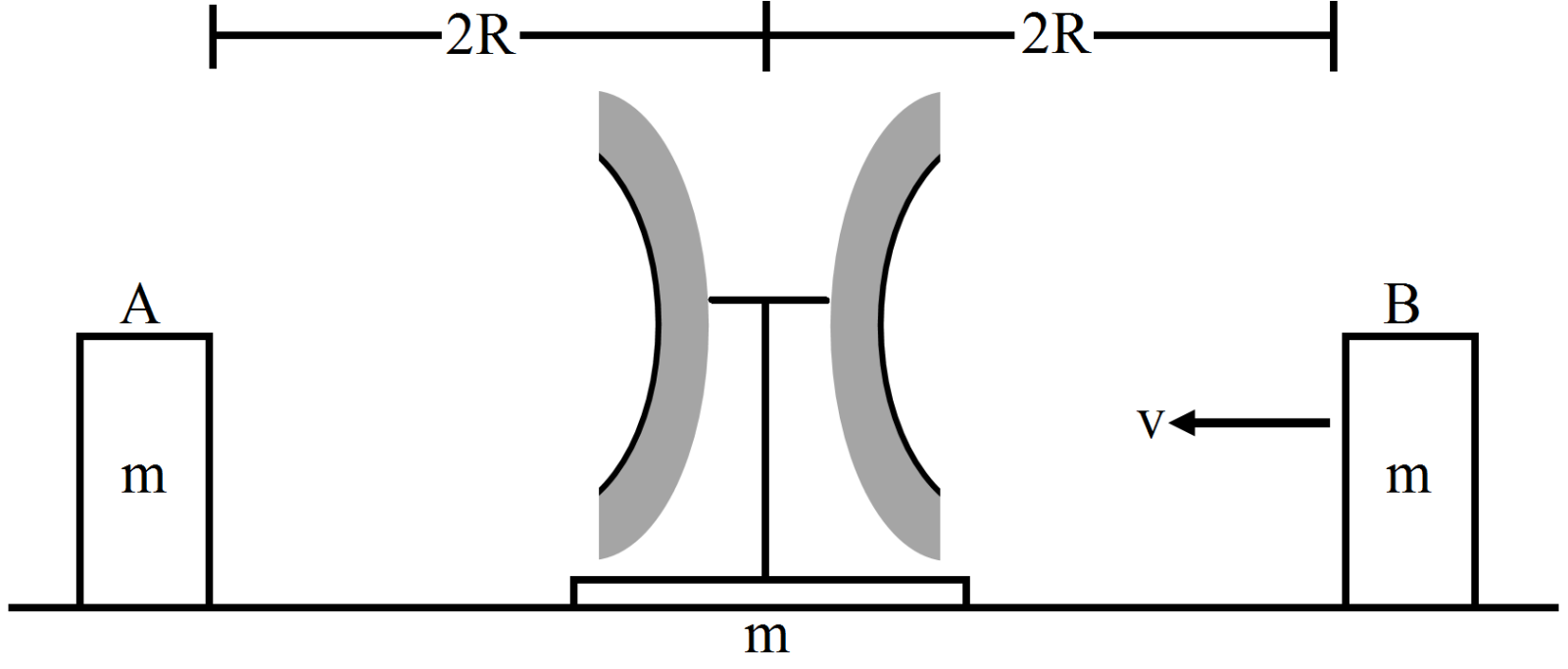
Two concave mirrors of equal radii of curvature R are fixed on a stand facing opposite directions. The whole system has a mass m and is kept on a frictionless horizontal table.

Two blocks A and B, each of mass m, are placed on the two sides of the stand. At t = 0, the separation between A and the mirrors is 2 R and also the separation between B and the mirrors is 2 R. The block B moves towards the mirror at a speed v. All collisions which take place are elastic. Taking the original position of the mirrors-stand system to be x = 0 and X-axis along AB, find the position of the images of A and B at t =
  1. $\frac{\text{R}}{\text{v}}$
  2. $\frac{3\text{R}}{\text{v}}$
  3. $\frac{5\text{R}}{\text{v}}$
Two identical pith balls are charged by rubbing against each other. They are suspended from a horizontal rod through two strings of length 20cm each, the separation between the suspension points being 5cm. In equilibrium, the separation between the balls is 3cm. Find the mass of each ball and the tension in the strings. The charge on each ball has a magnitude $2.0 \times 10^{-8}C.$
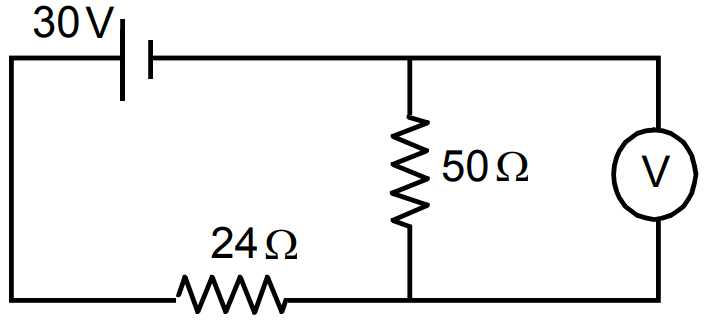
The voltmeter shown in the figure. reads 18V across the $50\Omega$ resistor. Find the resistance of the voltmeter.
An LR circuit having a time constant of 50ms is connected with an ideal battery of emf $\in.$ Find the time elapsed before:
  1. The current reaches half its maximum value.
  2. The power dissipated in heat reaches half its maximum value.
  3. The magnetic field energy stored in the circuit reaches half its maximum value.
Consider a metallic pipe with an inner radius of 1cm. If a cylindrical bar magnet of radius 0.8cm is dropped through the pipe, it takes more time to come down than it takes for a similar unmagnetised cylindrical iron bar dropped through the metallic pipe. Explain.
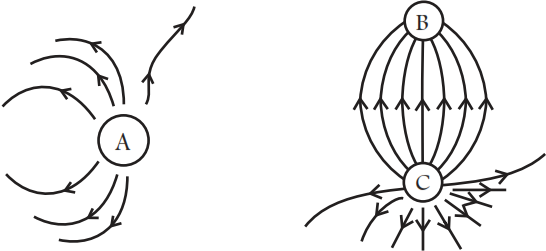
Fig. shows the electric field lines around three point charges A, B and C.
  1. Which charges are positive?
  2. Which charge has the largest magnitude? Why?
  3. In which region or regions of the picture could the electric field be zero? Justify your answer.
  1. Near A,
  2. Near B,
  3. Near C,
  4. Nowhere.
A thin lens made of a material of refractive index $\mu_2$ has a medium of refractive index $\mu_1$ on one side and a medium of refractive index $\mu_3$ on the other side. The lens is biconvex and the two radii of curvature have equal magnitude R. A beam of light travelling parallel to the principal axis is incident on the lens. Where will the image be formed if the beam is incident from:
  1. The medium $\mu_1$
  2. From the medium $\mu_3?$
  1. Draw a labelled ray diagram to obtain the real image formed by an astronomical telescope in normal adjustment position. Define its magnifying power.
  2. You are given three lenses of power 0.5 D, 4 D and 10 D to design a telescope:
  1. Which lenses should he used as objective and eyepiece? Justify your answer.
  2. Why is the aperture of the objective preferred to be large?
A ball is whirled in a circle by attaching it to a fixed point with a string. Is there an angular rotation of the ball about its centre? If yes, is this angular velocity equal to the angular velocity of the ball about the fixed point?