Two concave mirrors of equal radii of curvature R are fixed on a stand facing opposite directions. The whole system has a mass m and is kept on a frictionless horizontal table.
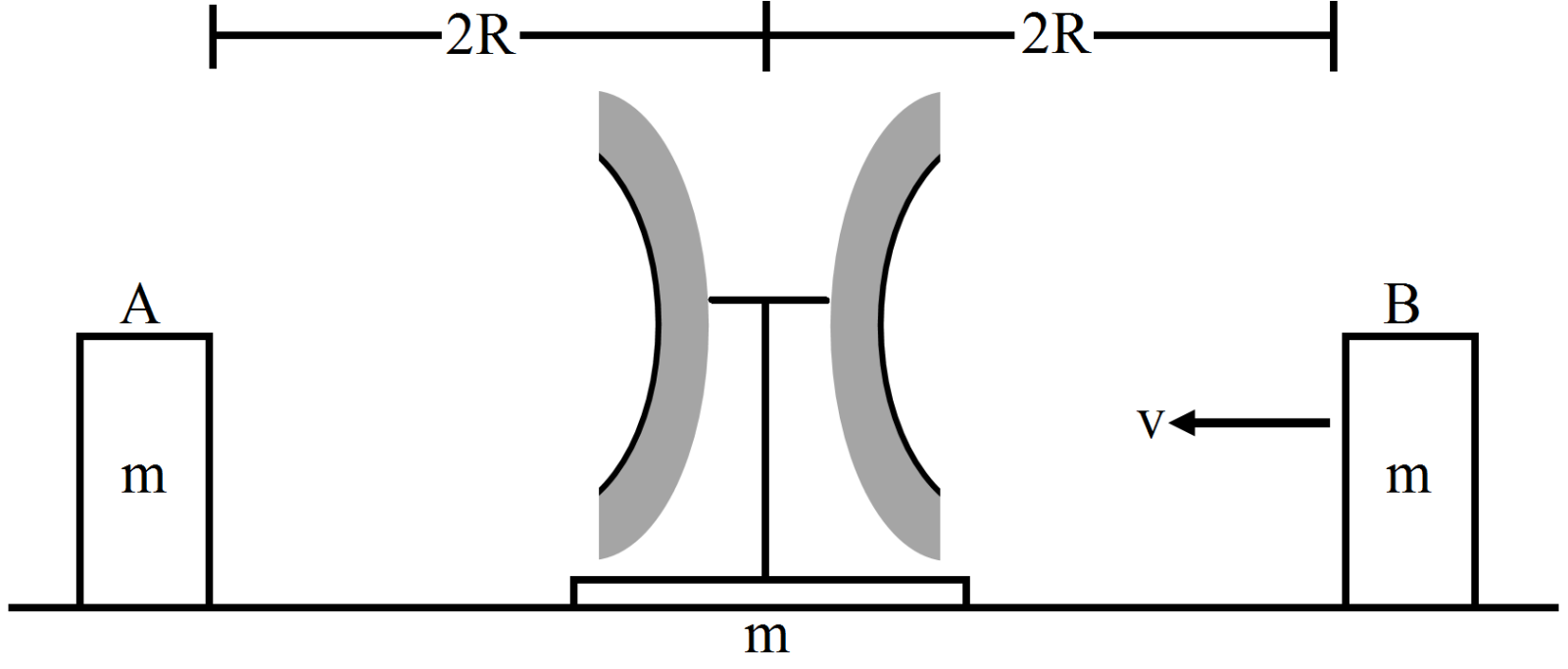
Two blocks A and B, each of mass m, are placed on the two sides of the stand. At t = 0, the separation between A and the mirrors is 2 R and also the separation between B and the mirrors is 2 R. The block B moves towards the mirror at a speed v. All collisions which take place are elastic. Taking the original position of the mirrors-stand system to be x = 0 and X-axis along AB, find the position of the images of A and B at t =
Two blocks A and B, each of mass m, are placed on the two sides of the stand. At t = 0, the separation between A and the mirrors is 2 R and also the separation between B and the mirrors is 2 R. The block B moves towards the mirror at a speed v. All collisions which take place are elastic. Taking the original position of the mirrors-stand system to be x = 0 and X-axis along AB, find the position of the images of A and B at t =
- $\frac{\text{R}}{\text{v}}$
- $\frac{3\text{R}}{\text{v}}$
- $\frac{5\text{R}}{\text{v}}$
Download our app for free and get started
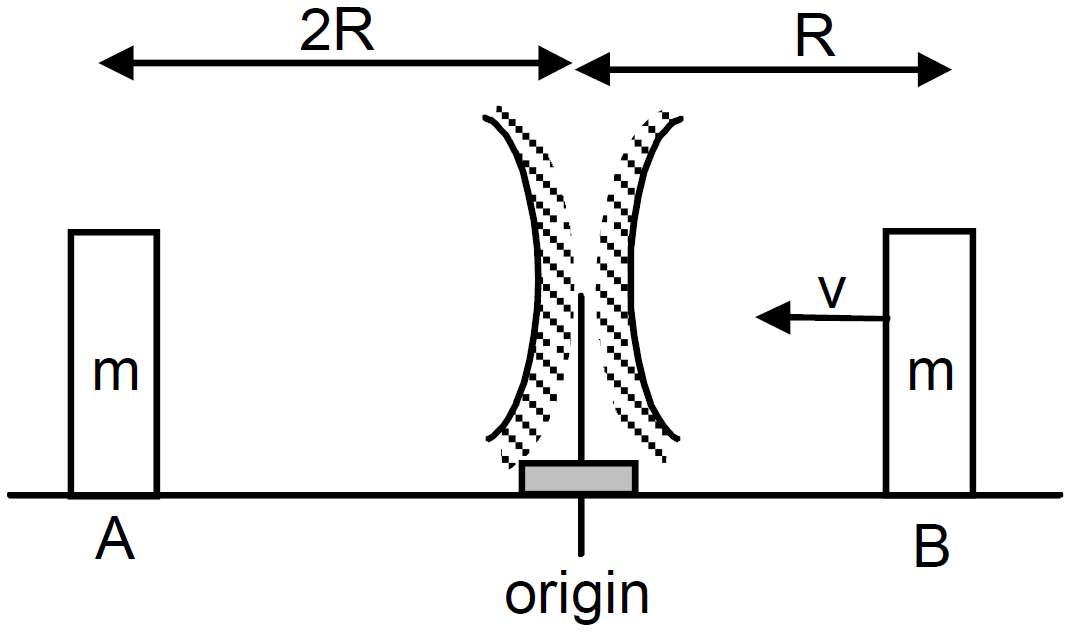
- In time, $\text{t}=\frac{\text{R}}{\text{V}}$ the mass B must have moved $\Big(\text{v}\times\frac{\text{R}}{\text{v}}\Big)=\text{R}$ closer to the mirror stand
For the block B:
$\text{u}=-\text{R}, \ \text{f}=-\frac{\text{R}}{2}$
$\therefore \ \frac{1}{\text{v}}=\frac{1}{\text{f}}-\frac{1}{\text{u}}=-\frac{2}{\text{R}}+\frac{1}{\text{R}}=-\frac{1}{\text{R}}$
$\Rightarrow\text{v}=-\text{R}$ at the same place
For the block A:
$\text{u}=-2\text{R}, \ \text{f}=-\frac{\text{R}}{2}$
$\therefore \ \frac{1}{\text{v}}=\frac{1}{\text{f}}-\frac{1}{\text{u}}=-\frac{2}{\text{R}}+\frac{1}{2\text{R}}=\frac{-3}{2\text{R}}$
$\Rightarrow\text{v}=\frac{-2\text{R}}{3}$ image of A at $\frac{2\text{R}}{3}$ from PQ in the x-direction.
So, with respect to the given coordinate system,
$\therefore$ Position of A and B are $\frac{-2\text{R}}{3},$ R respectively from origin.
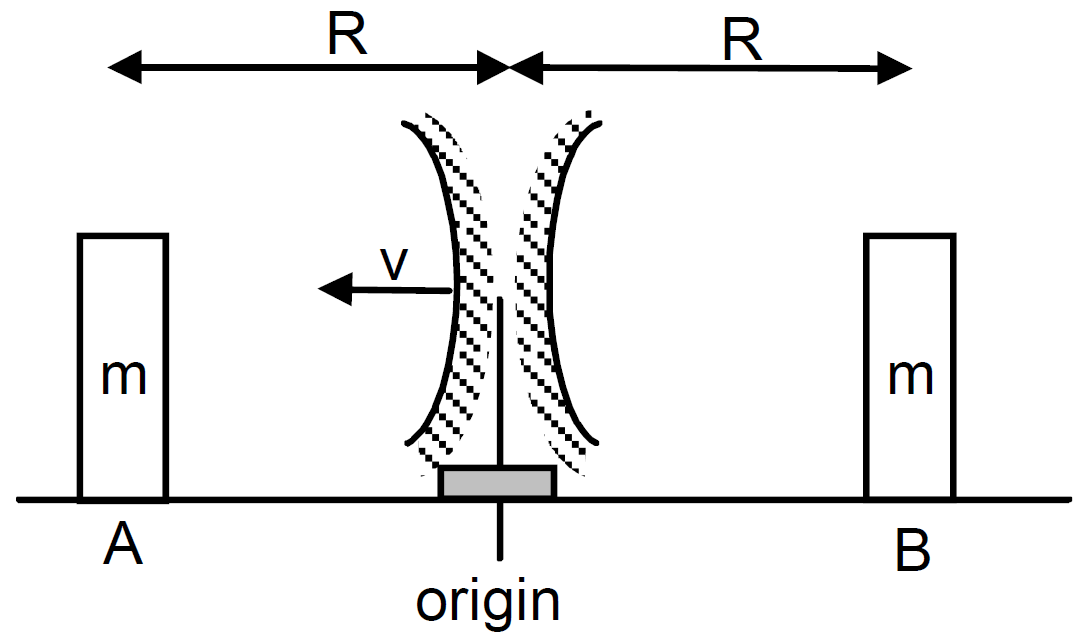
- When $\text{t}=\frac{3\text{R}}{\text{v}},$ the block B after colliding with mirror stand must have come to rest (elastic collision) and the mirror have travelled a distance R towards left form its initial position.
For block A:
$\text{u}=-\text{R}, \ \text{f}=-\frac{\text{R}}{2}$
Using lens formula, v = -R (from the mirror),
So, position xA = -2R (from origin of coordinate system)
For block B:
Image is at the same place as it is R distance from mirror.
Hence, position of image is ‘0’.
Distance from PQ (coordinate system)
$\therefore$ positions of images of A and B are = -2R, 0 from origin.
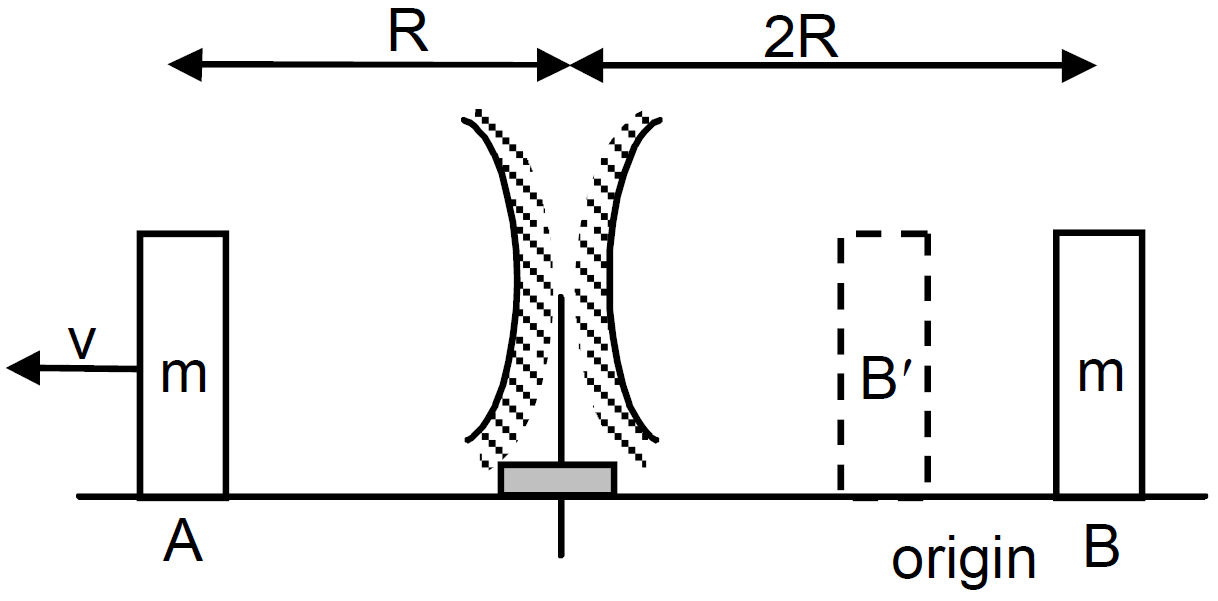
- Similarly, it can be proved that at time $\text{t}=\frac{5\text{R}}{\text{v}},$

Download our appand get started for free
Experience the future of education. Simply download our apps or reach out to us for more information. Let's shape the future of learning together!No signup needed.*
Similar Questions
- 1View SolutionA man with normal near point (25 cm) reads a book with small print using a magnifying glass: a thin convex lens of focal length 5 cm.
- What is the closest and the farthest distance at which he should keep the lens from the page so that he can read the book when viewing through the magnifying glass?
- What is the maximum and the minimum angular magnification (magnifying power) possible using the above simple microscope?
- 2View SolutionDefine magnifying power of a telescope. Write its expression.
A small telescope has an objective lens of focal length 150 cm and an eye piece of focal length 5 cm. If this telescope is used to view a 100m high tower 3 km away, find the height of the final image when it is formed 25 cm away from the eye piece. - 3View SolutionA particle is moving at a constant speed V from a large distance towards a concave mirror of radius R along its principal axis. Find the speed of the image formed by the mirror as a function of the distance x of the particle from the mirror.
- 4A point object 'O' is kept in a medium of refractive index $n_1$ in front of a convex spherical surface of radius of curvature R which separates the second medium of refractive index $n_2$ from the first one, as shown in the figure. Draw the ray diagram showing the image formation and deduce the relationship between the object distance and the image distance in terms of $n_1, n_2$ and R.View Solution
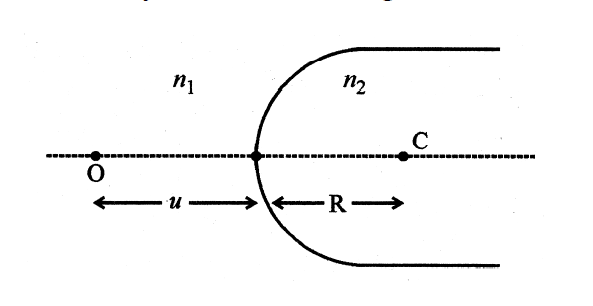
- hen the image formed above acts as a virtual object for concave spherical, surface separating the medium $n_2$ from $n_1 (n_2> n_1),$ draw this ray diagram and write the similar (similar to (a) relation. Hence obtain the expression for the lens maker's formula.
- 5View Solution
- Draw a labelled ray diagram to show the formation of image in an astronomical telescope for a distant object.
- Write three distinct advantages of a reflecting type telescope over a refracting type telescope.
- A convex lens of focal length 10 cm is placed coaxially 5 cm away from a concave lens of focal length 10 cm. If an object is placed 30 cm in front of the convex lens, find the position of the final image formed by the combined system.
- 6Derive the lens formula $\frac{1}{\text{f}}=\frac{1}{\text{v}}-\frac{1}{\text{u}}$ for a thin concave lens, using the necessary ray diagram.View Solution
- 7View SolutionA 4.5 cm needle is placed 12 cm away from a convex mirror of focal length 15 cm. Give the location of the image and the magnification. Describe what happens as the needle is moved farther from the mirror.
- 8View SolutionMrs. Rashmi Singh broke her reading glasses. When she went to the shopkeeper to order new spects, he suggested that she should get spectacles with plastic lenses instead of glass lenses. On getting the new spectacles, she found that the new ones were thicker than the earlier ones. She asked this question to the shopkeeper but he could not offer satisfactory explanation for this. At home, Mrs. Singh raised the same question to her daughter Anuja who explained why plastic lenses were thicker.
- Write two qualities displayed each by Anuja and her mother.
- How do you explain this fact using lens maker's formula?
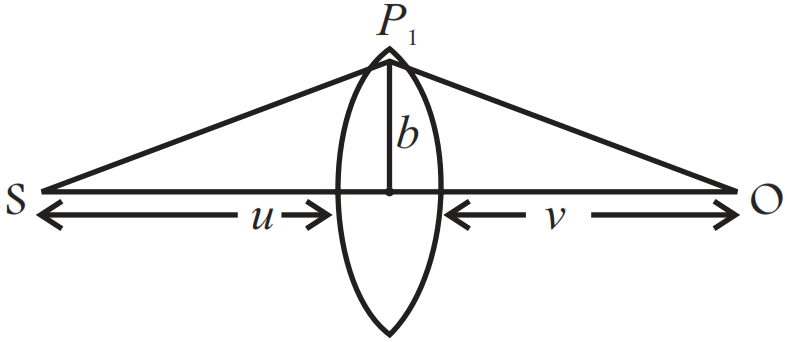
- 9Consider a thin lens placed between a source (S) and an observer (O) (Fig). Let the thickness of the lens vary as $\text{w}\text{(b)}=\text{w}_0-\frac{\text{b}^2}{\alpha}$, where b is the verticle distance from the pole. $w_0$ is a constant. Using Fermat’s principle i.e. the time of transit for a ray between the source and observer is an extremum, find the condition that all paraxial rays starting from the source will converge at a point O on the axis. Find the focal length.View Solution
- 10View Solution
- Draw a ray diagram to show the image formation by a combination of two thin convex lenses in contact. Obtain the expression for the power of this combination in terms of the focal lengths of the lenses.
- A ray of light passing from air through an equilateral glass prism undergoes minimum deviation when the angle of incidence is $\frac{3}{4}^{th}$ of the angle of prism. Calculate the speed of light in the prism.