MCQ
An electromagnet:
  • A
    Has its own persistent magnetic field.
  • Acts as a magnet when an electric current passes through it.
  • C
    Both $A$ and $B.$
  • D
    None of the above.

Answer

Correct option: B.
Acts as a magnet when an electric current passes through it.

Electromagnets are a different from permanent magnets. Electromagnets are made of coils of wire with electricity passing through them.
When the coils of wire in an electromagnet have an electric current passing through them then magnetic field produced around the coils so the coils behave like a magnet.

Need a full question paper?

Generate a complete, print-ready paper with questions like this in minutes — across 16+ boards, with answer keys.
Start Generating Free

Similar questions

Electric bulb 50 W-100 V glowing at full power are to be used in parallel with battery 120 V, 10 W. Maximum number of bulbs that can be connected so that they glow in full power is
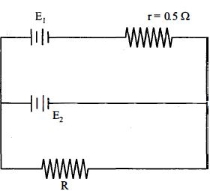
A $dc$ source of $emf \,E_1 = 100\,V$ and internal resistance $r = 0.5\,\Omega ,$ a storage battery of emf $E_2 = 90\,V$ and an external resistance $R$ are connected as shown in figure. For what value of $R$ no current will pass through the battery ? ................ $\Omega$
What fraction of a radioactive material will get disintegrated in a period of two half-lives
The simplest type of $AC$ voltage or current is the one which.
Carbon, silicon and Germanium atoms have four valence electrons each. Their valence and conduction band are separated by energy band gaps represented by $(Eg)_C. (Eg)_{Si}$ and $(Eg)_Ge$ respectively. Which one of the following relationship is true in their case
With reference to the observations in photo-electric effect, identify the correct statements from below:

$A.$ The square of maximum velocity of photoelectrons varies linearly with frequency of incident light.

$B.$ The value of saturation current increases on moving the source of light away from the metal surface.

$C.$ The maximum kinetic energy of photo-electrons decreases on decreasing the power of LED (light emitting diode) source of light.

$D.$ The immediate emission of photo-electrons out of metal surface can not be explained by particle nature of light/electromagnetic waves.

$E.$ Existence of threshold wavelength can not be explained by wave nature of light/electromagnetic waves.

Choose the correct answer from the options given below:

Assertion : Different colours travel with different speed in vacuum.

Reason : Wavelength of light depends on refractive index of medium.

A simple telescope, consisting of an objective of focal length $60\, cm$ and a single eye lens of focal length $5\, cm$ is focussed on a distant object is such a way that parallel rays comes out from the eye lens. If the object subtends an angle $2^o$ at the objective, the angular width of the image........$^o$
Two spherical nuclei have mass numbers $216$ and $64$ with their radii $R_1$ and $R _2$ respectively. The ratio, $\frac{R_1}{R_2}$ is equal to
In an hydrogen atom, the electron revolves around the nucleus in an orbit of radius $0.53\times 10^{-10}m$. Then the electrical potential produced by the nucleus at the position of the electron is