MCQ
An electromagnetic waves can be produced, when charge is:
  • A
    Moving with constant velocity
  • B
    Moving in a circular orbit
  • C
    Falling in an electric field
  • both $(b)$ and $(c)$

Answer

Correct option: D.
both $(b)$ and $(c)$

An accelerated charge is the source of electromagnetic waves $\text{(EMWs).}$ When the charge is in a circular motion, the direction of its velocity continuously changes and thus it is in accelerated motion and produces $\text{EMWs.}$
A charge falling in an electric field is accelerated by the electric force and thus produces $\text{EMWs.}$

Need a full question paper?

Generate a complete, print-ready paper with questions like this in minutes — across 16+ boards, with answer keys.
Start Generating Free

Similar questions

${H^ + },\,H{e^ + }$ and ${O^{ + + }}$ ions having same kinetic energy pass through a region of space filled with uniform magnetic field $B$ directed perpendicular to the velocity of ions. The masses of the ions ${H^ + },\,H{e^ + }$and ${O^{ + + }}$ are respectively in the ratio $1:4:16$. As a result
Two point charges $+ Q$ and $+ q$ are separated by a certain distance. If $+ Q > + q$ then in between the charges the electric field is zero at a point.
A charge $( - q)$ and another charge $( + Q)$ are kept at two points $A$ and $B$ respectively. Keeping the charge $( + Q)$ fixed at $B$, the charge $( - q)$ at $A$ is moved to another point $C$ such that $ABC$ forms an equilateral triangle of side $l$. The net work done in moving the charge $( - q)$ is
A freshly prepared radioactive sample of half- life $1$ hour emits radiations that are $128$ times as intense as the permissible safe limit. The minimum time after which this sample can be safely used is .........$hours$
In gamma ray emission from a nucleus
In Young's interference experiment, the central bright fringe can be identified due to the fact that it:
There is an electric field E in X-direction. If the work done on moving a charge 0.2 C through a distance of 2 m along a line making an angle 60° with the X-axis is 4.0, what is the value of E
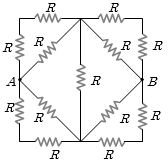
Thirteen resistances each of resistance $R\, ohm$ are connected in the circuit as shown in the figure below. The effective resistance between $A$ and $B$ is
If in hydrogen atom, radius of ${n^{th}}$ Bohr orbit is ${r_n},$ frequency of revolution of electron in ${n^{th}}$ orbit is ${f_n}$ choose the correct option
What is the voltage gain in a common emitter amplifier, where input resistance is $3\, \Omega$ and load resistance $24\, \Omega, \beta=0.6 \,?$