An electron (charge = $1.6 \times {10^{ - 19}}$ $coulomb$) is accelerated through a potential of $1,00,000$ $volts$. The energy required by the electron is
Easy
Download our app for free and get started
(d) Energy $ = 1.6 \times {10^{ - 19}} \times 100000 = 1.6 \times {10^{ - 14}}J$

Download our appand get started for free
Experience the future of education. Simply download our apps or reach out to us for more information. Let's shape the future of learning together!No signup needed.*
Similar Questions
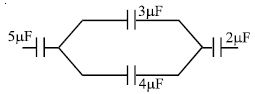
- 1If charge on left plane of the $5\ \mu F$ capacitor in the circuit segment shown in the figure is $-20\ \mu C$, the charge on the right plate of $3\ \mu F$ capacitor is.......$ \mu C$View Solution
- 2An air filled parallel plate capacitor has capacity $C$. If distance between plates is doubled and it is immersed in a liquid then capacity becomes twice. Dielectric constant of the liquid isView Solution
- 3View SolutionThe capacity of a parallel plate capacitor increases with the
- 4A spherical charged conductor has surface charge density $\sigma $ . The electric field on its surface is $E$ and electric potential of conductor is $V$ . Now the radius of the sphere is halved keeping the charge to be constant. The new values of electric field and potential would beView Solution
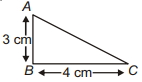
- 5$A B C$ is a right angled triangle situated in a uniform electric field $\vec{E}$ which is in the plane of the triangle. The points $A$ and $B$ are at the same potential of $15 \,V$ while the point $C$ is at a potential of $20 \,V . A B=3 \,cm$ and $B C=4 \,cm$. The magnitude of electric field is (in $S.I.$ Units)View Solution
- 6Between the plates of a parallel plate condenser there is $1\,mm$ thick paper of dielectric constant $4$. It is charged at $100\;volt$. The electric field in $volt/metre$ between the plates of the capacitor isView Solution
- 7View SolutionThe separation between the plates of a isolated charged parallel plate capacitor is increased. Which of the following quantities will change?
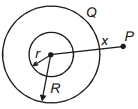
- 8Two concentric hollow conducting spheres of radius $r$ and $R$ are shown. The charge on outer shell is $Q$. What charge should be given to inner sphere so that the potential at any point $P$ outside the outer sphere is zero?View Solution
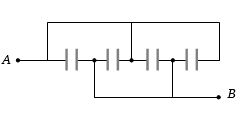
- 9Four condensers are joined as shown in the adjoining figure. The capacity of each is $8\,\mu F$. The equivalent capacity between the points $A$ and $B$ will be......$\mu F$View Solution
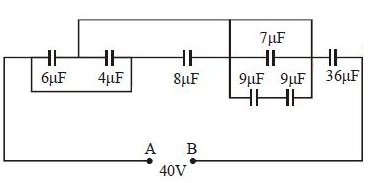
- 10In the following diagram, the charge and potential difference across $8\, \mu F$ capacitance will be nearlyView Solution