Between the plates of a parallel plate condenser there is $1\,mm$ thick paper of dielectric constant $4$. It is charged at $100\;volt$. The electric field in $volt/metre$ between the plates of the capacitor is
Easy
Download our app for free and get started
(b) $E = \frac{V}{d} = \frac{{100}}{{{{10}^{ - 3}}}} = 10,0000\,V/m$

Download our appand get started for free
Experience the future of education. Simply download our apps or reach out to us for more information. Let's shape the future of learning together!No signup needed.*
Similar Questions
- 1The equivalent capacitance of three capacitors of capacitance ${C_1},{C_2}$ and ${C_3}$ are connected in parallel is $12$ units and product ${C_1}.{C_2}.{C_3} = 48$. When the capacitors ${C_1}$ and ${C_2}$ are connected in parallel, the equivalent capacitance is $6$ units. Then the capacitance areView Solution
- 2In a hollow spherical shell potential $(V)$ changes with respect to distance $(r)$ from centreView Solution
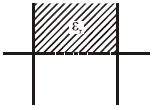
- 3What will be the capacity of a parallel-plate capacitor when the half of parallel space between the plates is filled by a material of dielectric constant ${\varepsilon _r}$ ? Assume that the capacity of the capacitor in air is $C$View Solution
- 4View SolutionWhich of the following statements is true about the flow of electrons in an electric circuit?
- 5The capacities of two conductors are ${C_1}$ and ${C_2}$ and their respective potentials are ${V_1}$ and${V_2}$. If they are connected by a thin wire, then the loss of energy will be given byView Solution
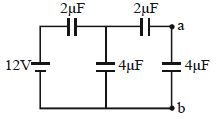
- 6Find the potential difference $V_a -V_b$ between the points $a$ and $b$ shown in each part of the figure.View Solution
- 7A parallel plate capacitor of capacitance $C$ has spacing $d$ between two plates having area $A$. The region between the plates is filled with $N$ dielectric layers, parallel to its plates, each with thickness $\delta=\frac{ d }{ N }$. The dielectric constant of the $m ^{\text {th }}$ layer is $K _{ m }= K \left(1+\frac{ m }{ N }\right)$. For a very large $N \left(>10^3\right)$, the capacitance $C$ is $\alpha\left(\frac{ K \varepsilon_0 A }{ d \;ln 2}\right)$. The value of $\alpha$ will be. . . . . . . .View Solution
[ $\epsilon_0$ is the permittivity of free space]
- 8An electric charge $10^{-3}$ $\mu C$ is placed at the origin $(0, 0) $ of $X - Y$ co-ordinate system. Two points $A$ and $B$ are situated at $\left( {\sqrt 2 ,\sqrt 2 } \right)$ and $(2,0)$ respectively. The potential difference between the points $A$ and $B$ will be.......$V$View Solution
- 9$27$ similar drops of mercury are maintained at $10 \,V$ each. All these spherical drops combine into a single big drop. The potential energy of the bigger drop is ....... times that of a smaller drop.View Solution
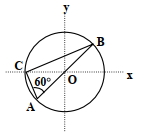
- 10Consider a system of three charges $\frac{\mathrm{q}}{3}, \frac{\mathrm{q}}{3}$ and $-\frac{2 \mathrm{q}}{3}$ placed at points $\mathrm{A}, \mathrm{B}$ and $\mathrm{C}$, respectively, as shown in the figure,View Solution
Take $\mathrm{O}$ to be the centre of the circle of radius $\mathrm{R}$ and angle $\mathrm{CAB}=60^{\circ}$
Figure:$Image$