Question
An electron emitted by a heated cathode and accelerated through a potential difference of 2.0 kV, enters a region with uniform magnetic field of 0.15 T. Determine the trajectory of the electron if the field,
  1. is transverse to its initial velocity,
  2. makes an angle of 30º with the initial velocity.
Answer

Magnetic field strength, B = 0.15 TCharge on the electron, $e = 1.6 \times 10^{-19} C$
Mass of the electron, $m = 9.1 \times 10^{-31} kg$
Potential difference, $V = 2.0 kV = 2 \times 10^3 V$
Thus, kinetic energy of the electron = eV
$\Rightarrow\text{eV}=\frac{1}{2}\text{mv}^{2}$
$\text{v}=\sqrt\frac{2\text{ev}}{\text{m}}.........(1)$
Where,
v = velocity of the electron
  1. Magnetic force on the electron provides the required centripetal force of the electron. Hence, the electron traces a circular path of radius r.
Magnetic force on the electron is given by the relation,
$\text{B ev}$
$\text{Centripetal force}=\frac{\text{mv}^{2}}{\text{r}}$
$\therefore\text{Bev}=\frac{\text{mv}^{2}}{\text{r}}$
$\text{r}=\frac{\text{mv}}{\text{Be}}.........(2)$
From equations (1) and (2), we get
$\text{r}=\frac{\text{m}}{\text{Be}}\Big[\frac{2\text{ev}}{\text{m}}\Big]^{\frac{1}{2}}$
$=\frac{9.1\times10^{-31}}{0.15\times1.6\times10^{-19}}\times\Big(\frac{2\times1.6\times10^{-19}\times2\times10^{3}}{9.1\times10^{-31}}\Big)^{\frac{1}{2}}$
$=100.55\times10^{-5}$
$=1.01\times10^{-3}\text{m}$
$=1\text{mm}$
Hence, the electron has a circular trajectory of radius 1.0 mm normal to the magnetic field.
  1. When the field makes an angle θ of 30° with initial velocity, the initial velocity will be,
$\text{v}_{1}=\text{v}\sin\theta$
From equation (2), we can write the expression for new radius as: $\text{r}_{1}=\frac{\text{mv}_{1}}{\text{Be}}$
$=\frac{\text{mv}\sin\theta}{\text{Be}}$
$=\frac{9.1\times10^{-31}}{0.15\times1.6\times10^{-19}}\times\Big(\frac{2\times1.6\times10^{-19}\times2\times10^{3}}{9\times10^{-31}}\Big)^{\frac{1}{2}}\times\sin30^{\circ}$
$=0.5\times10^{-31}\text{m}$
$=0.5\text{mm}$
Hence, the electron has a helical trajectory of radius 0.5 mm along the magnetic field direction.

Need a full question paper?

Generate a complete, print-ready paper with questions like this in minutes — across 16+ boards, with answer keys.

Start Generating Free

Similar questions

For the past some time, Aarti had been observing some erratic body movement, unsteadiness and lack of coordination in the activities of her sister Radha, who also used to complain of severe headache occasionally. Aarti suggested to her parents to get a medical check-up of Radha. The doctor thoroughly examined Radha and diagnosed that she has a brain tumour.
  1. What, according to you, are the values displayed by Aarti?
  2. How can radioisotopes help a doctor to diagnose brain tumour?
A sample contains a mixture of $^{108}Ag$ and $^{110}Ag$ isotopes each having an activity of $8.0 \times 10^8$ disintegration per second. $^{110}Ag$ is known to have larger half-life than $^{108}Ag$. The activity A is measured as a function of time and the following data are obtained.
Time (s) Activity (A) $(10^8$ disinte- grations $s^{-1})$ Time (s) Activity (A) $(10^8$ disinte-grations $s^{-1})$
20 11.799 200 3.0828
40 9.1680 300 1.8899
60 7.4492 400 1.1671
80 6.2684 500 0.7212
100 5.4115    
  1. Plot ln $\Big(\frac{\text{A}}{\text{A}_0}\Big)$ versus time.
  2. See that for large values of time, the plot is nearly linear. Deduce the half-life of $^{110}Ag$ from this portion of the plot.
  3. Use the half-life of $^{110}Ag$ to calculate the activity corresponding to $^{108}Ag$ in the first 50s.
  4. Plot In $\Big(\frac{\text{A}}{\text{A}_0}\Big)$ versus time for $^{108}Ag$ for the first 50s.
  5. Find the half-life of $^{108}Ag.$
In tug of war, the team that exerts a larger tangential force on the ground wins. Consider the period in which a team is dragging the opposite team by applying a larger tangential force on the ground. List which of the following works are positive, which are negative and which are zero?
  1. Work by the winning team on the losing team.
  2. Work by the losing team on the winning team.
  3. Work by the ground on the winning team.
  4. Work by the ground on the losing team.
  5. Total external work on the two teams.
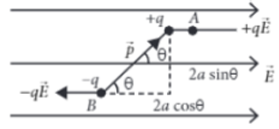
When electric dipole is placed in uniform electric field, its two charges experience equal and opposite forces, which cancel each other and hence net force on electric dipole in uniform electric field is zero. However these forces are not collinear, so they give rise to some torque on the dipole. Since net force on electric dipole in uniform electric field is zero. so no work is done in moving the electric dipole in uniform electric field. However some work is done in rotating the dipole against the torque acting on it.
Image
$(i)$ The dipole moment of a dipole in a uniform external field $\vec{E}$ is $\vec{P}$. Then the torque $\vec{\tau}$ acting on the dipole is
$(a) \ \vec{\tau}=2(\vec{P}+\vec{E})$
$(b) \ \vec{\tau}=\vec{P} \cdot \vec{E}$
$(c) \ \vec{\tau}=(\vec{P}+\vec{E})$
$(d) \ \vec{\tau}=\vec{P} \times \vec{E}$
$(ii)$ An electric dipole consists of two opposite charges, each of magnitude $1.0 \mu C$ separated by a distance of $2.0 \ cm$ . The dipole is placed in an external field of $10^5 NC ^{-1}$. The maximum torque on the dipole is
$(a) \ 4 \times 10^{-3} Nm$
$(b) \ 2 \times 10^{-3} Nm$
$(c) \ 1 \times 10^{-3} Nm$
$(d) \ 0.2 \times 10^{-3} Nm$
$(iii)$ Torque on a dipole in uniform electric field is minimum when $\theta$ is equal to
$(a) \ 0^{\circ} \ (b) \ 90^{\circ}\  (c) \ 180^{\circ} \ (d)$ Both $0^{\circ}$ and $180^{\circ}$
$(iv)$ When an electric dipole is held at an angle in a uniform electric field, the net force $F$ and torque on the dipole are
$(a) \ F =0, \tau=0$
$(b) \ F \neq 0, \tau \neq 0$
$(c) \ F \neq 0, \tau=0$
$(d) \ F =0, \tau \neq 0$
OR
An electric dipole of moment $p$ is placed in an electric field of intensity $E$. The dipole acquires a position such that the axis of the dipole makes an angle $\theta$ with the direction of the field. Assuming that the potential energy of the dipole to be zero when $\theta=90^{\circ}$, the torque and the potential energy of the dipole will respectively be
$(a) \ pE \sin \theta,- pE \cos \theta$
$(b) \ pE \cos \theta,- pE \sin \theta$
$(c) \ pE \sin \theta, 2 pE \cos \theta$
$(d) \ pE \sin \theta,-2 pE \cos \theta$
The potential barrier in the p-n junction diode is the barrier in which the charge recquires additional force for crossing the region. ln other words, the barrier in which the charge carrier stopped by the obstructive force is known as the potential barrier.
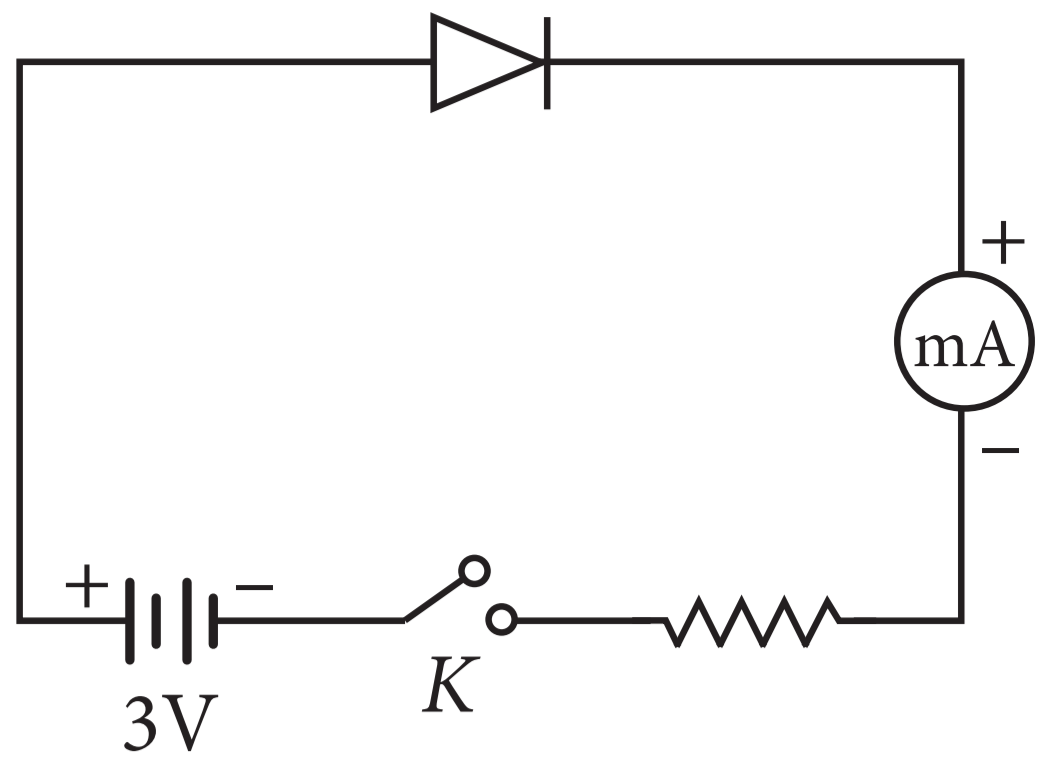
When a p-type semiconductor is brought into a close contact with n-ype semiconductor, we get a p-n junction with a barrier potential 0.4V, and width of depletion region is $4.0 \times 10^{-7}m$. This p-n junction is forward biased with a battery of voltage 3V and negligible internal resistance, in series with a resistor of resistance R, ideal millimeter, and key K as shown in figure. When key is pressed, a current of 20mA passes through the diode.
  1. The intersity of the electric field in the depletion region when p-n junction is unbiased is:
  1. $0.5 \times 10^6Vm^{-1}$
  2. $1.0 \times 10^6Vm^{-1}$
  3. $2.0 \times 10^6Vm^{-1}$
  4. $1.5 \times 10^6Vm^{-1}$
  1. The resistance of resistor R is:
  1. $150\Omega$
  2. $300\Omega$
  3. $130\Omega$
  4. $180\Omega$
  1. In a p-n junction, the potential barrier is due to the charges on either side of the junction, these charges are:
  1. Majority carriers.
  2. Minority carriers.
  3. Both (a) and (b).
  4. Fixed donor and acceptor ions.
  1. If the voltage of the potential barrier is $V_0$. A voltage Vis applied to the input, at what moment will the barrier disappear?
  1. $V < V_0$
  2. $V = V_0$
  3. $V > V_0$
  4. $V << V_0$
  1. If an electron with speed $4.0 \times 10^5ms^{-1}$ approaches the p-n junction from then-side, the speed with which it will enter the p-side is:
  1. $1.39 \times 10^5ms^{-1}$
  2. $2.78 \times 10^5ms^{-1}$
  3. $1.39 \times 10^6ms^{-1}$
  4. $2.78 \times 10^6ms^{-1}$
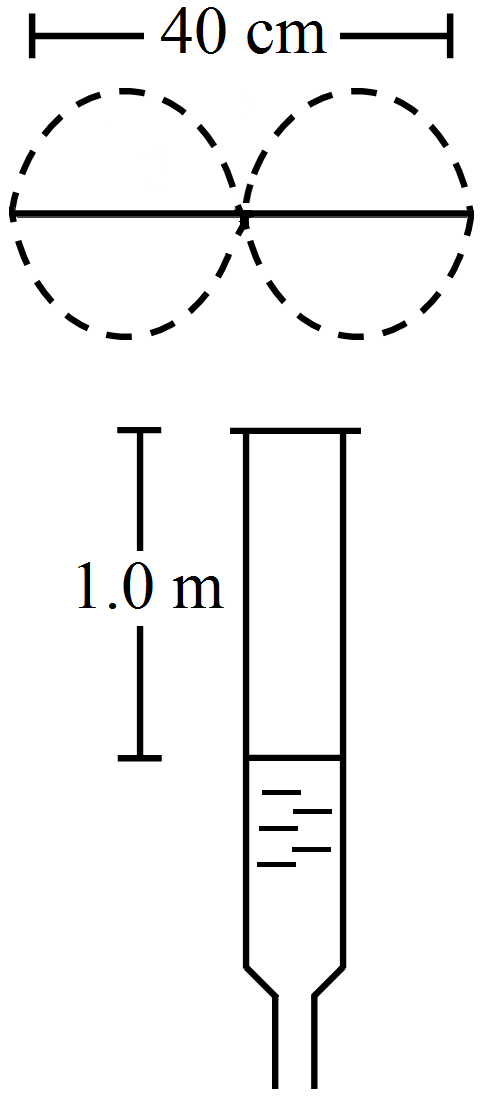
Consider the situation shown in figure. The wire which has a mass of 4.00g oscillates in its second harmonic and sets the air column in the tube into vibrations in its fundamental mode. Assuming that the speed of sound in air is 340m/s, find the tension in the wire.
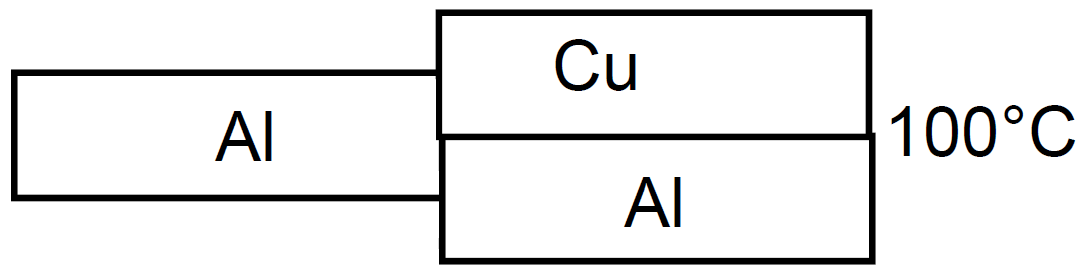
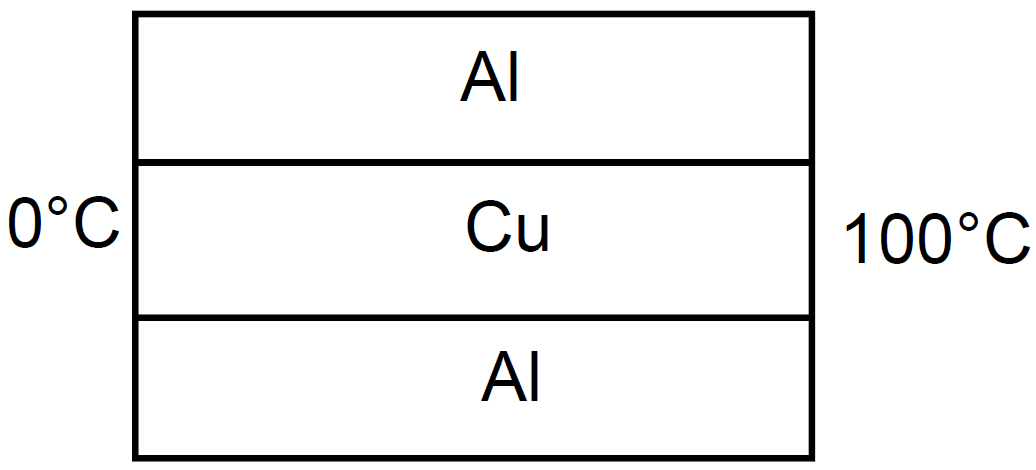
The three rods shown in figure, have identical geometrical dimensions. Heat flows from the hot end at a rate of 40 Win the arrangement (a) Find the rates of heat flow when the rods are joined as in arrangement (b) and in (c) Thermal conductivities of aluminium and copper are ${200Wm^{-1}}^\circ C^{-1}$ and ${400Wm^{-1}}^\circ C^{-1}$ respectively.
  1.  
  1.  
  1.  
Show that the magnetic field at a point due to a magnetic dipole is perpendicular to the magnetic axis if the line joining the point with the centre of the dipole makes an angle of $\tan^{-1}(\sqrt{2})$ with the magnetic axis.
A stationary charge produces only an electrostatic field while a charge in uniform motion produces a magnetic field, that does not change with time. An oscillating charge is an example of accelerating charge. It produces an oscillating magnetic field, which in turn produces an oscillating electric fields and so on. The oscillating electric and magnetic fields regenerate each other as a wave which propagates through space.
Image
$(i).$ Magnetic field in a plane electromagnetic wave is given by $\vec{B}= B _0 \sin ( kx +\omega t ) \hat{j} T$Expression for corresponding electric field will be (Where c is speed of light.)
$(a) \vec{E}= B _0 c \sin ( kx +\omega t ) \hat{k} V / m$
$(b) \vec{E}=- B _0 c \sin ( kx -\omega t ) \hat{k} V / m$
$(c) \vec{E}=- B _0 c \sin ( kx +\omega t ) \hat{k} V / m$
$(d) \vec{E}=\frac{B_0}{c} \sin ( kx +\omega t ) \hat{k} V / m$
$(ii)$ The electric field component of a monochromatic radiation is given by $\vec{E}=2 E _0 \hat{i} \cos kz \cos \omega t$. Its magnetic field $\vec{B}$ is then given by
$(a) -\frac{2 E_0}{c} \hat{j} \sin kz \sin \omega t$
$(b) \frac{2 E_0}{c} \hat{j} \sin kz \sin \omega t$
$(c) \frac{2 E_0}{c} \hat{j} \sin kz \cos \omega t$
$(d) \frac{2 E_0}{c} \hat{j} \cos kz \cos \omega t$
$(iii)$ A plane em wave of frequency $25 \ MHz$ travels in a free space along $x -$direction. At a particular point in space and time, $E =(6.3 \hat{j}) V / m$. What is magnetic field at that time?
$(a) \ 0.089 \mu T$
$(b) \ 0.124 \mu T$
$(c) \ 0.021 \mu T$
$(d) \ 0.095 \mu T$
OR
A plane electromagnetic wave travels in free space along $x-$axis. At a particular point in space, the electric field along $y$-axis is $9.3 V m ^{-1}$. The magnetic induction $(B)$ along $z -$axis is
$(a) \ 3.1 \times 10^{-8} T$
$(b) \ 3 \times 10^{-5} T$
$(c) \ 3 \times 10^{-6} T$
$(d) \ 9.3 \times 10^{-6} T$
$(iv)$ A plane electromagnetic wave travelling along the $x-$direction has a wavelength of $3 \ mm$ . The variation in the electric field occurs in the $y-$direction with an amptitude $66 V m ^{-1}$. The equations for the electric and magnetic fields as a function of $x$ and $t$ are respectively
$ \text { a) } E_y =11 \cos 2 \pi \times 10^{11}\left(t-\frac{x}{c}\right), \text { b) } E_y =66 \cos 2 \pi \times 10^{11}\left(t-\frac{x}{c}\right),$
$B_y =11 \times 10^{-7} \cos 2 \pi \times 10^{11}\left(t-\frac{x}{c}\right) B_z =2.2 \times 10^{-7} \cos 2 \pi \times 10^{11}\left(t-\frac{x}{c}\right)$
$\text { c) } E_x =33 \cos \pi \times 10^{11}\left(t-\frac{x}{c}\right), \text { d) } E_y =33 \cos \pi \times 10^{11}\left(t-\frac{x}{c}\right),$
$B_x =11 \times 10^{-7} \cos \pi \times 10^{11}\left(t-\frac{x}{c}\right) B_z =1.1 \times 10^{-7} \cos \pi \times 10^{11}\left(t-\frac{x}{c}\right)$
Some washing machines have cloth driers. It contains a drum in which wet clothes are kept. As the drum rotates, the water particles get separated from the cloth. The general description of this action is that "the centrifugal force throws the water particles away from the drum". Comment on this statement from the viewpoint of an observer rotating with the drum and the observer who is washing the clothes.