Question
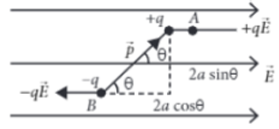
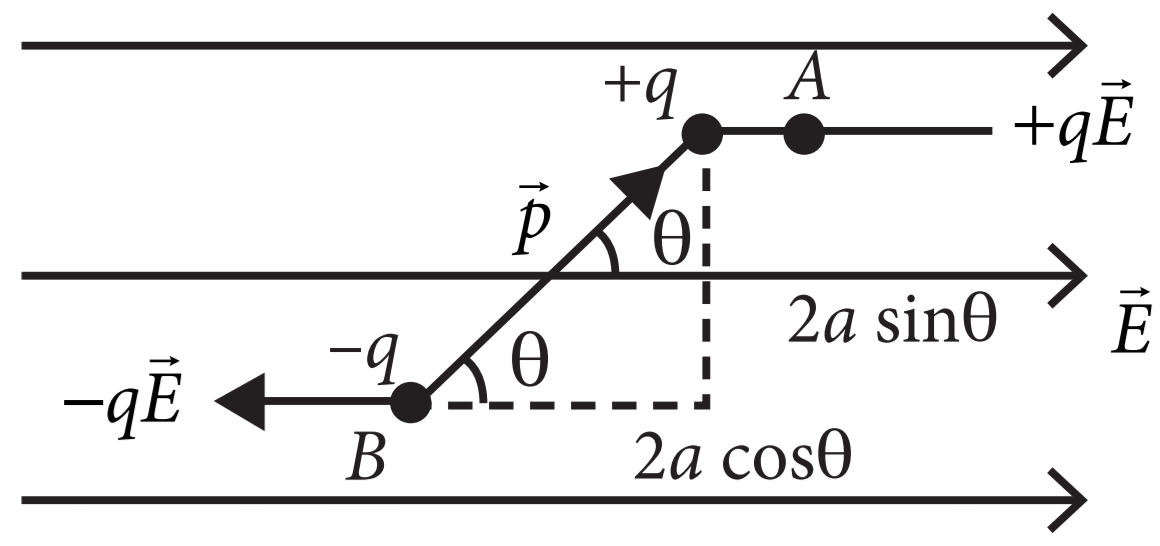
When electric dipole is placed in uniform electric field, its two charges experience equal and opposite forces, which cancel each other and hence net force on electric dipole in uniform electric field is zero. However these forces are not collinear, so they give rise to some torque on the dipole. Since net force on electric dipole in uniform electric field is zero. so no work is done in moving the electric dipole in uniform electric field. However some work is done in rotating the dipole against the torque acting on it.
Image
$(i)$ The dipole moment of a dipole in a uniform external field $\vec{E}$ is $\vec{P}$. Then the torque $\vec{\tau}$ acting on the dipole is
$(a) \ \vec{\tau}=2(\vec{P}+\vec{E})$
$(b) \ \vec{\tau}=\vec{P} \cdot \vec{E}$
$(c) \ \vec{\tau}=(\vec{P}+\vec{E})$
$(d) \ \vec{\tau}=\vec{P} \times \vec{E}$
$(ii)$ An electric dipole consists of two opposite charges, each of magnitude $1.0 \mu C$ separated by a distance of $2.0 \ cm$ . The dipole is placed in an external field of $10^5 NC ^{-1}$. The maximum torque on the dipole is
$(a) \ 4 \times 10^{-3} Nm$
$(b) \ 2 \times 10^{-3} Nm$
$(c) \ 1 \times 10^{-3} Nm$
$(d) \ 0.2 \times 10^{-3} Nm$
$(iii)$ Torque on a dipole in uniform electric field is minimum when $\theta$ is equal to
$(a) \ 0^{\circ} \ (b) \ 90^{\circ}\  (c) \ 180^{\circ} \ (d)$ Both $0^{\circ}$ and $180^{\circ}$
$(iv)$ When an electric dipole is held at an angle in a uniform electric field, the net force $F$ and torque on the dipole are
$(a) \ F =0, \tau=0$
$(b) \ F \neq 0, \tau \neq 0$
$(c) \ F \neq 0, \tau=0$
$(d) \ F =0, \tau \neq 0$
OR
An electric dipole of moment $p$ is placed in an electric field of intensity $E$. The dipole acquires a position such that the axis of the dipole makes an angle $\theta$ with the direction of the field. Assuming that the potential energy of the dipole to be zero when $\theta=90^{\circ}$, the torque and the potential energy of the dipole will respectively be
$(a) \ pE \sin \theta,- pE \cos \theta$
$(b) \ pE \cos \theta,- pE \sin \theta$
$(c) \ pE \sin \theta, 2 pE \cos \theta$
$(d) \ pE \sin \theta,-2 pE \cos \theta$
Answer

When electric dipole is placed in uniform electric field, its two charges experience equal and opposite forces, which cancel each other and hence net force on electric dipole in uniform electric field is zero. However these forces are not collinear, so they give rise to some torque on the dipole. Since net force on electric dipole in uniform electric field is zero. so no work is done in moving the electric dipole in uniform electric field. However some work is done in rotating the dipole against the torque acting on it.
Image
$(i) \ (d) \vec{\tau}=\vec{P} \times \vec{E}$
Explanation: As $\tau=$ either force $\times$ perpendicular distance between the two forces
$= qaE \sin \theta \text { or } \tau= PE \sin \theta$
$\text { or } \vec{P} \times \vec{E}(\because qa = P )$
$(ii) \ (b) 2 \times 10^{-3} Nm$
Explanation: The maximum torque on the dipole in an external field is given by
$\tau= pE = q (2 a ) \times E$
$\text { Here, } q =1 \mu C =10^{-6} C , 2 a =2 \ cm=2 \times 10^{-2} m, E =10^5 NC ^{-1}, \tau=?$
$\therefore \tau=10^{-6} \times 2 \times 10^{-2} \times 10^5=2 \times 10^{-3} Nm $
$(iii) (d)$ Both $0^{\circ}$ and $180^{\circ}$
Explanation: When $\theta$ is $0$ or $180^{\circ}$, the $\tau$ is minimum, which means the dipole moment should be parallel to the direction of the uniform electric field.
$(iv) \ (d) F =0, \tau \neq 0$
Explanation: Net force is zero and torque acts on the dipole, trying to align $p$ with $E .$
OR
$(a) pE \sin \theta,- pE \cos \theta$
Explanation: Torque, $\tau= pE \sin \theta$ and potential energy
$U=-p E \cos \theta$

Need a full question paper?

Generate a complete, print-ready paper with questions like this in minutes — across 16+ boards, with answer keys.

Start Generating Free

Similar questions

An electromagnetic wave transports linear momentum as it travels through space. If an electromagnetic wave transfers a total energy $U$ to a surface in time $t ,$ then total linear momentum delivered to the surface is $p =\frac{U}{c}$. When an electromagnetic wave falls on a surface, it exerts pressure on the surface. In $1903,$ the American scientists Nichols and Hull succeeded in measuring radiation pressures of visible light where other had failed, by making a detailed empirical analysis of the ubiquitous gas heating and ballistic effects.
$(i)$ The pressure exerted by an electromagnetic wave of intensity $I \left( W m ^{-2}\right)$ on a non $-$ reflecting surface is $( c$ is the velocity of light$)$
$(a)\ \frac{I}{c}$
$(b) \ \frac{I}{c^2}$
$(c) \ Ic ^2$
$(d) \ IC$
$(ii)$ Light with an energy flux of $18 W / cm ^2$ falls on a non $-$ reflecting surface at normal incidence.
The pressure exerted on the surface is:
$(a)\ 2 N / m ^2$
$(b)\ 6 \times 10^{-4} N / m ^2$
$(c)\ 2 \times 10^{-4} N / m ^2$
$(d)\ 6 N / m ^2$
$(iii)$ Radiation of intensity $0.5 W m ^{-2}$ are striking a metal plate. The pressure on the plate is
$(a)\ 0.212 \times 10^{-8} N m ^{-2}$
$(b)\ 0.132 \times 10^{-8} N m ^{-2}$
$(c)\ 0.166 \times 10^{-8} N m ^{-2}$
$(d)\ 0.083 \times 10^{-8} N m ^{-2}$
OR
The radiation pressure of the visible light is of the order of
$(a)\ 10^{-4} N / m$
$(b)\ 10^{-6} N / m ^2$
$(c)\ 10^{-8} N$
$(d)\ 10^{-2} N m ^2$
$(iv)$ A point source of electromagnetic radiation has an average power output of $1500 W$ . The maximum value of electric field at a distance of $3 m$ from this source $($in $V m ^{-1})$ is
$(a)\ 500$
$(b)\ \frac{500}{3}$
$(c)\ \frac{250}{3}$
$(d)\ 100$
Some washing machines have cloth driers. It contains a drum in which wet clothes are kept. As the drum rotates, the water particles get separated from the cloth. The general description of this action is that "the centrifugal force throws the water particles away from the drum". Comment on this statement from the viewpoint of an observer rotating with the drum and the observer who is washing the clothes.
(a) An electron is revolving with a speed of 2 $\times 10^5 m / s$ in the orbit of radius $0.51 A$ in a hydrogen atom. Calculate the magnetic moment of the electron.
(b) Equivalent electric current due to orbital speed of electron.
(c) Magnetic field generated at the centre of the nucleus.
Explain the forward bias characteristics of $p-n$ junction diode with necessary graph.
The moon rotates about the earth in such a way that only one hemisphere of the moon faces the earth. Can we ever see the ''other face'' of the moon from the earth? Can a person on the moon ever see all the faces of the earth?
The magnetometer of the previous problem is used with the same magnet in $\tan-\text{B}$ position. Where should the magnet be placed to produce a 37° deflection of the needle?
A heavy nucleus breaks into comparatively lighter nuclei, which are more stable compared to the original heavy nucleus. When a heavy nucleus like uranium is bombarded by slow moving neutrons, it splits into two parts, releasing large amount of energy. The typical fission reaction of $_{92}\text{U}^{235}$.
$_{92}\text{U}^{235}+\ _0\text{n}^1\rightarrow\ _{56}\text{Ba}^{141}+\ _{36}\text{kr}^{92}+\ 3_0\text{n}^1+\ 200\text{ MeV}$
The fission of $_{92}\text{U}^{235}$ approximately released 200 MeV of energy.
  1. If 200 MeV energy is released in the fission of a single nucleus of $_{92}^{235}\text{U}$, the fissions which are required to produce a power of 1kW is.
  1. $3.125 \times 10^{13}$
  2. $1.52 \times 10^6$
  3. $3.125 \times 10^{12}$
  4. $3.125 \times 10^{14}$
  1. The release in energy in nuclear fission is consistent with the fact that uranium has
  1. More mass per nucleon than either of the two fragments.
  2. More mass per nucleon as the two fragment.
  3. Exactly the same mass per nucleon as the two fragments.
  4. Less mass per nucleon than either of two fragments.
  1. When $_{92}\text{U}^{235}$ undergoes fission, about 0.1% of the original mass is converted into energy. The energy released when 1kg of $_{92}\text{U}^{235}$ undergoes fission is.
  1. $9 \times 10^{11}J$
  2. $9 \times 10^{13}J$
  3. $9 \times 10^{15}J$
  4. $9 \times 10^{18}J$
  1. A nuclear fission is said to be critical when multiplication factor or K.
  1. $K = 1$
  2. $K > 1$
  3. $K < 1$
  4. $K = 0$
  1. Einstein's mass-energy conversion relation $E = mc^2$ is illustrated by.
  1. Nuclear fission
  2. $\beta-\text{decay}$
  3. Rocket propulsion
  4. Steam engine
When electric dipole is placed in uniform electric field, its two charges experience equal and opposite forces, which cancel each other and hence net force on electric dipole in uniform electric field is zero. However, these forces are not collinear, so they give rise to some torque on the dipole. Since net force on electric dipole in uniform electric field is zero, so no work is done in moving the electric dipole in uniform electric field. However, some work is done in rotating the dipole against the torque acting on it.
  1. The dipole moment of a dipole in a uniform external field $\vec{\text{E}}$ is $\vec{\text{P}}.$ Then the torque 'i acting on the dipole is:
  1. $\vec{\tau}=\vec{\text{P}}\times\vec{\text{E}}$
  2. $\vec{\tau}=\vec{\text{P}}\cdot\vec{\text{E}}$
  3. $\vec{\tau}=2(\vec{\text{P}}+\vec{\text{E}})$
  4. $\vec{\tau}=(\vec{\text{P}}+\vec{\text{E}})$
  1. An electric dipole consists of two opposite charges, each of magnitude $1.0\mu\text{C}$ separated by a distance of 2.0cm. The dipole is placed in an external field of $10^5N C^{-1}$. The maximum torque on the dipole is:
  1. $0.2 \times 10^{-3}Nm$
  2. $1 \times 10^{-3}Nm$
  3. $2 \times 10^{-3}Nm$
  4. $4 \times 10^{-3}Nm$
  1. Torque on a dipole in uniform electric field is minimum when $\theta$ is equal to:
  1. 90º
  2. 180º
  3. Both (a) and (c)
  1. When an electric dipole is held at an angle in a uniform electric field, the net force F and torque t on the dipole are:
  1. $\text{F}=0, \tau=0$
  2. $\text{F}\not=0, \tau\not=0$
  3. $\text{F}=0, \tau\not=0$
  4. $\text{F}\not=0, \tau=0$
  1. An electric dipole of moment pis placed in an electric field of intensity E. The dipole acquires a position such that the axis of the dipole makes an angle $\theta$ with the direction of the field. Assuming that the potential energy of the dipole to be zero when $\theta=90^\circ$ the torque and the potential energy of the dipole will respectively be:
  1. $\text{pE}\sin\theta,-\text{pE}\cos\theta$
  2. $\text{pE}\sin\theta,-2\text{pE}\cos\theta$
  3. $\text{pE}\sin\theta,2\text{pE}\cos\theta$
  4. $\text{pE}\cos\theta,-2\text{pE}\sin\theta$
A child has near point at 10cm. What is the maximum angular magnification the child can have with a convex lens of focal length 10cm?
Out of the two magnetic materials, 'A' has relative permeability slightly greater than unity while 'B' has less than unity. Identify the nature of the materials 'A' and 'B'. Will their susceptibilities be positive or negative?