Question
An electron gun emits $2.0 \times 10^{16}$ electrons per second. What electric current does this correspond to?

Answer

No. of electrons per second $= 2 \times 10^{16}$ electrons$/ \sec.$
Charge passing per second $=2\times10^{16}\times1.6\times10^{-9}\frac{\text{coulomb}}{\text{sec}}$
$=3.2\times10^{-9}$ Coulomb$/ \sec$
Current $=3.2\times10^{-3}\text{A}.$

Need a full question paper?

Generate a complete, print-ready paper with questions like this in minutes — across 16+ boards, with answer keys.
Start Generating Free

Similar questions

Explain network, junction point (branch point) and loop.
What is diffraction? Which are the factors on which diffraction depends ? Give some examples of day to day life where the diffraction phenomenon is observed.
A bullet passes past a person at a speed of 220m/s. Find the fractional change in the frequency of the whistling sound heard by the person as the bullet crosses the person. Speed of sound in air = 330m/s.
Why are infrared waves often called heat waves ? Explain.
The output of an OR gate is connected to both the inputs of a NAND gate. Draw the logic circuit of this combination of getes and write its truth table.
Can two states of an ideal gas be connected by an isothermal process as well as an adiabatic process?
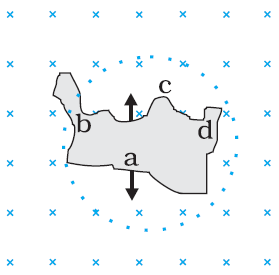
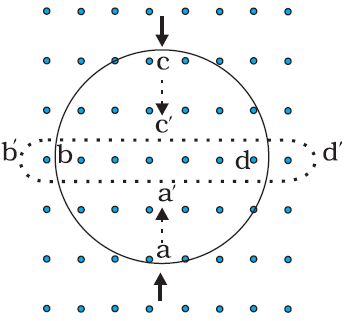
Use Lenz’s law to determine the direction of induced current in the situations described by Fig.
  1. $A$ wire of irregular shape turning into a circular shape;
  1. $A$ circular loop being deformed into a narrow straight wire.
At noon, the sun and the earth pull the objects on the earth's surface in opposite directions. At midnight the sun and the earth pull these objects in same direction. Is the weight of an object, as measured by a spring balance on the earth's surface, more at midnight as compared to its weight at noon?
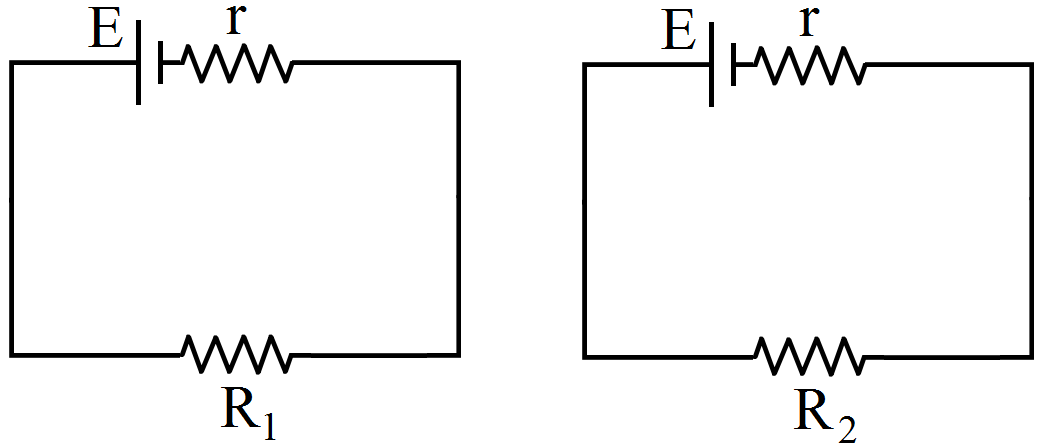
Two unequal resistances $R_1$ and $R_2$ are connected across two identical batteries of emf $\varepsilon$ and internal resistance $r$. Can the thermal energies developed in $R_1$ and $R_{2}$ be equal in a given time. If yes, what will be the condition?
Distinguish between the terms ‘effective value’ and peak value of alternating current.