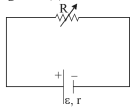
Question
Explain network, junction point (branch point) and loop.

Answer

Simple circuits can be easily understood by using ohm's law only.
"If the components of circuit like resistors, capacitors, inductors and electric cells are connected to each other in a very complex way, then such a circuit cannot be studied just by using ohm's law. Such a complex circuit is called a network."
Junction point (branch point) : The point in a network, where more than two conductors meet is called a junction point (or branch point)
Loop : A closed circuit formed by conductors is called loop.
Need a full question paper?

Generate a complete, print-ready paper with questions like this in minutes — across 16+ boards, with answer keys.

Start Generating Free

Similar questions

Plot a graph showing variation of de Broglie wavelength $(\lambda)$ associated with a charged particle of mass m, versus $\frac{1}{\sqrt{\text{V}}},$ where V is the potential difference through which the particle is accelerated. How does this graph give us the information regarding the magnitude of the charge of the particle?
A single lens is mounted in a tube. A parallel beam enters the tube and emerges out of the tube as a divergent beam. Can you say with certainty that there is a diverging lens in the tube?
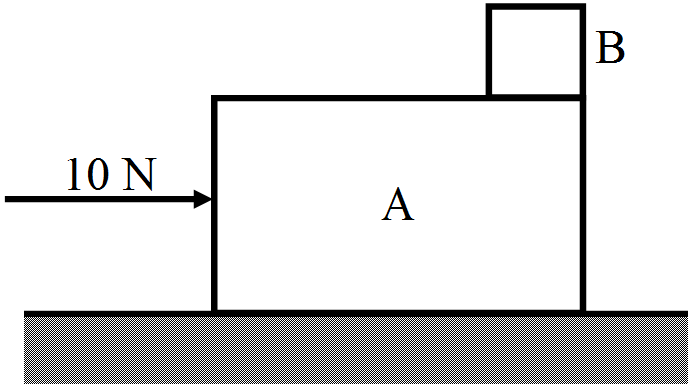
$A$ small block $B$ is placed on another block $A$ of mass $5\ kg$ and length $20\ cm.$ Initially the block $B$ is near the right end of block $A. A$ constant horizontal force of $10N$ is applied to the block $A$. All the surfaces are assumed frictionless. Find the time elapsed before the block $B$ separates from $A.$
A closed organ pipe can vibrate at a minimum frequency of 500Hz. Find the length of the tube. Speed of sound in air = 340m/s.
A variable resistor R, electromotive force and internal resistance $r$ are joined as shown in the given figure across the ends of the cell. Draw graph to show (i) terminal voltage and (ii) current $I$ as a function of $R$.
Image
Explain in short about electric dipole.
A boy is sitting on a chair placed on the floor of a room. Write as many action-reaction pairs of forces as you can.
What is Electromagnetic induction ? Give names of experiments of Faraday and Henry explaining this phenomenon.
At what speed the volume of an object shrinks to half its rest value?
Answer the following questions: Magnifying power of a simple microscope is inversely proportional to the focal length of the lens. What then stops us from using a convex lens of smaller and smaller focal length and achieving greater and greater magnifying power?