MCQ
An electron having charge ‘$e$’ and mass ‘$m$’ is moving in a uniform electric field $E$. Its acceleration will be
  • A
    $\frac{{{e^2}}}{m}$
  • B
    $\frac{{{E^2}e}}{m}$
  • $\frac{{eE}}{m}$
  • D
    $\frac{{mE}}{e}$

Answer

Correct option: C.
$\frac{{eE}}{m}$
c
$a = \frac{F}{m} = \frac{{eE}}{m}$

Need a full question paper?

Generate a complete, print-ready paper with questions like this in minutes — across 16+ boards, with answer keys.

Start Generating Free

Similar questions

The radius of hydrogen atom in its ground state is $5.3 \times {10^{ - 11}}m$. After collision with an electron it is found to have a radius of $21.2 \times {10^{ - 11}}m$. What is the principal quantum number $n$ of the final state of the atom $n=.........$
A parallel plate capacitor of capacitance $12.5 \mathrm{pF}$ is charged by a battery connected between its plates to potential difference of $12.0 \mathrm{~V}$. The battery is now disconnected and a dielectric slab $\left(\in_{\mathrm{r}}=6\right)$ is inserted between the plates. The change in its potential energy after inserting the dielectric slab is_______.$\times 10^{-12} \mathrm{~J}$.
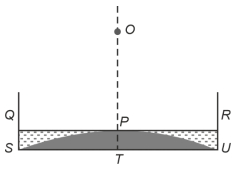
A glass beaker has a solid, plano-convex base of refractive index $1.60$ , as shown in the figure. The radius of curvature of the convex surface ($SPU$) is $9 cm$, while the planar surface ($STU$) acts as a mirror. This beaker is filled with a liquid of refractive index $n$ up to the level $QPR$. If the image of a point object $O$ at a height of $h$ (OT in the figure) is formed onto itself, then, which of the following option($s$) is (are) correct?

$(A)$ For $n=1.42, h=50 \ cm$   $(B)$ For $n=1.35, h=36 \ cm$   $(C)$ For $n=1.45, h=65 \ cm$   $(D)$ For $n=1.48, h=85 \ cm$
The field due to a long straight wire carrying a current I is proportional to
The photodiode is used to detect the optiocal signals. These diodes are preferably operated in reverse biased mode because.
Two charges each equal to $\eta q({\eta ^{ - 1}} < \sqrt 3 )$ are placed at the corners of an equilateral triangle of side $a$. The electric field at the third corner is ${E_3}$ where $({E_0} = q/4\pi {\varepsilon _0}{a^2})$
A uniform wire of resistance $R$ is uniformly compressed along its length, until its radius becomes $n$ times the original radius. Now resistance of the wire becomes
An achromatic telescope objective is to be made by combining the lenses of flint and crown glasses. This proper choice is
If $I _0$ is the intensity of the principal maximum in the single slit diffraction pattern, then what will be its intensity when the slit width is doubled
Radiations of monochromatic waves of wavelength $400\  nm$ are incident on the surface of metals $Zn$, $Fe$ and $Ni$ of work functions $3.4\  eV$, $4.8\  eV$ and $5.9\  eV$ respectively. (Take $hc = 1242\  eV\  nm$)

$(a)$ Maximum $KE$ associated with photoelectrons from the surface of any metal is $0.3\  eV$

$(b)$ No photoelectrons are emitted from the surface of $Ni$

$(c)$ If the frequency of the source of radiation is doubled then $KE$ of photoelectrons is also doubled

$(d)$ Photoelectrons will be emitted from the surfaces of all the three metals if the wavelength of the incident radiation is less than $200\  nm$

Correct statements are