Question
An electron is accelerated through a potential difference of 100 volts. What is the de-Broglie wavelength associated with it? To which part of the electromagnetic spectrum does this value of wavelength correspond?

Answer

$\lambda = \frac{\text{h}}{\sqrt{2\text{meV}}}\text{ or } \lambda = \frac{12.27}{\sqrt{\text{V}}}\mathring{\text{A}}$
$\lambda =\frac{12.27}{\sqrt{100}}\mathring{\text{A}} = \frac{12.27}{10}\mathring{\text{A}}=1.227\mathring{\text{A}}$
This wavelength corresponds to the X rays.

Need a full question paper?

Generate a complete, print-ready paper with questions like this in minutes — across 16+ boards, with answer keys.
Start Generating Free

Similar questions

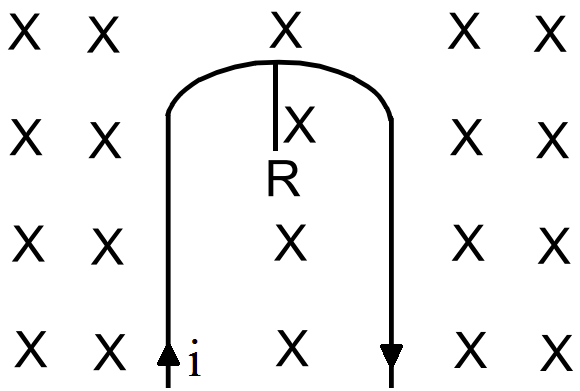
A rigid wire consists of a semi-circular portion of radius R and two straight sections The wire is partially immersed in a perpendicular magnetic field B, as shown in the figure. Find the magnetic force on the wire if it carries a current i.

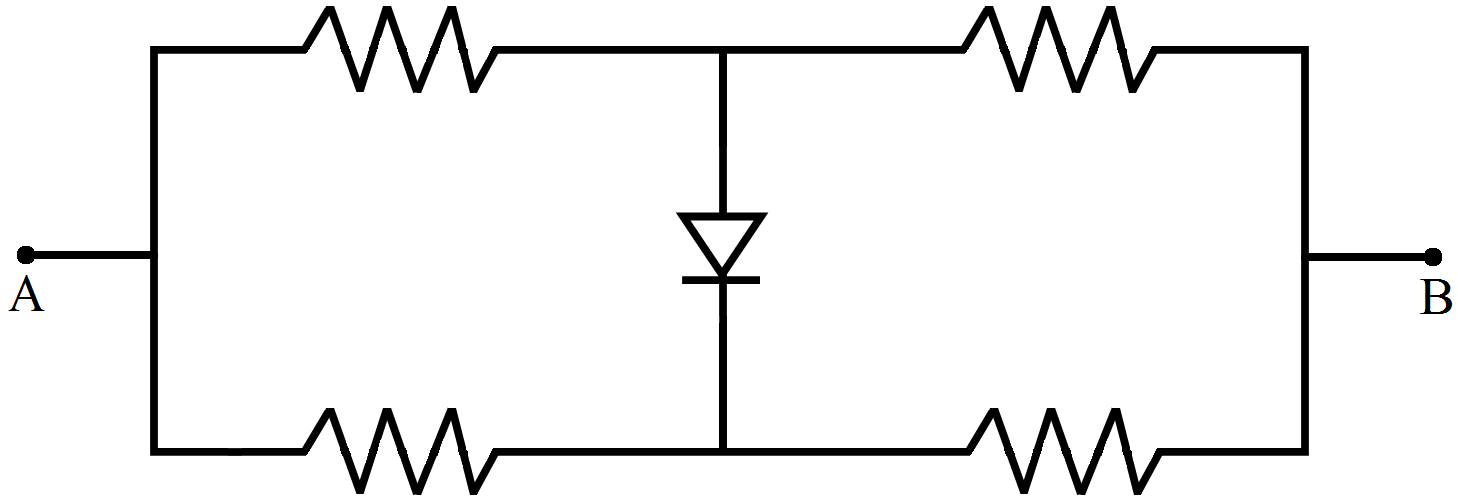
Each of the resistances shown in figure. has a value of $20\Omega.$ Find the equivalent resistance between A and B. Does it depend on whether the point A or B is at higher potential?

Find the maximum Coulomb force that can act on the electron due to the nucleus in a hydrogen atom.
Explain paramagnetism and paramagnetic substances.
Does short-sightedness (myopia) or long-sightedness (hypermetropia) imply necessarily that the eye has partially lost its ability of accommodation? If not, what might cause these defects of vision?
An electric dipole of length 4 cm, when placed with its axis making an angle of 60o with a uniform electric field, experiences a torque of $4\sqrt{3}$Nm. Calculate the potential energy of the dipole, if it has charge $\pm$8 nC.
In the decay 64Cu → 64Ni + e+ + v, the maximum kinetic energy carried by the positron is found to be 0.650MeV.
  1. What is the energy of the neutrino which was emitted together with a positron of kinetic energy 0.150MeV?
  2. What is the momentum of this neutrino in kg-m/s?
Use the formula applicable to a photon.
Two point charges 4Q, Q are separated by 1 m in air. At what point on the line joining the charges is the electric field intensity zero?
Also calculate the electrostatic potential energy of the system of charges, taking the value of charge, Q = 2 × 10⁻⁷ C.
Write down the equation of electric potential for a point - outside the spherical shell - on the surface of a spherical shell and - inside the spherical shell.
It is heard sometime that mercury is used in defining the temperature scale because it expands uniformly with temperature. If the temperature scale is not yet defined, is it logical to say that a substance expands uniformly with temperature?