MAGNETISM AND MATTER — Physics STD 12 Science — Question
Bihar BoardEnglish MediumSTD 12 SciencePhysicsMAGNETISM AND MATTER2 Marks
Question
Explain paramagnetism and paramagnetic substances.
✓
Answer
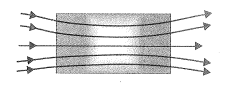
→Paramagnetic substances are those which get weakly magnetised when placed in external magnetic field. →Atoms (or ions or molecules) of paramagnetic materials possess a permanent magnetic dipole moment, but due to continuous (ceaseless) random thermal motion of atoms, net magnetisation is zero. So in normal condition, such substances do not behave as a magnet. → When such substances are placed in sufficiently strong external magnetic field $\left(\overrightarrow{B_0}\right)$ at low temperature, the atomic dipole moments of individual atoms are aligned in the direction of magnetic field ( $\overrightarrow{ B _0}$ ), and they get weakly magnetised. →Therefore, as shown in Fig., magnetic field inside a paramagnetic substance is enhanced, and the field lines get concentrated inside the material. This enhancement is slight, generally one part in $10^5$. →When placed in a non-uniform magnetic field, they tend to move from weak field to strong, i.e. get weakly attracted to a magnet. →This effect (property) is known as paramagnetism and such materials are known as paramagnetic materials. →Some examples of paramagnetic materials are : aluminium, sodium, calcium, oxygen (at STP) and copper chloride. →For a paramagnetic material both $\chi$ and $\mu_r$. depend not only on the material, but also on the sample temperature. As the field is increased or the temperature is lowerd the magnetisation increases until it reaches the saturation value at which point all the dipoles are perfectly aligned with the field.
Need a full question paper?
Generate a complete, print-ready paper with questions like this in minutes — across 16+ boards, with answer keys.