MCQ
An electron is accelerated through a potential difference of $10,000\; \mathrm{V}$. Its de Broglie wavelength is, (nearly):

$\left(\mathrm{m}_{\mathrm{e}}=9 \times 10^{-31}\;\mathrm{kg}\right)$

  • A
    $12.2 \times 10^{-13} \;\mathrm{m}$
  • $12.2 \times 10^{-12} \;\mathrm{m}$
  • C
    $12.2 \times 10^{-14} \;\mathrm{m}$
  • D
    $12.2\; \mathrm{nm}$

Answer

Correct option: B.
$12.2 \times 10^{-12} \;\mathrm{m}$
b
$\lambda=\sqrt{\frac{150}{V}} \mathring A$

$\lambda=\sqrt{\frac{150}{10^{4}}} \mathring A$$=12.27 \times 10^{-12} \;\mathrm{m}$

Need a full question paper?

Generate a complete, print-ready paper with questions like this in minutes — across 16+ boards, with answer keys.

Start Generating Free

Similar questions

The potential difference between the cathode and the target in a Collidge tube is 100 kV. The minimum wavelength of the X-rays emitted by the tube is
Two electric bulbs whose resistances are in the ratio of $1 : 2$ are connected in parallel to a constant voltage source. The powers dissipated in them have the ratio
A bar magnet is moved along the axis of a copper ring placed far away from the magnet, Looking from the side of the magnet an anticlockwise current is found to be induced in the ring. Which of the following may be true?
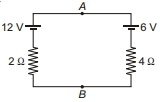
Potential difference across $A B$ i.e., $V_A-V_B$ is ......... $V$
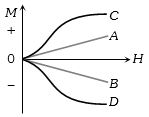
The most appropriate magnetization $M$ versus magnetising field $ H $ curve for a paramagnetic substance is
A bar magnet of magnetic moment $10^4\,J/T$ is free to rotate in a horizontal plane. The work done in rotating the magnet slowly from a direction parallel to a horizontal magnetic field of $4×10^{-5}\, T$ to a direction $ 60° $ from the field will be.....$ J$
Microwaves are electromagnetic waves with frequency in the range of:
An $AC$ source producing emf $\in=\in_{0}\Big[\cos\big(100\pi\text{s}^{-1}\big)\text{t}+\cos\big(500\pi\text{s}^{-1}\big)\text{t}\Big]$ is connected in series with a capacitor and a resistor. The steady-state current in the circuit is found to be $\text{i}=\text{i}_1\cos\Big[\big(100\pi\text{s}^{-1}\big)\text{t}+\phi_1\Big]+\text{i}_2\cos\Big[\big(500\pi\text{s}^{-1}\big)\text{t}+\phi_2\Big].$
$n$ equal cell having emf $E$ and internal resistance $r$, are connected in a circuit of a resistance $R$ . Same current flows in circuit either they are connected in series or parallel, if
If $\mathrm{E}=\mathrm{at}+\mathrm{bt}^2$, what is the temperature of inversion