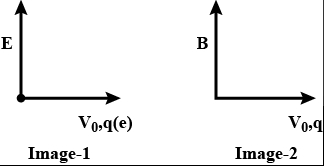
An electron is projected with velocity $v_0$ in a uniform electric field $E$ perpendicular to the field. Again it is projetced with velocity $v_0$ perpendicular to a uniform magnetic field $B/$ If $r_1$ is initial radius of curvature just after entering in the electric field and $r_2$ is initial radius of curvature just after entering in magnetic field then the ratio $r_1:r_2$ is equal to 
Advanced
Download our app for free and get startedPlay store
For electric field,

Refer image $1.$

$q \rightarrow$ change of electron.

Four due to electric field $=q E$

$\therefore \frac{m v_{0} {^2}}{R_{e}}=q E$

where $R_{e}$ is radius of curvature,

$\therefore \frac{1}{R_{e}}=\frac{q E}{m v_{0} {^{2}}}$

$\therefore=\frac{m v_{0} {^{2}}}{q E}=r_{1}$

In magnetic field,

Focus on electron $=q V_{0} B$

Refer image $2 .$

Balancing of centripetal and centrifugal focuses,

$\frac{m V_{0} {^{2}}}{R b}=q V_{0} B$

$\therefore R_{b}=\frac{m V_{0}}{q B}=r_{2}$

$\therefore \frac{r_{1}}{r_{2}}=\frac{R_{c}}{R_{b}}=\frac{\frac{m V_{0^{2}}}{q E}}{\frac{m V_{0}}{q B}}$

$\therefore \frac{r_{1}}{r_{2}}=\frac{B V_{0}}{E}$

art

Download our app
and get started for free

Experience the future of education. Simply download our apps or reach out to us for more information. Let's shape the future of learning together!No signup needed.*

Similar Questions

  • 1
    Find magnetic field at point $P$ in given diagram.
    View Solution
  • 2
    The magnetic field $d\overrightarrow B $ due to a small current element $d\overrightarrow {l\,} $ at a distance $\overrightarrow {r\,} $ and element carrying current $i$ is
    View Solution
  • 3
    A magnetised wire of moment $M$ is bent into an arc of a circle subtending an angle of $60^o$ at the centre; then the new magnetic moment is
    View Solution
  • 4
    A wire $A$, bent in the shape of an arc of a circle, carrying a current of $2\, A$ and having radius $2\, cm$ and another wire $B ,$ also bent in the shape of arc of a circle, carrying a current of $3\, A$ and having radius of $4\, cm ,$ are placed as shown in the figure. The ratio of the magnetic fields due to the wires $A$ and $B$ at the common centre $O$ is
    View Solution
  • 5
    Current flows through uniform, square frames as shown. In which case is the magnetic field at the centre of the frame not zero?
    View Solution
  • 6
    A particle having a mass of $10^{- 2} \,kg$ carries a charge of $5 \times 10^{-8}\, C.$ The particle is given an initial horizontal velocity of $10^5\, m/s $ in the presence of electric field $E$ and magnetic field  $B.$ To keep the particle moving in a horizontal direction, it is necessary that
    $(1)$ $\vec B$ should be perpendicular to the direction of velocity and $\vec E$ should be along the direction of velocity
    $(2)$  Both $\vec B$ and $\vec E$ should be along the direction of velocity
    $(3)$ Both $\vec B$ and $\vec E$ are mutually perpendicular and perpendicular to the direction of velocity.
    $(4)$ $\vec B$ should be along the direction of velocity and $\vec E$ should be perpendicular to the direction of velocity
    Which one of the following pairs of statements is possible?
    View Solution
  • 7
    The pole strength of a bar magnet is $48$  $ampere-metre$ and the distance between its poles is $ 25 \,cm$ . The moment of the couple by which it can be placed at an angle of $30°$ with the uniform magnetic intensity of flux density $0.15 $ $Newton /ampere-metre$ will be.......$Newton × metre$ 
    View Solution
  • 8
    The deflection in moving coil galvanometer falls from $25$ divisions to $5$ division when a shunt of $24\  \Omega$ is applied. The resistance of galvanometer coil will be :
    View Solution
  • 9
    An electron is moving along the positive $X$-axis. You want to apply a magnetic field for a short time so that the electron may reverse its direction and move parallel to the negative $X$-axis. This can be done by applying the magnetic field along
    View Solution
  • 10
    If the strength of the magnetic field produced $10\,cm$ away from a infinitely long straight conductor is ${10^{ - 5}}\,Weber/{m^2}$, the value of the current flowing in the conductor will be........$ampere$
    View Solution