The pole strength of a bar magnet is $48$ $ampere-metre$ and the distance between its poles is $ 25 \,cm$ . The moment of the couple by which it can be placed at an angle of $30°$ with the uniform magnetic intensity of flux density $0.15 $ $Newton /ampere-metre$ will be.......$Newton × metre$
Easy


Download our appand get started for free
Experience the future of education. Simply download our apps or reach out to us for more information. Let's shape the future of learning together!No signup needed.*
Similar Questions
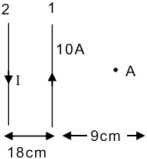
- 1In figure two parallel infinitely long current carrying wires are shown. If resultant magnetic field at point $A$ is zero. Then determine current $I.$ (in $A$)View Solution
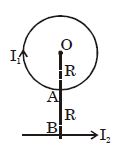
- 2In the diagram, $I_1$ , $I_2$ are the strength of the currents in the loop and infinite long straight conductor respectively. $OA = AB = R$ . The net magnetic field at the centre $O$ is zero. Then the ratio of the currents in the loop and the straight conductor isView Solution
- 3Current $i$ is passed as shown in diagram. If radius of the circle is a, then the magnetic flux density at the centre $P$ will be:View Solution

- 4The dimension of where $\sqrt {\frac{\mu }{ \in }} $ is permeability $\& \varepsilon$ is permittivity is same as :View Solution
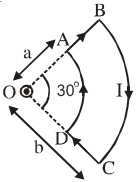
- 5A current loop $ABCD$ is held fixed on the plane of the paper as shown in the figure. The arcs $ BC$ (radius $= b$) and $DA $ (radius $= a$) of the loop are joined by two straight wires $AB $ and $CD$. A steady current $I$ is flowing in the loop. Angle made by $AB$ and $CD$ at the origin $O$ is $30^o $. Another straight thin wire with steady current $I_1$ flowing out of the plane of the paper is kept at the origin.View Solution
Due to the presence of the current $I_1$ at the origin
- 6View SolutionA metallic ring with a small cut is held horizontally and a magnet is allowed to fall vertically through the ring then the acceleration of the metallic ring is :
- 7Consider the motion of a positive point charge in a region where there are simultaneous uniform electric and magnetic fields $\vec{E}=E_0 \hat{j}$ and $\vec{B}=B_0 \hat{j}$. At time $t=0$, this charge has velocity $\nabla$ in the $x$-y plane, making an angle $\theta$ with $x$-axis. Which of the following option$(s)$ is(are) correct for time $t>0$ ?View Solution
$(A)$ If $\theta=0^{\circ}$, the charge moves in a circular path in the $x-z$ plane.
$(B)$ If $\theta=0^{\circ}$, the charge undergoes helical motion with constant pitch along the $y$-axis.
$(C)$ If $\theta=10^{\circ}$, the charge undergoes helical motion with its pitch increasing with time, along the $y$-axis.
$(D)$ If $\theta=90^{\circ}$, the charge undergoes linear but accelerated motion along the $y$-axis.
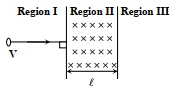
- 8A particle of mass $m$ and charge $\mathrm{q}$, moving with velocity $\mathrm{V}$ enters Region $II$ normal to the boundary as shown in the figure. Region $II$ has a uniform magnetic field B perpendicular to the plane of the paper. The length of the Region $II$ is $\ell$. Choose the correct choice$(s)$.View Solution
Figure: $Image$
$(A)$ The particle enters Region $III$ only if its velocity $V>\frac{q / B}{m}$
$(B)$ The particle enters Region $III$ only if its velocity $\mathrm{V}<\frac{\mathrm{q} / \mathrm{B}}{\mathrm{m}}$
$(C)$ Path length of the particle in Region $II$ is maximum when velocity $V=\frac{q / B}{m}$
$(D)$ Time spent in Region $II$ is same for any velocity $V$ as long as the particle returns to Region $I$
- 9View SolutionIn a current carrying long solenoid, the field produced does not depend upon
- 10A circular coil of $30$ turns and radius $8.0\, cm$ carrying a current of $6.0\, A$ is suspended vertically in a uniform horizontal magnetic field of magnitude $1.0\, T$. The field lines make an angle of $60^o$ with the normal of the coil. Calculate the magnitude of the counter torque that must be applied to prevent the coil from turning.....$Nm$View Solution