An electron is travelling along the $x$-direction. It encounters a magnetic field in the $y$-direction. Its subsequent motion will be
AIIMS 2003, Easy
Download our app for free and get started
(b) $\overrightarrow F = - e(\overrightarrow v \times \overrightarrow B )$ $==>$ $\overrightarrow F = - e[v\hat i \times B\hat j] = evB[ - \hat k]$
i.e. Force on electron is acting towards negative $z$-axis. Hence particle will move on a circle in $xz$-plane.
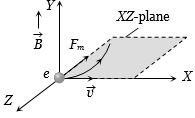
i.e. Force on electron is acting towards negative $z$-axis. Hence particle will move on a circle in $xz$-plane.

Download our appand get started for free
Experience the future of education. Simply download our apps or reach out to us for more information. Let's shape the future of learning together!No signup needed.*
Similar Questions
- 1The oscillator frequency of a cyclotron is $10 \,MHz$. What should be the operating magnetic field for accelerating proton is ......... $T$View Solution
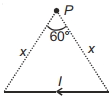
- 2A straight wire of finite length carrying current $l$ subtends an angle of $60^{\circ}$ at point $P$ as shown. The magnetic field at $P$ isView Solution
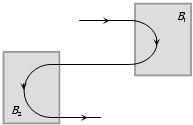
- 3Following figure shows the path of an electron that passes through two regions containing uniform magnetic fields of magnitudes $B_1$ and $B_2$. It's path in each region is a half circle, choose the correct optionView Solution
- 4A current $I$ flows along the length of a thin walled, long metallic hollow cylinder of radius $R$, distributed uniformly on its surface then pressure on the wall will beView Solution
- 5A uniform magnetic field $B$ is acting from south to north and is of magnitude $1.5$ $Wb/{m^2}$. If a proton having mass $ = 1.7 \times {10^{ - 27}}\,kg$ and charge $ = 1.6 \times {10^{ - 19}}\,C$ moves in this field vertically downwards with energy $5\, MeV$, then the force acting on it will beView Solution
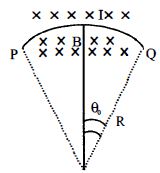
- 6A wire carrying current $I$ is tied between points $P$ and $Q$ and is in the shape of a circular arc of radius $R$ due to a uniform magnetic field $B$ (perpendicular to the plane of the paper, shown by $\times \times \times $) in the vicinity of the wire. If the wire subtends an angle $2\theta_0$ at the centre of the circle (of which it forms an arc) then the tension in the wire isView Solution
- 7A $36 \,\Omega$ galvanometer is shunted by resistance of $4\,\Omega$. The percentage of the total current, which passes through the galvanometer isView Solution
- 8An electron having kinetic energy $T$ is moving in a circular orbit of radius $R$ perpendicular to a uniform magnetic induction $\vec B$ . If kinetic energy is doubled and magnetic induction tripled, the radius will becomeView Solution
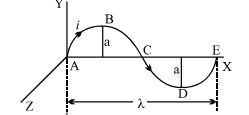
- 9A conductor $ABCDE$, shaped as shown, carries a current i. It is placed in the $xy$ plane with the ends $A$ and $E$ on the $x$-axis. $A$ uniform magnetic field of magnitude $B$ exists in the region. The force acting on it will beView Solution
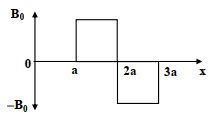
- 10A magnetic field $\overrightarrow{\mathrm{B}}=\mathrm{B}_0 \hat{\mathrm{j}}$ exists in the region $\mathrm{a} < \mathrm{x} < 2 \mathrm{a}$ and $\vec{B}=-B_0 \hat{j}$, in the region $2 \mathrm{a} < \mathrm{x} < 3 \mathrm{a}$, where $\mathrm{B}_0$ is a positive constant. $\mathrm{A}$ positive point charge moving with a velocity $\overrightarrow{\mathrm{v}}=\mathrm{v}_0 \hat{\dot{i}}$, where $v_0$ is a positive constant, enters the magnetic field at $x=a$. The trajectory of the charge in this region can be like,View Solution