An electron (mass $= 9 \times 10^{-31}\,kg$. Charge $= 1.6 \times 10^{-19}\,C$) whose kinetic energy is $7.2 \times 10^{-18}$ $joule$ is moving in a circular orbit in a magnetic field of $9 \times 10^{-5} \,weber/m^2$. The radius of the orbit is.....$cm$
Medium
Download our app for free and get started
(d) $r = \frac{{\sqrt {2mE} }}{{qB}} = \frac{{\sqrt {2 \times 9 \times {{10}^{ - 31}} \times 7.2 \times {{10}^{ - 18}}} }}{{1.6 \times {{10}^{ - 19}} \times 9 \times {{10}^{ - 5}}}}$
= $0.25\, m = 25\, cm$
= $0.25\, m = 25\, cm$

Download our appand get started for free
Experience the future of education. Simply download our apps or reach out to us for more information. Let's shape the future of learning together!No signup needed.*
Similar Questions
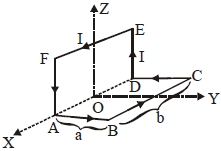
- 1A wire carrying current $I$ is bent in the shape $A\,B\,C\,D\,E\,F\,A$ as shown, where rectangle $A\,B\,C\,D\,A$ and $A\,D\,E\,F\,A$ are perpendicular to each other. If the sides of the rectangles are of lengths $a$ and $b,$ then the magnitude and direction of magnetic moment of the loop $A\,B\,C\,D\,E\,F\,A\,$ isView Solution
- 2An electron is accelerated by a potential difference of $12000\, volts$. It then enters a uniform magnetic field of ${10^{ - 3}}\,T$ applied perpendicular to the path of electron. Find the radius of path. Given mass of electron $ = 9 \times {10^{ - 31}}\,kg$ and charge on electron $ = 1.6 \times {10^{ - 19}}\,C$View Solution
- 3A long solenoid has a radius $a$ and number of turns per unit length is $n$. If it carries a current $i$, then the magnetic field on its axis is directly proportional toView Solution
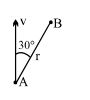
- 4A charge particle $A$ of charge $q = 2\,\, C$ has velocity $v = 100\,\, m/s.$ When it passes through point Aand has velocity in the direction shown. The strength of magnetic field at point $B$ due to this moving charge is.......$\mu T$ $(r = 2\,\, m).$View Solution
- 5Two parallel wires of length $9\, m$ each are separated by a distance $0.15\, m$. If they carry equal currents in the same direction and exerts a total force of $30 \times 10^{-7} \,N$ on each other, then the value of current must be........$amp$View Solution
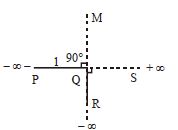
- 6An infinitely long conductor $PQR$ is bent to from a right angle as shown. A current $I$ flows through $PQR$ . The magnetic field due to this current at the point $M$ is $H_1$ . Now, another infinitely long straight conductor $QS$ is connected at $Q$ so that the current in $PQ$ remaining unchanged. The magnetic field at $M$ is now $H_2$ . The ratio $H_1/H_2$ is given byView Solution
- 7A galvanometer has a resistance of $50\ \Omega$ and it allows maximum current of $5 \mathrm{~mA}$. It can be converted into voltmeter to measure upto $100 \mathrm{~V}$ by connecting in series a resistor of resistanceView Solution
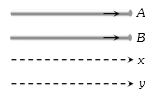
- 8$A$ and $B$ are two conductors carrying a current $i$ in the same direction. $x$ and $y$ are two electron beams moving in the same directionView Solution
- 9The magnetic moment of a circular orbit of radius $‘r’$ carrying a charge $‘q’$ and rotating with velocity $v$ is given byView Solution
- 10Two mutually perpendicular conductors carrying currents $I_1$ and $I_2$ lie in one plane. Locus of the point at which the magnetic induction is zero, is aView Solution