MCQ
An electron $($mass $m)$ with an initial velocity $\text{v}=\text{v}_0\hat{\text{i}}(\text{v}_0>0)$ is in an electric field $\text{E}=-\text{E}_0\hat{\text{i}}(\text{E}_0=\text{constant}>0)$. It’s de Broglie wavelength at time $t$ is given by:
  • A
    $\frac{\lambda_0}{\bigg(1+\frac{\text{eE}_0}{\text{m}}\frac{\text{t}}{\text{v}_0}\bigg)}$
  • B
    ${\lambda_0}{\bigg(1+\frac{\text{eE}_0\text{t}}{\text{m}\text{v}_0}\bigg)}$
  • $\lambda_0$
  • D
    $\lambda_0\text{t.}$

Answer

Correct option: C.
$\lambda_0$

The initial de$-$broglie wavelength of electron is given by $\lambda_0=\frac{1}{\text{mv}_0}$
Force on electron in electric field is given by $F = -eE$
$=-\text{E}[-\text{E}_0\text{i}]$
$=\text{e}\text{E}_0\text{i}$
Now, $\text{F}=\text{ma}$
$\Rightarrow\ \text{a}=\frac{\text{F}}{\text{m}}$
Substituting $\text{F}=\text{eE}_0\text{i}\text{ in a}=\frac{\text{F}}{\text{m}}$, we get
$\text{a}=\frac{\text{eE}_0\text{i}}{\text{m}}$
The velocity of electron after time $t$ is given by
$\text{v}=\text{v}_0\hat{\text{i}}+\text{at}$
Substituting $\text{a}=\frac{\text{eE}_0\text{i}}{\text{m}}$, we get
$\text{v}=\text{v}_0\hat{\text{i}}+\Big(\frac{\text{eE}_0\text{i}}{\text{m}}\Big)\text{t}$
$=\bigg(\text{v}_0+\frac{\text{eE}_0}{\text{m}}\text{t}\bigg)\hat{\text{i}}$
$=\text{v}_0\bigg(1+\frac{\text{eE}_0}{\text{m}\text{v}_0}\text{t}\bigg)\hat{\text{i}}$
The de$-$Broglie wavelength associated with electron at time $t$ is given by $\lambda=\frac{\text{h}}{\text{mv}}$
Substituting $\text{v}=\text{v}_0\bigg(1+\frac{\text{eE}_0}{\text{m}\text{v}_0}\text{t}\bigg)\hat{\text{i}}$ we get
$\lambda=\frac{\text{h}}{\text{m}\bigg[\text{v}_0\Big(\frac{\text{eE}_0}{\text{mv}_0}\text{t}\Big)\bigg]}$
$\Rightarrow \lambda=\frac{\lambda_0}{\Big(1+\frac{\text{eE}_0}{\text{mv}_0}\text{t}\Big)}\ \ \bigg[\because\ \lambda_0=\frac{\text{h}}{\text{mv}_0}\bigg]$

Need a full question paper?

Generate a complete, print-ready paper with questions like this in minutes — across 16+ boards, with answer keys.

Start Generating Free

Similar questions

The focal length of a normal eye$-$lens is about:
Inside a hollow charged spherical conductor, the potential
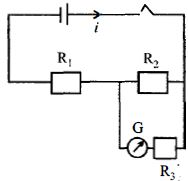
To find the resistance of a galvanometer by the half deflection method the following circuit is used with resistances $R_1 = 9970\,\Omega,$ $R_2 = 30\,\Omega$ and $R_3 = 0\,\Omega.$ The deflection in the galvanometer is $d$. With $R_3 = 107\,\Omega$ the deflection changed to $\frac {d}{2}$The galvanometer resistance is approximately ............... $\Omega$
Given below are two statements: One is labelled as Assertion $A$ and the other is labelled as Reason $R$.

Assertion $A:$ For measuring the potential difference across a resistance of $600\,\Omega$, the voltmeter with resistance $1000\,\Omega$ will be preferred over voltmeter with resistance $4000\,\Omega$.

Reason $R:$ Voltmeter with higher resistance will draw smaller current than voltmeter with lower resistance.

In the light of the above statements, choose the most appropriate answer from the options given below.

Give the unit of work function.
The refractive index of a prism for a monochromatic wave is $\sqrt 2 $ and its refracting angle is $60^o $. For minimum deviation, the angle of incidence will be......$^o$
Rutherford’s $a-$particle experiment showed that the atoms have:
Consider a glass cube slab of dielectric bound by the planes $x=0, x=a ; y=0, y=b ; z=0, z=c$; with $b > a > c$. The slab is placed in air and has a refractive index of $n$. The minimum value for $n$, such that all rays entering the dielectric at $y=0$ reach $y=b$ is
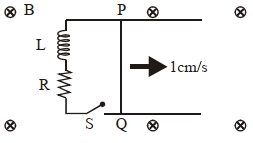
A $10 cm$ long perfectly conducting wire $PQ$ is moving, with a velocity $1 cm / s$ on a pair of horizontal rails of zero resistance. One side of the rails is connected to an inductor $L=1 mH$ and a resistance $K =1 \Omega$ as shown in figure. The horizontal rails, $L$ and $R$ lie in the same plane with a uniform magnetic field $B =1 T$ perpendicular to the plane. If the key $S$ is closed at certain instant, the current in the circuit after 1 millisecond is $x \times 10^{-3} A$, where the value of $x$ is. . . . . . [Assume the velocity of wire $PQ$ remains constant $(1 cm / s )$ after key $S$ is closed. Given : $e ^{-1}=0.37$, where $e$ is base of the natural logarithm]
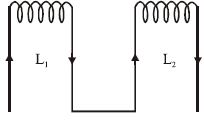
A circuit contains two inductors of self inductance $L_1$ and $L_2$ in series (Fig). If $M$ is the mutual inductance, then the effective inductance of the circuit shown will be