MCQ
Given below are two statements: One is labelled as Assertion $A$ and the other is labelled as Reason $R$.

Assertion $A:$ For measuring the potential difference across a resistance of $600\,\Omega$, the voltmeter with resistance $1000\,\Omega$ will be preferred over voltmeter with resistance $4000\,\Omega$.

Reason $R:$ Voltmeter with higher resistance will draw smaller current than voltmeter with lower resistance.

In the light of the above statements, choose the most appropriate answer from the options given below.

  • $A$ is not correct but $R$ is correct
  • B
    Both $A$ and $R$ are correct and $R$ is the correct explanation of $A$
  • C
    Both $A$ and $R$ are correct but $R$ is not the correct explanation of $A$
  • D
    $A$ is correct but $R$ is not correct

Answer

Correct option: A.
$A$ is not correct but $R$ is correct
a
Error of voltmeter decreases with increase in its resistance.

Need a full question paper?

Generate a complete, print-ready paper with questions like this in minutes — across 16+ boards, with answer keys.

Start Generating Free

Similar questions

The parallel combination of two air filled parallel plate capacitors of capacitance $C$ and $nC$ is connected to a battery of voltage, $V$. When the capacitor are fully charged, the battery is removed and after that a dielectric material of dielectric constant $K$ is placed between the two plates of the first capacitor. The new potential difference of the combined system is
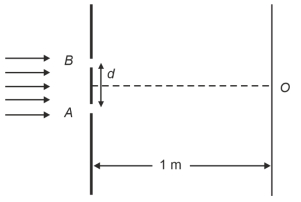
In a Young's double slit experiment, each of the two slits $A$ and $B$, as shown in the figure, are oscillating about their fixed center and with a mean separation of $0.8 mm$. The distance between the slits at time $t$ is given by $d=(0.8+0.04 \sin \omega t) mm$, where $\omega=0.08 rad s ^{-1}$. The distance of the screen from the slits is $1 m$ and the wavelength of the light used to illuminate the slits is $6000 \mathring A$. The interference pattern on the screen changes with time, while the central bright fringe (zeroth fringe) remains fixed at point $O$.

($1$) The $8^{\text {mh }}$ bright fringe above the point $O$ oscillates with time between two extreme positions. The separation between these two extreme positions, in micrometer $(\mu m )$, is. . . . .

($2$) The maximum speed in $\mu m / s$ at which the $8^{\text {th }}$ bright fringe will move is. . . . .

Give the answer or quetion ($1$) and ($2$)

The concept of displacement current introduced by Maxwell removes asymmetry between.
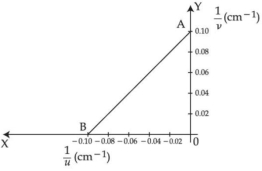
The graph between $\frac{1}{ u }$ and $\frac{1}{ v }$ for a thin convex lens in order to determine its focal length is plotted as shown in the figure. The refractive index of length is $1.5$ and its both the surfaces have same radius of curvatures $R$. The value of $R$ will be $cm$

(Where $u =$ object distance, $v =$ image distance)

When a dielectric is introduced between the plates of a condenser, the capacity of condenser:
White light is passed through a prism whose angle is 5°. If the refractive indices for rays of red and blue colour are respectively 1.64 and 1.66, the angle of deviation between the two colours will be
When two identical batteries of internal resistance $1 \Omega$ each are connected in series across a resistor $\mathrm{R}$, the rate of heat produced in $R$ is $J_1$. When the same batteries are connected in parallel across $R$, the rate is $\mathrm{J}_2$. If $\mathrm{J}_1=2.25 \mathrm{~J}_2$ then the value of $\mathrm{R}$ in $\Omega$ is
The largest distance between the interatomic planes of a crystal is $10^{-7}$ cm. The upper limit for the wavelength of $X-$ rays which can be usefully studied with this crystal is ............ $\mathop {\rm{A}}\limits^o $
Let there be a spherically symmetric charge distribution with charge density varying as $\rho (r)=\;\rho _0\left( {\frac{5}{4} - \frac{r}{R}} \right)$, upto $r = R$ ,and $\rho (r) = 0$ for $r > R$ , where $r$ is the distance from the origin. The electric field at a distance $r(r < R)$ from the origin is given by
There is 10 units of charge at the centre of a circle of radius 10m. The work done in moving 1 unit of charge around the circle once is