An electron moves in a circular orbit with a uniform speed $v$. It produces a magnetic field $B$ at the centre of the circle. The radius of the circle is proportional to
AIPMT 2005, Medium


Download our appand get started for free
Experience the future of education. Simply download our apps or reach out to us for more information. Let's shape the future of learning together!No signup needed.*
Similar Questions
- 1A moving coil galvanometer has resistance $50\,\Omega $ and it indicates full deflection at $4\,mA$ current. A voltmeter is made using this galvanometer and a $5\,k\Omega $ resistance. The maximum voltage, that can be measured using this voltamenter, will be close to ......$V$View Solution
- 2View SolutionAn electron is moving in the north direction. It experiences a force in vertically upward direction. The magnetic field at the position of the electron is in the direction of
- 3If $ m$ is magnetic moment and $B$ is the magnetic field, then the torque is given byView Solution
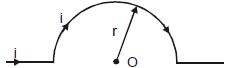
- 4A portion of a conductive wire is bent in the form of a semicircle of radius $r$ as shown below in fig. At the centre of semicircle, the magnetic induction will beView Solution
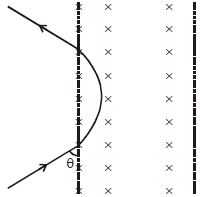
- 5View SolutionA positively charged particle enters in a region of uniform. Transverse magnetic field as shown in figure find net deviation in path of the particle.
- 6A long straight wire carries a current of $35\, A$. What is the magnitude of the field $B$ at a point $20\, cm$ from the wire ?View Solution
- 7Two long parallel wires carrying equal current separated by $1\,m$, exert a force of $2 \times {10^{ - 7}}\,N/m$ on one another. The current flowing through them isView Solution
- 8Two straight horizontal parallel wires are carrying the same current in the same direction, $d$ is the distance between the wires. You are provided with a small freely suspended magnetic needle. At which of the following positions will the orientation of the needle be independent of the magnitude of the current in the wiresView Solution
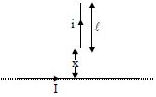
- 9View SolutionThe magnetic force between wires as shown in figure is :-
- 10A charge $+ Q$ is moving upwards vertically. It enters a magnetic field directed to the north. The force on the charge will be towardsView Solution