An electron moves with a speed of $2 \times 10^5\, m/s$ along the $+ x$ direction in a magnetic field $\vec B = \left( {\hat i - 4\hat j - 3\hat k} \right)\,tesla$. The magnitude of the force (in newton) experienced by the electron is (the charge on electron $= 1.6 \times 10^{-19}\, C$)
Medium
Download our app for free and get started
Given
$\overrightarrow{\mathrm{v}} =\left(2 \times 10^{5} \hat{\mathrm{i}}\right) \mathrm{m} / \mathrm{s} $
$\overrightarrow{\mathrm{B}} =(\hat{\mathrm{i}}-4 \hat{\mathrm{j}}-3 \hat{\mathrm{k}}) \mathrm{T} $
$\overrightarrow{\mathrm{F}} =\mathrm{e}(\overrightarrow{\mathrm{v}} \times \overrightarrow{\mathrm{B}})$
$=\mathrm{e}\left[\left(2 \times 10^{5} \hat{\mathrm{i}}\right) \times(\hat{\mathrm{i}}-4 \hat{\mathrm{j}}-3 \hat{\mathrm{k}})\right] $
$=2 \times 10^{5} \times 1.6 \times 10^{-19}[-4 \hat{\mathrm{k}}+3 \hat{\mathrm{j}}]$
Its magnitude is
$\mathrm{F}=2 \times 10^{5} \times 1.6 \times 10^{-19} \times \sqrt{(-4)^{2}+(3)^{2}}$
${=2 \times 10^{5} \times 1.6 \times 10^{-19} \times 5} $
${=1.6 \times 10^{-13} \mathrm{\,N}}$

Download our appand get started for free
Experience the future of education. Simply download our apps or reach out to us for more information. Let's shape the future of learning together!No signup needed.*
Similar Questions
- 1The current sensitivity of a moving coil galvanometer increases by $20 \%$ when its resistance is doubled. Calculate, by what factor does the voltage sensitivity change?View Solution
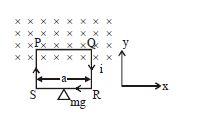
- 2A rectangular loop of wire, supporting a mass $m$, hangs with one end in a uniform magnetic field $\vec B$ pointing into the plane of the paper. $A$ clockwise current is set up such that $i> mg/Ba,$ where $a$ is the width of the loop. ThenView Solution
- 3A steady current $I$ flows along an infinitely long hollow cylindrical conductor of radius $R$. This cylinder is placed coaxially inside an infinite solenoid of radius $2 \ R$. The solenoid has $n$ turns per unit length and carries a steady current $I$. Consider a point $P$ at a distance $r$ from the common axis. The correct statement$(s)$ is (are) :View Solution
$(A)$ In the region $0 < r < R$, the magnetic field is non-zero.
$(B)$ In the region $R < r < 2 R$, the magnetic field is along the common axis.
$(C)$ In the region $R < r < 2 R$, the magnetic field is tangential to the circle of radius $r$, centered on the axis.
$(D)$ In the region $r > 2 R$, the magnetic field is non-zero.
- 4A $2 \mathrm{~A}$ current carrying straight metal wire of resistance $1 \Omega$, resistivity $2 \times 10^{-6} \Omega \mathrm{m}$, area of cross-section $10 \mathrm{~mm}^2$ and mass $500 \mathrm{~g}$ is suspended horizontally in mid air by applying a uniform magnetic field $\vec{B}$. The magnitude of $B$ is__________.$\times 10^{-1} \mathrm{~T}\left(\right.$ given, $\mathrm{g}=10 \mathrm{~m} / \mathrm{s}^2$ )View Solution
- 5Two similar coils of radius $R$ are lying concentrically with their planes at right angles to each other. The currents flowing in them are $I$ and $2I$, respectively. The resultant magnetic field induction at the centre will beView Solution
- 6Consider two thin identical conducting wires covered with very thin insulating material. One of the wires is bent into a loop and produces magnetic field $B_1,$ at its centre when a current $I$ passes through it.The second wire is bent into a coil with three identical loops adjacent to each other and produces magnetic field $B_2$ at the centre of the loops when current $I/3$ passes through it. The ratio $B_1 : B_2$ isView Solution
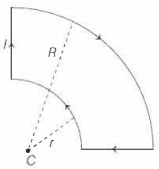
- 7An arrangement with a pair of quarter circular coils of radii $r$ and $R$ with a common centre $C$ and carrying a current $I$ is shown in the figure. The permeability of free space is $\mu_0$. The magnetic field at $C$ isView Solution
- 8A proton and an $\alpha$ -particle, having kinetic energies $K _{ p }$ and $K _{\alpha},$ respectively, enter into $a$ magnetic field at right angles.View Solution
The ratio of the radii of trajectory of proton to that of $\alpha$ -particle is $2: 1 .$ The ratio of $K _{ p }: K _{\alpha}$ is :
- 9A moving coil galvanometer is converted into an ammeter reading upto $0.03\,A$ by connecting a shunt of resistance $4r$ across it and into an ammeter reading upto $0.06\,A$ when a shunt of resistance $r$ is connected across it. What is the maximum current which can be sent through this galvanometer if no shunt is used ............... $A$View Solution
- 10A positive charge $'q'$ of mass $'m'$ is moving along the $+ x$ axis. We wish to apply a uniform magnetic field $B$ for time $\Delta t$ so that the charge reverses its direction crossing the $y$ axis at a distance $d.$ ThenView Solution