MCQ
An electron oscillating with a frequency of 3 × 10⁶ Hz, would generate:
- AX-rays
- BUltraviolet rays
- CRadio waves
- DMicrowaves
Generate a complete, print-ready paper with questions like this in minutes — across 16+ boards, with answer keys.
A light ray is incident by grazing one of the face of a prism and after refraction ray does not emerge out, what should be the angle of prism while critical angle is C
|
(a) Equal to 2C |
(b) Less than 2C |
(c) More than 2C |
(d) None of the above |
Solid targets of different elements are bombarded by highly energetic electron beams. The frequency (f) of the characteristic X-rays emitted from different targets varies with atomic number Z as
|
(a) f ∝ |
(b) f ∝ |
(c) f ∝ Z |
(d) f ∝ |
Three electric bulbs of rating 60W each are joined in series and then connected to electric mains. The power consumed by these three bulbs will be
|
(a) 180 W |
(b) 60 W |
(c) 20 W |
(d) |
An object 1 cm tall is placed 4cm infront of a mirror. In order to produce an upright image of 3cm height one needs a
|
(a) Convex mirror of radius of curvature 12 cm |
|
(b) Concave mirror of radius of curvature 12 cm |
|
(c) Concave mirror of radius of curvature 4 cm |
|
(d) Plane mirror of height 12 cm |
A point source of light is used in an experiment on photoelectric effect. Which of the following curves best represents the variation of photo current (i) with distance (d) of the source from the emitter
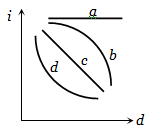
|
(a) a |
(b) b |
(c) c |
(d) d |
In a transistor, a change of 8.0 mA in the emitter current produces a change of 7.8 mA in the collector current. What change in the base current is necessary to produce the same change in the collector current
| (a) 50 mA | (b) 100 mA | (c) 150 mA | (d) 200 mA |


