Questions · Page 1 of 4

M.C.Q (1 Marks)

🎯

Test yourself on this topic

50 questions · timed · auto-graded

MCQ 11 Mark
An electric field $\overrightarrow{\text{E}}$ and a magnetic field $\overrightarrow{\text{B}}$ exist in a region. The fields are not perpendicular to each other.
  • A
    This is not possible.
  • B
    No electromagnetic wave is passing through the region.
  • C
    An electromagnetic wave may be passing through the region.
  • D
    An electromagnetic wave is certainly passing through the region.
Answer
  1. An electromagnetic wave may be passing through the region.

Explanation:

For an electromagnetic wave,electric field, magnetic field and direction of propagation are mutually perpendicular to each other. We can have a region in which electric and magnetic fields are applied at an angle with each other. In transmission lines Different modes exist. In transverse electric (TE) mode-no electric field exist in the direction of propagation. These are sometimes called H modes because there is only a magnetic field along the direction of propagation (His the conventional symbol for magnetic field).

View full question & answer
MCQ 21 Mark
Which of the following cannot travel in vacuum?
  • A
    Radio waves
  • B
    Gamma Waves
  • C
    Infrared Waves
  • D
    Infrasonic waves
Answer
  1. Infrasonic waves

Explanation:

Radio waves, gamma waves, and infrared waves are electromagnetic waves and due to this they do not need any material medium to travel and hence, can travel in vacuum. Whereas, infrasonic waves are mechanical waves and so, they need a material medium to travel. Therefore, infrasonic waves cannot travel in vacuum.

View full question & answer
MCQ 31 Mark
Which of the following electromagnetic waves is used in medicine to destroy cancer cells?
  • A
    IR-rays
  • B
    Visible rays
  • C
    Gamma rays
  • D
    Ultraviolet rays
Answer
  1. Gamma rays

Explanation:

Gamma rays has property to kill cancer cell because the energy released by gamma ray is perfect to kill and leave out the healthy ones.

View full question & answer
MCQ 41 Mark
For which frequency of light, the human eye is most sensitive?
  • A
    55.405 × 10¹⁴ Hz
  • B
    95.405 × 10¹⁴ Hz
  • C
    5.405 × 10¹⁴ Hz
  • D
    79.405 × 10¹⁴ Hz
Answer
  1. 5.405 × 10¹⁴ Hz

Explanation:

Human eye is sensitive to light of wavelength ➔ $\lambda$ = 5550 angstrom.

So its frequency is $\text{v}=\frac{\text{c}}{\lambda}$

$\text{v} =\frac{5550}{3 × 10^8} × 10^{-10}$

v = 5.405 × 10¹⁴ Hz

View full question & answer
MCQ 51 Mark
Which of the following cannot be polarized?
  • A
    Ultraviolet rays
  • B
    Ultrasonic waves
  • C
    X-rays
  • D
    Radiowaves
Answer
  1. Ultrasonic waves

Explanation:

All the longitudinal waves like sound etc cannot be polarized because the motion of the particles is already in one dimension that is the direction of propagation of wave.

Thus all the transverse waves like electromagnetic waves can be polarized.

Thus, (B) Ultrasonic waves being sound waves having frequency greater than 20kHz but being longitudinal in nature cannot be polarized

View full question & answer
MCQ 61 Mark
If the directions of electric and magnetic field vectors of a plane electromagnetic wave are along positive y-direction and positive z-direction respectively, then the direction of propagation of the wave is along:
  • A
    positive z-direction
  • B
    negative z-direction
  • C
    negative y-direction
  • D
    positive x-direction
Answer
  1. positive x-direction

Explanation:

e = E × B, direction of propagation is always perpendicular to plane of E and B. It will be positive in x-direction.

View full question & answer
MCQ 71 Mark
A plane electromagnetic wave propagating along x direction can have the following pairs of E and B.
  • A
    Ex , By.
  • B
    Ey, Bz.
  • C
    Bx , Ey.
  • D
    Ez , By.
Answer
  1. Ey, Bz.
  1. Ez , By.

​​​​​​​Solution:

Key concept: The direction of propagation of electromagnetic wave is perpendicular to both electric field vector $(\vec{\text{E}})$ and $(\vec{\text{B}})$ magntic field vector B, i.e., in the direction of $\vec{\text{E}}\times\vec{\text{B}}$.

Here in the question electromagnetic wave is propagating along x-direction. So, electro and magnetic field vectors should have either y-direction of 2-direction.

View full question & answer
MCQ 81 Mark
Radiation pressure on any surface:
  • A
    Is dependent on wavelength of the light used
  • B
    Is dependent on nature of surface and intensity of light used
  • C
    Is dependent on frequency and nature of surface
  • D
    Depends on the nature of source from which light is coming and on nature of surface on which it is falling.
Answer
  1. Is dependent on nature of surface and intensity of light used

Explanation:

Radiation pressure is given by $\text{P}_\text{R}=\frac{(1+\alpha)\text{I}}{\text{C}}$

where α is the coefficient of reflection of the surface.

For completely reflecting surface $\alpha=1$

For completely absorbing surface $\alpha=0$

So, radiation pressure depends on the nature of surface on which the light is falling but independent of wavelength of light falling.

View full question & answer
MCQ 91 Mark
An electromagnetic waves can be produced, when charge is:
  • A
    Moving with constant velocity
  • B
    Moving in a circular orbit
  • C
    Falling in an electric field
  • D
    both (b) and (c)
Answer
  1. both (b) and (c)

Explanation:

An accelerated charge is the source of electromagnetic waves (EMWs). When the charge is in a circular motion, the direction of its velocity continuously changes and thus it is in accelerated motion and produces EMWs.

A charge falling in an electric field is accelerated by the electric force and thus produces EMWs.

View full question & answer
MCQ 101 Mark
The displacement current was first populated by.
  • A
    Maxwell
  • B
    Marconi
  • C
    Ampere
  • D
    Hertz
Answer
  1. Maxwell

Explanation:

In electromagnetism, displacement current is a quantity appearing in Maxwell's equations that is defined in terms of the rate of change of electric displacement field.

View full question & answer
MCQ 111 Mark
Speed of electromagnetic waves is the same:
  • A
    For all wavelengths.
  • B
    In all media.
  • C
    For all intensities.
  • D
    For all frequencies.
Answer
  1. For all intensities.

Explanation:

For any given medium, the speed (c) of an electromagnetic wave is given by,

$\text{C}=\text{v}\lambda$

Where,

V = Frequency of the electromagnetic wave.

$\lambda=$ wavelength of the electromagnetic wave.

As the frequency and wavelength are changed, the speed of the electromagnetic wave changes. So, the speed of an electromagnetic wave is not same for all wavelengths and all frequencies in any medium. The velocity of an electromagnetic wave changes with change in medium. Also, the speed of an electromagnetic wave is same for all the intensities in any medium.

View full question & answer
MCQ 121 Mark
Consider an electromagnetic wave propagating in vacuum. Choose the correct statement:
  • A
    For an electromagnetic wave propagating in +y direction the 1 A electric field is $\overrightarrow{\text{E}}=\frac{1}{\sqrt{2}}\text{E}_\text{yz}(\text{x,t})\hat{\text{z}}$ and the magnetic field is $\overrightarrow{\text{B}}=\frac{1}{\sqrt{2}}\text{B}_\text{z}(\text{x,t})\hat{\text{y}}$
  • B
    For an electromagnetic wave propagating in +y direction the electric field is $\overrightarrow{\text{E}}=\frac{1}{\sqrt{2}}\text{E}_\text{yz}(\text{x,t})\hat{\text{y}}$ and the magnetic field is $\overrightarrow{\text{B}}=\frac{1}{\sqrt{2}}\text{B}_\text{z}(\text{x,t})\hat{\text{z}}$
  • C
    For an electromagnetic wave propagating in +x direction the electric field is $\overrightarrow{\text{E}}=\frac{1}{\sqrt{2}}\text{E}_\text{yz}(\text{y,z,t})(\hat{\text{y}}+\hat{\text{z}})$ and the magnetic field is $\overrightarrow{\text{B}}=\frac{1}{\sqrt{2}}\text{E}_\text{yz}(\text{x,t})(\hat{\text{y}}+\hat{\text{z}})$
  • D
    For an electromagnetic wave propagating in +x direction the electric field is $\overrightarrow{\text{E}}=\frac{1}{\sqrt{2}}\text{E}_\text{yz}(\text{x,t})(\hat{\text{y}}-\hat{\text{z}})$ and the magnetic field is $\overrightarrow{\text{B}}=\frac{1}{\sqrt{2}}\text{E}_\text{yz}(\text{x,t})(\hat{\text{y}}+\hat{\text{z}})$
Answer
  1. For an electromagnetic wave propagating in +x direction the electric field is $\overrightarrow{\text{E}}=\frac{1}{\sqrt{2}}\text{E}_\text{yz}(\text{x,t})(\hat{\text{y}}-\hat{\text{z}})$ and the magnetic field is $\overrightarrow{\text{B}}=\frac{1}{\sqrt{2}}\text{E}_\text{yz}(\text{x,t})(\hat{\text{y}}+\hat{\text{z}})$

Explanation:

Electromagnetic waves travel in the direction perpendicular to electric as well as magnetic field. Cross product of electric and magnetic field should give the direction of electromagnetic wave.

View full question & answer
MCQ 131 Mark
 The EM waves when travel into different media gets:
  • A
    Refracted
  • B
    Transmitted
  • C
    Reflected
  • D
    Emitted
Answer
  1. Reflected
View full question & answer
MCQ 141 Mark
An electromagnetic radiation has an energy of 13.2 keV. Then the radiation belongs to the region of.
  • A
    visible light
  • B
    ultraviolet
  • C
    infrared
  • D
    X-ray
Answer
  1. X-ray
View full question & answer
MCQ 151 Mark
Which of the following have zero average value in a plane electromagnetic wave?
  • A
    Electric field.
  • B
    Magnetic field.
  • C
    Electric energy.
  • D
    Magnetic energy.
Answer
  1. Electric field.
  2. Magnetic field.

Explanation:

In a plane electromagnetic wave, the electric and the magnetic fields oscillate sinusoidally. For an electromagnetic wave propagating in the z-direction, the electric and magnetic fields are given by,

$\text{E}_\text{x}=\text{E}_0\sin(\text{kz}-\omega\text{t})$

$\text{B}_\text{y}=\text{B}_0\sin(\text{kz}-\omega\text{t})$

These are sinusoidal functions. Therefore, for a fixed value of z. the average value of the electric and magnetic fields are zero.

View full question & answer
MCQ 161 Mark
The value of electric field in an electromagnetic wave originating from a point source of light at a distance of  10 meter is $\text{E}=\frac{500\text{Volt}}{\text{m}}$ The electric field at a distance of 5 meter will be.
  • A
    $\frac{1000\text{Volt}}{\text{meter}}$
  • B
    $\frac{2000\text{Volt}}{\text{meter}}$
  • C
    $\frac{50\text{Volt}}{\text{meter}}$
  • D
    $\frac{25\text{Volt}}{\text{meter}}$
Answer
  1. $\frac{2000\text{Volt}}{\text{meter}}$

Explanation:

As we know, $\text{E}\propto\text{R}^{-2}$

Therefore, $\text{E}(\text{R}=5)=\frac{500}{10^{-2}}5^{-2}=\frac{2000\text{V}}{\text{m}}$

View full question & answer
MCQ 171 Mark
Monica wanted to take photographs of a monument. But since the surrounding is filled with smoke, she is not able to take good photos. Which one of the following electromagnetic waves can be used in this situation to help Monica?
  • A
    X-rays
  • B
    Gamma rays
  • C
    Ultraviolet rays
  • D
    Infrared waves
Answer
  1. Infrared waves

Explanation:

Infrared waves can be used to take photographs during conditions of smoke, fog, etc. as these waves are scattered less than visible rays and hence travel longer distances through the atmosphere. So, using infrared waves can help Monica out.

View full question & answer
MCQ 181 Mark
Is the ratio of frequencies of UV rays and IR rays in the glass more than, less than or equal to 1?
  • A
    Insufficient data
  • B
    Equal to 1
  • C
    Less than 1
  • D
    More than 1
Answer
  1. More than 1

Explanation:

The ratio of frequencies of UV rays and IR rays in the glass is more than 1. This is because the frequency of UV rays is greater than that of infrared rays. This situation is applicable in glass or vacuum or air.

View full question & answer
MCQ 191 Mark
The amplitude of the magnetic field of a harmonic electromagnetic wave in vacuum is B0​ = 510nT. The amplitude of the electric field part of the wave is:
  • A
    120 N C−1
  • B
    163 N C−1
  • C
    510 N C−1
  • D
    153 N C−1
Answer
  1. 153 N C−1

Explanation:

Given,

B0​ = 510nT

c = 3×10⁸m/s

The magnitude of electric field is given by

E0​ = B0​c

E0​ = 510×10−9×3×108

E​= 153 N C−1

View full question & answer
MCQ 201 Mark
In an electromagnetic wave.
  • A
    Power is equally transferred along electric and magnetic fields
  • B
    Power is transmitted in a direction perpendicular to both the field
  • C
    Power is transmitted along electric field
  • D
    Power is transmitted along magnetic field
Answer
  1. Power is transmitted in a direction perpendicular to both the field

Explanation:

For electromagnetic waves E and B are always perpendicular to each other and perpendicular to the direction of propagation. The direction of propagation is the direction of E × B.

The direction of propagation of the wave is the direction of propagation of its energy and power.

View full question & answer
MCQ 211 Mark
Microwaves are electromagnetic waves with frequency in the range of:
  • A
    Micro hertz
  • B
    Giga hertz
  • C
    Mega hertz
  • D
    Hertz
Answer
  1. Giga hertz
View full question & answer
MCQ 221 Mark
An EM wave radiates outwards from a dipole antenna, with E0 as the amplitude of its electric field vector. The electric field E0 which transports significant energy from the source falls off as:
  • A
    $\frac{1}{\text{r}^3}$
  • B
    $\frac{1}{\text{r}^2}$
  • C
    $\frac{1}{\text{r}}$
  • D
    Remains constant.
Answer
  1. $\frac{1}{\text{r}}$

Solution:

A diode antenna radiates the electromagnetic waves outwards. The amplitude of electric field vector (E0) which transports significant energy from the source falls intensity inversely as the distance (r) from the antenna,

i.e., $\text{E}_0\propto\frac{1}{\text{r}}$.

View full question & answer
MCQ 231 Mark
In Thomson's experiment to measure e/ m of electron, the electric and the magnetic fields are.
  • A
    In the same direction
  • B
    In the opposite direction
  • C
    At an angle of 45° with each other
  • D
    Perpendicular to each other
Answer
  1. Perpendicular to each other

Explanation:

The experimental set up of Thomson's experiment is shown in figure, 

According to this figure, the electric field is applied between two horizontal parallel plates, this field is directed in downward direction.

The cross in figure shows the magnetic field is directed inside the paper. Therefore, both the fields are perpendicular to each other.

View full question & answer
MCQ 241 Mark
What is the ratio of the speed of infrared and ultraviolet rays in a vacuum?
  • A
    1:1
  • B
    2:1
  • C
    1
  • D
    0
Answer
  1. 1

Explanation:

 Ratio = 1 because the speed of an electromagnetic wave in vacuum is independent of its wavelength or frequency. Therefore, the ratio of speed of infrared and ultraviolet rays in a vacuum is one.

View full question & answer
MCQ 251 Mark
Which of the following statement(s) is/ are correct?
  • A
    Conduction current obeys Ohm's law whereas displacement current does not.
  • B
    Conduction current is the actual current whereas displacement current is the apparent current produced by time varying electric field.
  • C
    Conduction current density is represented by $\overrightarrow{\text{J}_\text{c}}=\sigma\overrightarrow{\text{E}}$ whereas displacement current density is given by $\overrightarrow{\text{J}_\text{d}}=\frac{\overrightarrow{\delta\text{E}}}{\delta\text{t}};\sigma=$ conductivity of the element, $\overrightarrow{\text{E}}=$ electric field.
  • D
    All of the above
Answer
  1. Conduction current obeys Ohm's law whereas displacement current does not.

Explanation:

Displacement current is the current that occurs due to charging electric field  introduced by maxwell. It depends on the frequency of electric field while conduction current follows ohms law, requires medium displacement.Current doesnot follow ohms law nor require medium.

View full question & answer
MCQ 261 Mark
Instantaneous displacement current 1A in the space between the parallel plates of $1\mu\text{F}$ capacitor can be established by changing the potential difference at the rate of:
  • A
    $\frac{0.1\text{V}}{\text{s}}$
  • B
    $\frac{1\text{V}}{\text{s}}$
  • C
    $\frac{10^6\text{V}}{\text{s}}$
  • D
    $\frac{10^{-6}\text{V}}{\text{s}}$
Answer
  1. $\frac{10^6\text{V}}{\text{s}}$

Explanation:

In a capacitor of capacitance C,

$\text{V}=\frac{\text{q}}{\text{C}}$

$\Rightarrow\frac{\text{dV}}{\text{dt}}=\frac{\text{i}}{\text{C}}=\frac{1\text{A}}{1\mu\text{F}}=\frac{10^6\text{V}}{\text{s}}$

View full question & answer
MCQ 271 Mark
The cellular mobile radio frequency band is:
  • A
    88 – 108 MHz
  • B
    54 – 72 MHz
  • C
    540 – 1600 KHz
  • D
    840 – 935 MHz
Answer
  1. 840 – 935 MHz
View full question & answer
MCQ 281 Mark
If the magnetic field of an electromagnetic wave is given as By ​= 2 × 10⁻⁷ sin(103x + 1.5 × 10¹²t) tesla, the wavelength of the electromagnetic wave is.
  • A
    0.314mm
  • B
    0.628mm
  • C
    6.28mm
  • D
    0.0628mm
Answer
  1. 6.28mm

Explanation:

The general equation of an electromagnetic wave is $\text{B = A}\sin(\text{kx + }\omega\text{t})$

Comparing this equation with the given equation, A = 2 × 10⁻⁷, k = 103 and $\omega$ = 1.5 × 10¹²

So, $10^3=\frac{2\pi}{\lambda}$

or $\lambda=6.28\times10^{-3}\text{m}=6.28\text{mm}$

View full question & answer
MCQ 291 Mark
A plane electromagnetic wave with a single frequency moves in vacuum in the positive x direction. Its amplitude is uniform over the yz plane. the amplitude of its magnetic field. 
  • A
    Increase
  • B
    Decrease
  • C
    same
  • D
    None
Answer
  1. same

Explanation:

The same amount of energy passes through equal areas parallel to the yz plane as the wave travels in the +x direction, so the amplitude and the intensity, which is proportional to the square of the amplitude, do not change.

View full question & answer
MCQ 301 Mark
Which of the following is not true for electromagnetic waves?
  • A
    They transport energy.
  • B
    They have momentum.
  • C
    They travel at different speeds in air depending on their frequency.
  • D
    They travel at different speeds in medium depending on their frequency.
Answer
  1. They travel at different speeds in air depending on their frequency.

Explanation:

They travel at different speed in air depending on their frequency. At constant as the speed will be same irrespective of frequency. Also frequency is source dependent and doesn't controls speed.

View full question & answer
MCQ 311 Mark
A plane electromagnetic wave of frequency 28MHz travels in free space along the positive x-direction. At a particular point in space and time, electric field is 9.3V/m along positive y-direction. The magnetic field (in T) at that point is 
  • A
    3.1×10⁻⁸ along positive z-direction
  • B
    3.1×10⁻⁸ along negative z-direction
  • C
    3.2×10along positive z-direction
  • D
    3.2×10along negative z-direction
Answer
  1. 3.1×10⁻⁸ along positive z-direction

Explanation:

$\text{B}=\frac{\text{E}}{\text{C}}$

$=\frac{9.3}{3\times10^8}$

$=3.1\times10^{-8}$

View full question & answer
MCQ 321 Mark
 When is the conduction current the same as the displacement current?
  • A
    When the source is ac
  • B
    When the source is dc
  • C
    When the source is either an ac or a dc
  • D
    When the source is neither dc nor ac
Answer
  1.  When the source is ac

Explanation:

The conduction current is the same as the displacement current when the source is ac.

View full question & answer
MCQ 331 Mark
An EM wave of intensity I falls on a surface kept in vacuum and exerts radiation pressure p on it. Which of the following are true?
  • A
    Radiation pressure is I/c if the wave is totally absorbed.
  • B
    Radiation pressure is I/c if the wave is totally reflected.
  • C
    Radiation pressure is 2I/c if the wave is totally reflected.
  • D
    Radiation pressure is in the range I/c < p < 2I/c for real surfaces.
Answer
  1. Radiation pressure is I/c if the wave is totally absorbed.
  1. Radiation pressure is 2I/c if the wave is totally reflected.
  2. Radiation pressure is in the range I/c < p < 2I/c for real surfaces.

Solution:

Key concept: Radiation pressure (p) is the force exerted by electromagnetic wave on unit area of the surface, i.e., rate of change of momentum per unit area of the surface.

Let us consider a surface exposed to electromagnetic radiation as shown in figure. The radiation is falling normally on the surface. Further, intensity of radiation is I and area of surface exposed to radiation is A.
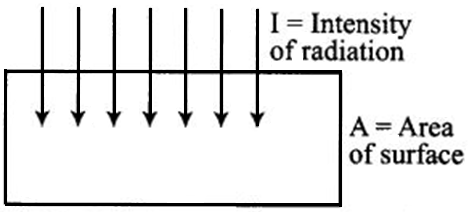
E = Energy received by surface per second = I.A

N = Number of photons received by surface per second

$\text{N}=\frac{\text{E}}{\text{E}_\text{Photon}}=\frac{\text{E}\lambda}{\text{hc}}=\frac{\text{IA}\lambda}{\text{hc}}$

Now, there are three cases possible which are as follows.

CaseI:

Surface is perfectly reflecting

$\Delta\text{P}_\text{one photon}=\text{Change in momentum}=\frac{2\text{h}}{\lambda}$

$\therefore\ \text{Total force experienced F}=\text{N}\times\Delta\text{P}_\text{one photon}=\frac{2\text{IA}}{\text{c}}$

Also, pressure $\text{P}=\frac{\text{F}}{\text{A}}=\frac{2\text{I}}{\lambda}$

Case II:

Surface is perfectly absorbing

$\Delta\text{P}_\text{one photon}=\frac{\text{h}}{\lambda}$

$\Rightarrow\ \text{F}=\text{N}\times\Delta\text{P}_\text{one photon}=\frac{\text{IA}}{\text{c}}$

Also, Pressure $\text{P}=\frac{\text{F}}{\text{A}}=\frac{\text{I}}{\text{c}}$

Hence radiation pressure is in the range $\frac{\text{I}}{\text{C}}<\text{P}<\frac{2\text{I}}{\text{c}}$ for real surfaces.

Important Points:

If surface is partly reflecting

Let us consider that surface reflects 70% and absorbs 30% of the incident radiation.

$\text{F}=0.7\Big(\frac{2\text{IA}}{\text{c}}\Big)+0.3\Big(\frac{\text{IA}}{\text{c}}\Big)=\frac{1.7\text{IA}}{\text{c}}$

Remarks:

  1. Radiation force/pressure supports photon theory of radiation.
  2. If radiation falls abliquely, then appropriate projection of area vector is taken.
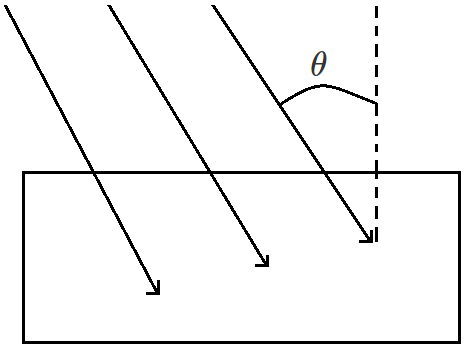
For situation as shown in figure,

$\text{F}=\frac{2\text{IA}\cos^2\theta}{\text{c}}$, for perfectly reflecting surface

$\text{F}=\frac{\text{IA}\cos\theta}{\text{c}}$, for perfectly absorbing surface

$\text{F}=\frac{1.4\text{IA}\cos^2\theta}{\text{c}}+\frac{0.3\text{IA}\cos \theta}{\text{c}}$, for partially reflecting surface.

View full question & answer
MCQ 341 Mark
An electromagnetic wave, going through vacuum is described by $\text{E}=\text{E}_0\sin(\text{kx}-\omega\text{t}.)$ Which of the following is independent of wavelength?
  • A
    $\text{k}$
  • B
    $\omega$
  • C
    $\frac{\text{k}}{\omega}$
  • D
    $\text{k}\omega$
Answer
  1. $\frac{\text{k}}{\omega}$

Explanation:

$\text{k}=\frac{2\pi}{\lambda}$

$\omega=\frac{2\pi\text{c}}{\lambda},$ where c is the velocity of light 

Hence, $=\frac{\text{k}}{2\pi}=\frac{\omega}{2\pi\text{c}}$

$\Rightarrow\frac{\text{k}}{\omega}$ is independent of the wavelength.


View full question & answer
MCQ 351 Mark
When electromagnetic waves enter the ionised layer of ionosphere, then the relative permittivity i.e. dielectric constant of the ionised layer:
  • A
    Does not change
  • B
    Appears to increase
  • C
    Appears to decrease
  • D
    Sometimes appears to increase and sometimes to decrease
Answer
  1. Appears to decrease
View full question & answer
MCQ 361 Mark
According to Maxwell's equation, the velocity of light in any medium is expressed as.
  • A
    $\frac{1}{\mu_0\in_0}$
  • B
    $\frac{1}{\sqrt\mu\in}$
  • C
    $\sqrt\frac{\mu}{\in}$
  • D
    $\sqrt\frac{\mu_0}{\in}$
Answer
  1. $\frac{1}{\sqrt\mu\in}$

Explanation:

Velocity of light in a medium,

$\text{c}=\frac{1}{\sqrt{\mu_0\in_0\mu_\text{r}\in_\text{r}}}=\frac{1}{\mu_0\in_0}$

View full question & answer
MCQ 371 Mark
Electromagnetic waves travel only through.
  • A
    material medium
  • B
    vacuum
  • C
    oscillating electric and magnetic fields
  • D
    oscillating electric and magnetic fields whose directions are perpendicular to each other
Answer
  1. oscillating electric and magnetic fields whose directions are perpendicular to each other

Explanation:

Electromagnetic waves travel through oscillating electric and magnetic fields whose directions are perpendicular to each other.

View full question & answer
MCQ 381 Mark
Displacement current goes through the gap between the plates of a capacitor when the charge of the capacitor:
  • A
    Increases.
  • B
    Decreases.
  • C
    Does not change.
  • D
    Is zero.
Answer
  1. Increases.
  2. Decreases.

Explanation:

Displacement current inside a capacitor,

$\text{i}_\text{d}=\in_0\frac{\text{d}\phi_\text{E}}{\text{dt}},$ where

$\phi_\text{E}$ is the electric flux inside the capacitor.

Up to the time the electric flux changes, there will be a displacement current. This is possible when the charge on a capacitor changes. Therefore, the displacement current goes through the gap between the plates of a capacitor when the charge of the capacitor or electric field increases or decreases inside the capacitor.

View full question & answer
MCQ 391 Mark
Which of the following radiations are used to treat muscle ache?
  • A
    Microwaves
  • B
    Infrared Rays
  • C
    Ultraviolet Rays
  • D
    X-Rays
Answer
  1. Infrared Rays

Explanation: 

Infrared rays are used to treat muscle aches.

View full question & answer
MCQ 401 Mark
Choose the correct answer from the alternatives given.
The amplitude of an electromagnetic wave in vaccum is doubled with no other changes made to the wave. As a result of this doubling of the amplitude, which of the following statement is correct?
  • A
    The frequency of the wave changes only
  • B
    The wave length of the wave changes only
  • C
    The speed of the wave propagation changes only
  • D
    None of the above is correct
Answer
  1. None of the above is correct

Explanation:

As we know, velocity of electromagnetic wave,

$\text{c}=\frac{1}{\sqrt{\mu_0\in_0}}=\frac{3\times10^8\text{m}}{\text{s}}$ 

which is constant

So It is independent of amplitude of electromagnetic wave, frequency and wavelength of electromagnetic wave.

so none of the above is correct.

View full question & answer
MCQ 411 Mark
A plane electromagnetic wave travels in vacuum along $\hat{\text{k}}$ direction, where $\hat1\hat{\text{j}}$​ and $\hat{\text{k}}$ are unit vectors along the x, y and z directions. The direction along which the electric and the magnetic field vectors point may be respectively.
  • A
    $\hat{\text{k}}\text{ and }\hat{\text{j}}$
  • B
    $\hat{\text{k}}\text{ and }\hat{-\text{j}}$
  • C
    $\hat{\text{j}}\text{ and }\hat{\text{i}}$
  • D
    $\hat{\text{k}}\text{ and }\hat{\text{i}}$
Answer
  1. $\hat{\text{k}}\text{ and }\hat{\text{j}}$

Explanation:

Electromagnetic wave is a transverse wave that means the electric and magnetic field associated to it will not only be perpendicular to each other but will also be

perpendicular to the direction in which the wave travels.

So, if waves travel along $\hat{\text{k}}$ direction then the electric and the magnetic field will be along $\hat{\text{i}}$ and $\hat{\text{j}}$​ directions.

View full question & answer
MCQ 421 Mark
Choose the correct answer from the alternatives given.
The conduction current is the same as displacement current when the source is.
  • A
    AC only
  • B
    DC only
  • C
    both AC and DC
  • D
    neither AC nor for DC
Answer
  1. AC only

Explanation:

For a capacitor, we have:

Q = CV

If Q is changing, there will be a current in capacitor plates,

$\text{I}=\frac{\text{dQ}}{\text{dt}}=\frac{\text{CdV}}{\text{dt}}$when voltage across the capacitor is constant, $\frac{\text{dV}}{\text{dt}}=0$

therefore, I = 0

It implies that, for a DC (constant) voltage, the capacitor current is zero.

Hence, for a DC source the conduction current and displacement current (capacitor current) are not same.

Whereas, by Maxwell's equation for a time varying voltage (AC voltage), both conduction and displacement currents are same.

View full question & answer
MCQ 431 Mark
10cm is a wavelength corresponding to the spectrum of:
  • A
    Infrared rays
  • B
    Ultraviolet rays
  • C
    Microwaves
  • D
    X-rays
Answer
  1. Microwaves

Explanation:

Microwaves have wavelength around 10cm.

View full question & answer
MCQ 441 Mark
The condition under which a microwave over heats up a food item containing water molecules most efficiently is:
  • A
    The frequency of the microwaves must match the resonant frequency of the water molecules.
  • B
    The frequency of the microwaves has no relation with natural frequency of the water molecules.
  • C
    Microwaves are heat waves, so always produce heating.
  • D
    Infrared waves produce heating in a microwave oven.
Answer
  1. The frequency of the microwaves must match the resonant frequency of the water molecules.

Explanation:

When frequency of microwave matches with frequency of water molecules i.e., resonant condition. Maximum energy is transferred to water molecules as their K.E. energy.

View full question & answer
MCQ 451 Mark
Which of the following type of radiations are radiated by on oscillating electric charge?
  • A
    Electric
  • B
    Magnetic
  • C
    Thermoelectric
  • D
    Electromagnetic
Answer
  1. Electromagnetic

Explanation:

Any stationary charge produce static electric field. And the field strength is given by:

r, is the radial distance from the point charge.
Q, is the charge in Coulomb.

When electric charge oscillates electric field at any point also oscillates.And according to Maxwell's equations varying electric field produces magnetic field and an oscillating electric field produces oscillating magnetic field. This thing is used in antennas in which oscillating current of certain frequency produces oscillating electric and magnetic field which propagates through space(electromagnetic waves).

View full question & answer
MCQ 461 Mark
Two opposite charged particles oscillate about their mean equilibrium position in free space, with a frequency of 109Hz. The wavelength of the corresponding electromagnetic wave produced is ______:
  • A
    0.3m
  • B
    109m
  • C
    3×10¹⁷m
  • D
    3.3m
Answer
  1. 0.3m

Explanation:

Electromagnetic wave V = 3×10⁸m/s

Given frequency (f) = 109Hz

$\text{V}=\text{f}\lambda$

$\lambda=\frac{\text{V}}{\text{f}}$

$=\frac{3 \times 10^8} {10^9}$

​= 0.3m

View full question & answer
MCQ 471 Mark
Which of the following effects could not be explained by Maxwell's electromagnetic wave theory?
  • A
    Photoelectric effect
  • B
    Compton effect
  • C
    Raman effect
  • D
    All of these
Answer
  1. All of these

Explanation:

  1. Photoelectric effect was discovered by heinrich Rudoy Hertz.
  2. Compton effect was discovered by Aethur Holl Compton.
  3. Raman effect was discovered by Sir Chandrasekhar Venbata Ram. 

So, none of these effect was discovered by Maxwell.

View full question & answer
MCQ 481 Mark
A charged particle oscillates about its mean equilibrium position with a frequency of 109 Hz. The frequency of electromagnetic waves produced by the oscillator is:
  • A
    10Hz
  • B
    107 Hz
  • C
    108 Hz
  • D
    109 Hz
Answer
  1. 109 Hz
View full question & answer
MCQ 491 Mark
The ozone layer in the atmosphere absorbs:
  • A
    Only the radiowaves
  • B
    Only the visible light
  • C
    Only the γ-rays
  • D
    X-rays and ultraviolet rays
Answer
  1. X-rays and ultraviolet rays
View full question & answer
MCQ 501 Mark
An electromagnetic wave can be produced when the charge is
  • A
    moving in a circular orbit
  • B
    moving with a constant velocity
  • C
    falling in an electric field
  • D
    Both (a) and (c)
Answer
  1. Both (a) and (c)

Explanation: 

An accelerated charge is the source of electromagnetic waves (EMWs). When the charge is in a circular motion, the direction of its velocity continuously changes and thus it is in accelerated motion and produces EMWs. A charge falling in an electric field is accelerated by the electric force and thus produces EMWs.

View full question & answer
M.C.Q (1 Marks) - Physics STD 12 Science Questions - Vidyadip