An electron revolves $6 × 10^{15}$ times/sec in circular loop. The current in the loop is
Easy
Download our app for free and get started
(a)$i = 6 \times {10^{15}} \times 1.6 \times {10^{ - 19}} = 0.96\,mA{\rm{.}}$

Download our appand get started for free
Experience the future of education. Simply download our apps or reach out to us for more information. Let's shape the future of learning together!No signup needed.*
Similar Questions
- 1Equivalent resistance between the adjacent corners of a regular $n$-sided polygon of uniform wire of resistance $R$ would be:View Solution
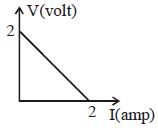
- 2Potential difference across a cell and current through a cell is shown in graph. A battery consists of such identical $40$ cells. Max current supplied by the battery through a load of $2.5\,\Omega $ equal to .............. $A$View Solution
- 3If $2.2\, Kwatt$ power is transmitted through a $10\, ohm$ line at $22000\, volt$, the power loss in the form of heat will be ............. $watt$View Solution
- 4$3$ identical bulbs are connected in series and these together dissipate a power $P$. If now the bulbs are connected in parallel, then the power dissipated will beView Solution
- 5Two circuits (shown below) are called ‘Circuit $A$ ’and ‘Circuit $B$’. The equivalent resistance of ‘Circuit $a$’ is $x$ and that of ‘Circuit $B$’ is $y$ between $1$ and $2.$View Solution

- 6In an experiment to measure the internal resistance of a cell by potentiometer, it is found that the balance point is at a length of $2\,m$ when the cell is shunted by a $5\,\Omega $ resistance; and is at a length of $3\,m$ when the cell is shunted by a $10\,\Omega $ resistance. The internal resistance of the cell is, then ................ $\Omega $View Solution
- 7A $25\, W$, $ 220\, V$ bulb and a $100\, W$, $220\, V$ bulb are connected in parallel across a $440\, V$ lineView Solution
- 8If a copper wire is stretched to increase its length by $20 \% $. The percentage increase in resistance of the wire is $..........\%$View Solution
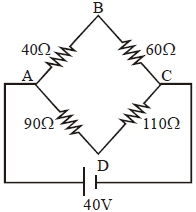
- 9Four resistances $40 \ \Omega, 60\ \Omega, 90\ \Omega$ and $110\ \Omega$ make the arms of a quadrilateral $A,B,C,D$. Across $AC$ is a battery of emf $40\, V$ and internal resistance negligible. The potential difference across $BD$ is $V$ is......View Solution
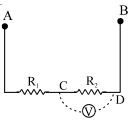
- 10Resistances $R_1$ and $R_2$ each $60\,\Omega$ are connected in series as shown in figure. The Potential difference between $A$ and $B$ is kept $120$ volt. Then what ............. $V$ will be the reading of voltmeter connected between the point $C$ and $D$ if resistance of voltmeter is $120\,\Omega .$View Solution