Question
An electron with velocity $\vec{v}=\left(v_x \hat{i}+v_y \hat{j}\right)$ moves through a magnetic field $\vec{B}=\left(B_x \hat{i}-B_y \hat{j}\right)$. The force $\overrightarrow{ F }$ on the electron is: ( e is the magnitude of its charge)

Answer

(d) $e\left(v_x B_y+v_y B_x\right) \hat{k}$
Explanation: $e\left(v_x B_y+v_y B_x\right) \hat{k}$
The force is given as $- e ( v \times B )$.

Need a full question paper?

Generate a complete, print-ready paper with questions like this in minutes — across 16+ boards, with answer keys.
Start Generating Free

Similar questions

Light waves producing interference have their amplitudes in the ratio 3 : 2. The intensity ratio of maximum and minimum of interference fringes is(a) 36 : 1 (b) 9 : 4(c) 25 : 1 (d) 6 : 4
       
In a working nuclear reactor, Cadmium rods, (control rods) are used to(a) Speed up neutrons(b) Slow down neutrons(c) Absorb some neutrons(d) Absorb all neutrons
   
   
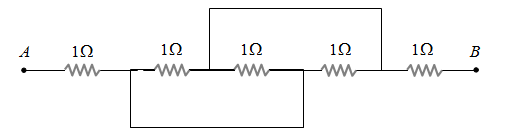
Equivalent resistance between the points $A$ and $B$ is $($in $\Omega)$
Among the following properties describing diamagnetism identify  the property that is wrongly stated(a) Diamagnetic material do not have permanent magnetic moment(b) Diamagnetism is explained in terms of electromagnetic induction(c) Diamagnetic materials have a small positive susceptibility(d) The magnetic moment of individual electrons neutralize each other


1 milli coulomb =
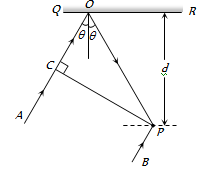
In the adjacent diagram, $CP$ represents a wavefront and $AO\ \&\ BP,$ the corresponding two rays. Find the condition on $q$  for constructive interference at $P$ between the ray $BP$ and reflected ray $OP$
Total internal reflection of a ray of light is possible when the $(i_c =$ critical angle, $i  =$  angle of incidence$)$
Current carrier in conductors is ____?
A circular disc of which 2/3 part is coated with yellow and 1/3 part is with blue. It is rotated about its central axis with high velocity, then it will be seen as(a) Green   (b) Brown(c) White                                            (d) Violet
       
In a cathode ray tube, what is the effect on the beam of particles if a hotter filament is used?