Questions

M.C.Q (1 Marks)

Take a timed test

12 questions · self-marked practice — reveal the answer and mark yourself.

Question 11 Mark
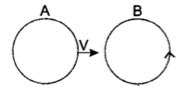
There are two coils A and B as shown in the figure. A current starts flowing in B as shown, when A is moved towards B and stops when A stops moving. The current in A is counter clockwise. B is kept stationary when A moves. We can infer that
Image
Answer
(a) there is a constant current in the counterclockwise direction in A.
Explanation: there is a constant current in the counterclockwise direction in A.
View full question & answer
Question 21 Mark
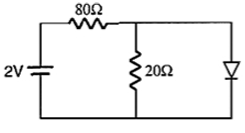
In the circuit shown, the current through the ideal diode is:
Image
Answer
(c) 25 mA
Explanation: The given diode is ideal and forward-biased so there is short circuit. No current flow through the $20 \Omega$ and whole current flow through the short circuit. The current flow through the circuit is, $I =\frac{2 V}{80 \Omega}=25 mA$
View full question & answer
Question 31 Mark
When $10^{19}$ electrons are removed from a neutral metal plate, the electric charge on it is
Answer
(c) +1.6 C
Explanation: $q = ne =10^{19} \times 1.6 \times 10^{-19} C =+1.6 C$.

View full question & answer
Question 41 Mark
A bar $-$ magnet of the pole-strength $2 Amp - m$ is kept in a magnetic field of induction $4 \times 10^{-5} Wb / m ^2$ such that the axis of the magnet makes an angle $30^{\circ}$ with the direction of the field. If the couple acting on the magnet is found to be $80 \times 10^{-7} Nm$, then the distance between the poles of the magnet is:
Answer
$(a) \ 20cm$
Explanation:
$\tau=q_m \times 2 l \times B \sin \theta$
$\therefore 2 l=\frac{\tau}{q_m \times B \sin \theta}$
$=\frac{80 \times 10^{-7}}{2 \times 4 \times 10^{-5} \times \sin 30^{\circ}}$
$=0.20 m$
​​​​​​​$=20 \ cm$
 
View full question & answer
Question 51 Mark
The minimum distance between an object and its real image formed by a convex lens of focal length f is:
Answer
(a) 4f
Explanation: 4f
View full question & answer
Question 61 Mark
Phase difference between any two points of a wavefront is
Answer
(b) $0$
Explanation: Wavefront is the locus of all points those are in same phase.

View full question & answer
Question 71 Mark
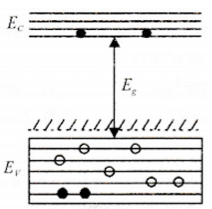
In the energy band diagram of a material as given below, the open circles and filled circles denote holes and electrons respectively. The material is a/an
Image
Answer
(c) p-type semiconductor
Explanation: One can see in the figure that number of holes are greater than number of electrons. Hence it is p−type semi conductor.
View full question & answer
Question 81 Mark
A bar magnet having a magnetic moment of $2 \times 10^4 JT ^{-1}$ is free to rotate in a horizontal plane. A horizontal magnetic field $B =6 \times 10^{-4} T$ exists in the space. The work done in taking the magnet slowly from a direction
Answer
(d) 6 J
Explanation: $W =m B\left(\cos \theta_1-\cos \theta_2\right)$
$=2 \times 10^4 \times 6 \times 10^{-4}\left(\cos 0^{\circ}-\cos 60^{\circ}\right)=6 J$

View full question & answer
Question 91 Mark
For a glass prism, the angle of minimum deviation will be smallest for the light of
Answer
(d) red colour.
Explanation: For a glass prism, the angle of minimum deviation will be smallest for the light of red color. As wavelength of red color is maximum among all, hence, $\mu \propto \frac{1}{\lambda}$, hence $\mu$ is smaller. As $\mu$ decreases, angle of deviation decreases.
View full question & answer
Question 101 Mark
An electron with velocity $\vec{v}=\left(v_x \hat{i}+v_y \hat{j}\right)$ moves through a magnetic field $\vec{B}=\left(B_x \hat{i}-B_y \hat{j}\right)$. The force $\overrightarrow{ F }$ on the electron is: ( e is the magnitude of its charge)
Answer
(d) $e\left(v_x B_y+v_y B_x\right) \hat{k}$
Explanation: $e\left(v_x B_y+v_y B_x\right) \hat{k}$
The force is given as $- e ( v \times B )$.
View full question & answer
Question 111 Mark
$m ^2 V^{-1} s^{-1}$ is the SI unit of which of the following?
Answer
(b) Mobility
Explanation: The charge carrier in most metals is the negatively charged electron. The mobility of the charge carrier is defined as the drift velocity of the charge carrier per unit electric field. It is denoted by $\mu$ and $\mu=v_d / E$ is given as. The Sl unit of $\mu$ is $m 2 V-1 s-1$.
View full question & answer
Question 121 Mark
A proton is about 1840 times heavier than an electron. When it is accelerated by a potential difference of 1 kV, its kinetic energy will be:
Answer
(c) 1 keV
Explanation: K.E. gained $= qV = e \times 1 kV =1 keV$
View full question & answer