Question
An element X which is a yellow solid at room temperature shows catenation and allotropy. X forms two oxides which are also formed during the thermal decomposition of ferrous sulphate crystals and are the major air pollutants.
  1. Identify the element X.
  2. Write the electronic configuration of X.
  3. Write the balanced chemical equation for the thermal decomposition of ferrous sulphate crystals?
  4. What would be the nature (acidic/ basic) of oxides formed?
  5. Locate the position of the element in the Modern Periodic Table.
Answer

  1. The available information suggests that the element X is sulphur.
  2. Electronic configuration of S(Z = 16) 2, 8, 6.
  3. $2\text{FeSO}_4.7\text{H}_2\text{O(s)}\xrightarrow{\ \ \ \text{heat}\ \ \ }\text{Fe}_2\text{O}_3(\text{s})+\text{SO}_2(\text{g})+\text{SO}_3(\text{g})+7\text{H}_2\text{O(g)}$
  4. $Fe _2 O _3$ (basic oxide), $SO _2$ (acidic oxide), $SO _3$ (acidic oxide).
  5. Sulphur is a member of group 16 and period 3.

Need a full question paper?

Generate a complete, print-ready paper with questions like this in minutes — across 16+ boards, with answer keys.

Start Generating Free

Similar questions

On heating blue coloured powder of copper (II) nitrate in a boiling tube, copper oxide (black), oxygen gas and a brown gas X is formed.
  1. Write a balanced chemical equation of the reaction.
  2. Identity the brown gas X evolved.
  3. Identity the type of reaction.
  4. What could be the pH range of aqueous solution of the gas X?
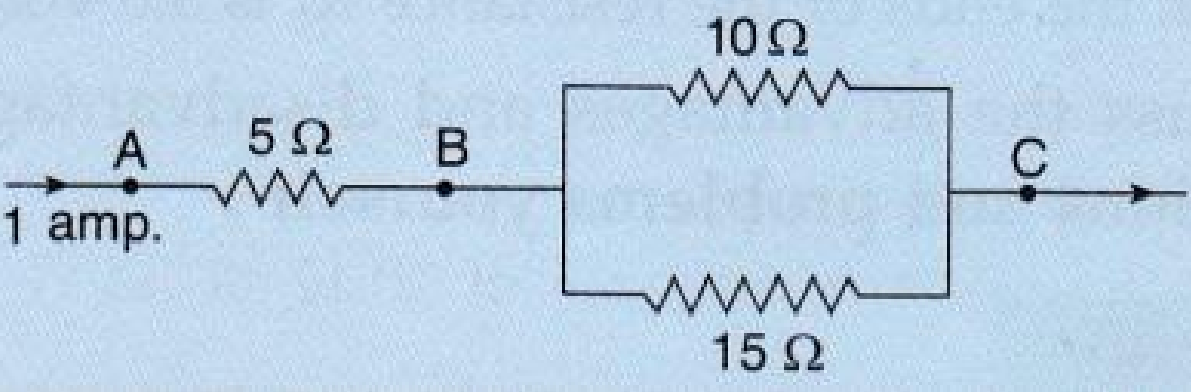
Three resistors are connected as shown in the diagram.

Through the resistor 5 ohm, a current of 1 ampere is flowing,
  1. What is the current through the other two resistors?
  2. What is the p.d. across AB and across AC?
  3. What is the total resistance?
If the teeth are not cleaned regularly, they become covered with a sticky yellowish layer W of food particles and bacteria. Since layer W covers the teeth, the alkaline liquid X secreted by glands Y inside the mouth cannot reach the teeth surface to neutralise the acid formed by the action of organisms Z on sugary food, and hence tooth decay sets in.
  1. What is W known as?
  2. What is (i) X, and (ii) Y?
  3. What are organisms Z?
  4. State one way of removing layer W from the teeth.
Mendeleev predicted the existence of certain elements not known at that time and named two of them as eka - aluminium, and eka - silicon.
  1. Name the element which has taken the place of (i) eka - aluminium, and (ii) eka - silicon.
  2. Mention the period/ periods of these elements in the modern periodic table.
  3. Write the group/ groups of these elements in the modern periodic table.
  4. Classify these elements as metals, non - metals or metalloids.
  5. How many valence electrons are present in the atoms of each of these elements?​​​​​​
If the teeth are not cleaned regularly, they become covered with a sticky yellowish layer W of food particles and bacteria. Since layer W covers the teeth, the alkaline liquid X secreted by glands Y inside the mouth cannot reach the teeth surface to neutralise the acid formed by the action of organisms Z on sugary food, and hence tooth decay sets in.
  1. What is W known as?
  2. What is (i) X, and (ii) Y?
  3. What are organisms Z?
  4. State one way of removing layer W from the teeth.
When a fertilised egg E formed in the oviduct of a human female divides repeatedly to form an embryo, the embryo gets implanted in the thick and soft lining of the uterus. After this a disc-like special tissue T develops between the uterus wall and embryo through which all the requirements of the developing embryo (and foetus) are met from the mother's body, The embryo is connected to the tissue T through a string like structure S.
  1. What is the other name of fertilised egg cell E?
  2. What is the name of tissue T?
  3. Name the string-like structure S.
  4. Name two substances which pass from mother's blood to embryo through tissue T and, one type of substance which passes from embryo to mother's blood.
  5. What happens to S when the baby is born? Why?
Consider the following organic compounds:
$CH _3 OH , C _2 H _5 OH , CH _3 COCH _3, CH _3 COOH , C _2 H _5 COOH , C _4 H _9 COOC _2 H _5, CH _4, C _2 H _6, CH _3 CHO , HCHO$
Out of these compounds:
a. Which compound is most likely to be sweet-smelling?
b. Which compound on treatment with conc. $H _2 SO _4$ at $170^{\circ} C$ forms an alkene?
c. Which compound on repeated chlorination forms chloroform?
d. Which compound is added to alcohol to denature it?
e. Which compound is a constituent of vinegar?
f. Which compound is used to sterilise wounds and syringes?
What are the main uses of coal and petroleum products?
An animal (guinea pig) having black colour is crossed with guinea pig having the same colour.
They produced 100 offsprings, of which 75 were black and 25 were white.
Find out
  1. What is the possible genotype?
  2. Which trait is dominant and which is recessive?
Solution A turns universal indicator blue to purple whereas solution B turns universal indicator orange to red.
  1. What will be the action of solution A on litmus?
  2. What will be action of solution B on litmus?
  3. Name any two substances which can give solutions like A.
  4. Name any two substances which can give solutions like B.
  5. What sort of reaction takes place when solution A reacts with solution B?