MCQ
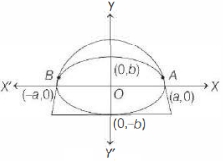
An ellipse inscribed in a semi-circle touches the circular arc at two distinct points and also touches the bounding diameter. Its major axis is parallel to the bounding diameter. When the ellipse has the maximum possible area, its eccentricity is
  • A
    $\cdot \frac{1}{\sqrt{2}}$
  • B
    $\frac{1}{2}$
  • C
    $.. \frac{1}{\sqrt{3}}$
  • $\sqrt{\frac{2}{3}}$

Answer

Correct option: D.
$\sqrt{\frac{2}{3}}$
d
(d)

Let equation of ellipse is

$\frac{x^2}{a^2}+\frac{y^2}{b^2}=1$

$\therefore$ Equation of circle is

$x^2+(y+b)^2=r^2$

Put $x^2=a^2-\frac{a^2 y^2}{b^2}$ in circle

$a^2-\frac{a^2 y^2}{b^2}+(y+b)^2=r^2$

$\Rightarrow\left(1-\frac{a^2}{b^2}\right) y^2+2 b y+\left(a^2+b^2-r^2\right)=0$

$D=0 \Rightarrow r^2=\frac{a^4}{a^2-b^2} \Rightarrow b=a \sqrt{1-\frac{a^2}{r^2}}$

Area of ellipse $=\pi a b$

$A=\pi a^2 \sqrt{1-\frac{a^2}{r^2}}$

$\frac{d A}{d a}=0 \Rightarrow a^2=\frac{2 r^2}{3} \Rightarrow a=\sqrt{\frac{2}{3} r}$

$\therefore \quad b=a \sqrt{1-\frac{2}{3}}=\frac{a}{\sqrt{3}}$

$\Rightarrow \quad e=\sqrt{1-\frac{b^2}{a^2}}=\sqrt{1-\frac{1}{3}}=\sqrt{\frac{2}{3}}$

Need a full question paper?

Generate a complete, print-ready paper with questions like this in minutes — across 16+ boards, with answer keys.

Start Generating Free