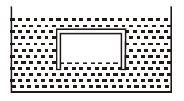
An empty glass jar is submerged in tank of water with open mouth of the jar downwards, so that air inside the jar is trapped and cannot get out. As the jar is pushed down slowly, the magnitude of net buoyant force on the system of volume of gas trapped in the jar and the jar
Medium


Download our appand get started for free
Experience the future of education. Simply download our apps or reach out to us for more information. Let's shape the future of learning together!No signup needed.*
Similar Questions
- 1A wooden block floats in a liquid with $40\%$ of its volume inside the liquid. When the vessel containing he liquid starts rising upwards with acceleration $a = g/2$, the percentage of volume inside the liquid is ......... $\%$View Solution
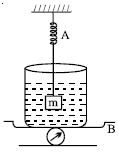
- 2The spring balance $A$ reads $2$ $kg$ with a block $m $ suspended from it. $A$ balance $B$ reads $5$ $kg$ when a beaker with liquid is put on the pan of the balance. The two balances are now so arranged that the hanging mass is inside the liquid in the beaker as shown in the figure in this situation:View Solution
- 3A tank $5\, m$ high is half-filled with water and then is filled to the top with oil of density $0.85\, g/cm^3$. The pressure at the bottom of the tank, due to these liquids is ....... $g\, dyne/cm^2$View Solution
- 4A $U-$tube contains water and methylated spirit separated by mercury. The mercury columns in the two arms are in level with $10.0\; cm$ of water in one arm and $12.5\; cm $ of spirit in the other. if $15.0\; cm$ of water and spirit each are further poured into the respective arms of the tube, what is the difference in the levels (in $cm$) of mercury in the two arms?View Solution
(the specific gravity of spirit is $0.8.)$
- 5View SolutionA liquid disturbed by stirring comes to rest after some time due to its property of
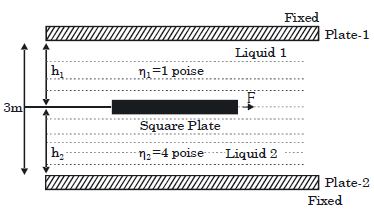
- 6A thin square plate of side $2\ m$ is moving at the interface of two very viscous liquids of viscosities ${\eta _1} = 1$ poise and ${\eta _2} = 4$ poise respectively as shown in the figure. Assume a linear velocity distribution in each fluid. The liquids are contained between two fixed plates. $h_1 + h_2 = 3\ m$ . A force $F$ is required to move the square plate with uniform velocity $10\ m/s$ horizontally then the value of minimum applied force will be ........ $N$View Solution
- 7Two identical cylindrical vessels are kept on the ground and each contain the same liquid of density $d.$ The area of the base of both vessels is $S$ but the height of liquid in one vessel is $x_{1}$ and in the other, $x_{2}$. When both cylinders are connected through a pipe of negligible volume very close to the bottom, the liquid flows from one vessel to the other until it comes to equilibrium at a new height. The change in energy of the system in the process isView Solution
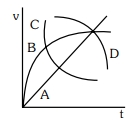
- 8A spherical ball is dropped in a long column of a highly viscous liquid. The curve in the graph shown, which represents the speed of the ball $(v)$ as a function of time $(t)$ isView Solution
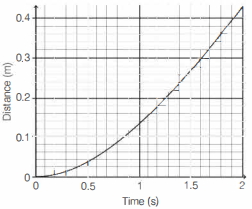
- 9A steel ball is dropped in a viscous liquid. The distance of the steel ball from the top of the liquid is shown below. The terminal velocity of the ball is closest to .......... $m/s$View Solution
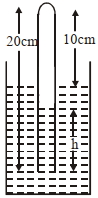
- 10A $20 \,cm$ long tube is closed at one end. It is held vertically, and its open end is dipped in water until only half of it is outside the water surface. Consequently, water rises in it by height $h$ as shown in the figure. The value of $h$ is closest to .............. $\,m / s$ (assume that the temperature remains constant, $P _{\text {armosphere }}=10^5 \,N / m ^2$, density. of water $=10^3 \,kg / m ^3$, and acceleration due to gravity $g =10 \,m / s ^2$ )View Solution