MCQ
An example of a perfect diamagnet is a superconductor. This implies that when a superconductor is put in a magnetic field of intensity $B$, the magnetic field $B_s$ inside the superconductor will be such that
  • A
    $B_s\, =-B$
  • $B_s\, =0$
  • C
    $B_s\, = B$
  • D
    $B_s\, < B$ but $B_s \ne 0$

Answer

Correct option: B.
$B_s\, =0$
b
Magnetic field inside the superconductor is zero . Diamagnetic substances are repelled in external magnetic field

Need a full question paper?

Generate a complete, print-ready paper with questions like this in minutes — across 16+ boards, with answer keys.

Start Generating Free

Similar questions

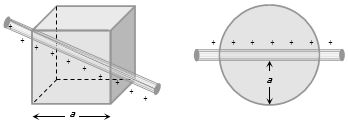
A linear charge having linear charge density $\lambda$ , penetrates a cube diagonally and then it penetrate a sphere diametrically as shown. What will be the ratio of flux coming cut of cube and sphere
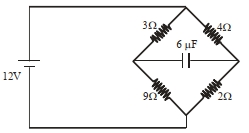
In the circuit shown, the energy stored in the capacitor is $n\,\mu J$. The value of $n$ is ..............
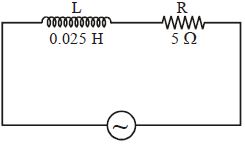
For the $L -R$ circuit shown in figure the phase angle......$^o$  if frequency is $f = 100/\pi $
A bar magnet of magnetic moment $m$ when kept in a maenetic field of intensity $\vec{B}$ experiences a torgue:
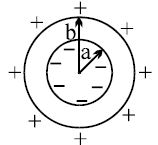
An empty thick conducting shell of inner radius $a$ and outer radius $b$ is shown in figure.If it is observed that the inner face of the shell carries a uniform charge density $-\sigma$ and the surface carries a uniform charge density $ '\sigma '$

If the charge $q_A$ is slowly moved inside the shell, then choose the statement$(s)$

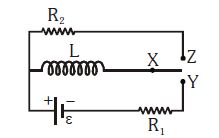
In the circuit shown, $X$ is joined to $Y$ for a longmtime, and then $X$ is joined to $Z$. The total heat produced in $R_2$ is 
A cube of side l is placed in a uniform field E, where E = E$\hat{l}$. The net electric flux through the cube is 
Which of the following statement is $NOT$ correct ?
A beam with wavelength $\lambda$ falls on a stack of partially reflecting planes with separation d . The angle q that the beam should make with the planes so that the beams reflected from successive planes may interfere constructively is (where $n =1,2, \ldots \ldots$ )
A charge $Q$ is uniformly distributed over a large plastic plate. The electric field at a point $P$ close to the centre of the plate is $10 Vm ^{-1}$. If the plastic plate is replaced by a copper plate of the same geometrical dimensions and carrying the same charge $Q$, the electric field at the point $P$ will become: