MCQ
An example of non-reducing sugar is
  • Cane sugar
  • B
    Fructose
  • C
    Lactose
  • D
    Cellobiose

Answer

Correct option: A.
Cane sugar
a
There is no free aldehydic group present in cane sugar.Due to glycosidic linkage, the aldehydic group is no more free. While in others, there is a free aldehydic/ketonic group present. Even if ketonic group is present, it isomerizes to aldehydic group. So, cane sugar is a non reducing sugar.Note: Sucrose and cane sugar are one and the same.

Need a full question paper?

Generate a complete, print-ready paper with questions like this in minutes — across 16+ boards, with answer keys.

Start Generating Free

Similar questions

Among the following compounds, the most acidic is
In Tollen's test for aldehyde, the overall number of electron(s) transferred to the Tollen's reagent formula $\left[ Ag \left( NH _{3}\right)_{2}\right]^{+}$ per aldehyde group to form silver mirror is $......$. (Round off to the Nearest integer)
A solution of methyl amine
The compound formed by the acetylation of salicylic acid is
Calculate solubility (in moles/litre) of a saturated aqueous solution of $Ag_3PO_4$ if the vapour pressure of the solution becomes $750\ torr$ at $373\ K$
Splitting a compound using electricity is called:
The freezing point of a solution prepared from $1.25\,gm$ of a non-electrolyte and $20\,gm$ of water is $271.9\,K$. If molar depression constant is $1.86K\,mol{e^{ - 1}}$, then molar mass of the solute will be
Which of the following has the smell of bitter almonds
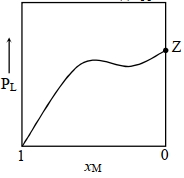
For a solution formed by mixing liquids $L$ and $M$, the vapour pressure of $L$ plotted against the mole fraction of $M$ in solution is shown in the following figure. Here $x_{L}$ and $x_M$ represent mole fractions of $L$ and $M$, respectively, in the solution. The correct statement(s) applicable to this system is(are)

(image)

$[A]$ Attractive intermolecular interactions between $L-L$ in pure liquid $L$ and $M-M$ in pure liquid $M$ are stronger than those between $L-M$ when mixed in solution

$[B]$ The point $Z$ represents vapour pressure of pure liquid $M$ and Raoult's law is obeyed when $x_{L} \rightarrow 0$

$[C]$ The point $Z$ represents vapour pressure of pure liquid $L$ and Raoult's law is obeyed when $x_{\mathrm{L}} \rightarrow 1$

$[D]$ The point $Z$ represents vapour pressure of pure liquid $M$ and Raoult's law is obeyed from $x_{L}=0$ to $x_{L}=1$
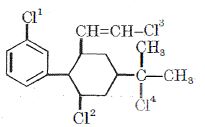
Which $Cl$ is most suscepetible to be attacked by aqueous $KOH$