Question
An experiment measured quantities a, b, c and then x is calculated by using the relation $\text{x}=\frac{\text{ab}^2}{\text{c}^3}$ If the percentage errors in measurements of a, b and care $\pm1\%, \pm2\% \text{ and } \pm 1.5\%$ respectively, then calculate the maximum percentage error in value of x obtained.
Answer

Given: $\text{x}=\frac{\text{ab}^2}{\text{c}^3}$ $\therefore\Big(\frac{\Delta​​\text{x}}{\text{x}}\Big)_{\text{max}}=\frac{\Delta\text{a}}{\text{a}}+2\frac{\Delta\text{b}}{\text{b}}+3\frac{\Delta\text{c}}{\text{c}}$ But $\frac{\Delta\text{a}}{\text{a}}=\pm1\%,\frac{\Delta\text{b}}{\text{b}}=\pm2\%$ And $\frac{\Delta\text{c}}{\text{c}}=\pm1.5\%$ $\therefore\Big(\frac{\Delta\text{x}}{\text{x}}\Big)_{\text{max}}=1\%+2\times2\%+3\times1.5\%$ $=(1+4+4.5)\%=9.5\%$

Need a full question paper?

Generate a complete, print-ready paper with questions like this in minutes — across 16+ boards, with answer keys.

Start Generating Free

Similar questions

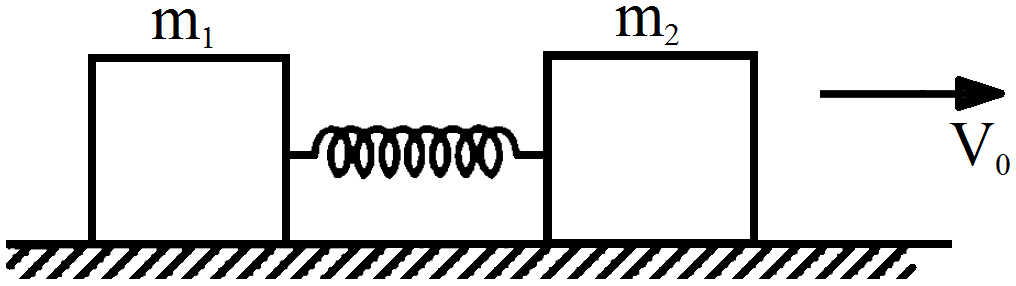
Two blocks of masses $m_1$ and $m_2$ are connected by a spring of spring constant $k.$ The block of mass $m_2$ is given a sharp impulse so that it acquires a velocity $v_0$ towards right. Find
  1. The velocity of the centre of mass.
  2. The maximum elongation that the spring will suffer.
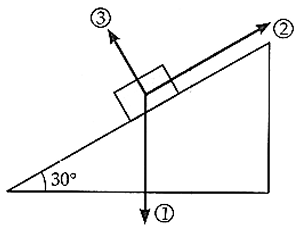
A block of wood of mass 3 kg is resting on the surface of a rough inclined surface, inclined at an angle $\theta$ as shown in the figure.
Image
a. Name the forces $(1,2,3)$.
b. If the coefficient of static friction is 0.2 , calculate the value of all three forces.
$
\text { (use } g=10 m / s^2 \text { ) }
$
The luminous flux of a 1W sodium vapour lamp is more than that of a 10kW source of ultraviolet radiation. Comment.
The density of water is 1000 $kg m ^{-3}$. The density of water vapour at $100^{\circ} C$ and $1 atm$ pressure is $0.6 kg m ^{-3}$. The volume of a molecule multiplied by the total number gives , what is called, molecular volume. The ratio (or fraction) of the molecular volume to the total volume occupied by the water vapour under the above conditions of temperature and pressure is $6 \times 10^{-4}$. Estimate the volume of a water molecule using this data.
A man can swim at the rate of $5km/ h$ in still water. A river $1km$ wide flows at the rate of $3km/ h$. A swimmer wishes to cross the river straight.
  1. Along what direction must he strike?
  2. What should be his resultant velocity?
  3. How much time he would take to cross?
A solid sphere of mass $0.1kg$ and radius $2.5cm$ rolls without sliding with a uniform velocity of $0.1ms^{-1}$ along a straight line on a smooth horizontal table. Find its total energy.
Average lifetime of a hydrogen atom excited to $n = 2$ state is $10^{-8}s$. Find the number of revolutions made by the electron on the average before it jumps to the ground state.
A wheel starting from rest is uniformly accelerated at $4 rad/-s^2$ for $10$ seconds.It is allowed to rotate uniformly for the next $10$ seconds and is finally brought to rest in the next 10 seconds. Find the total angle rotated by the wheel.
When you lift a box from the floor and put it on an almirah the potential energy of the box increases, but there is no change in its kinetic energy. Is it a violation of conservation of energy?
The gravitational force between two bodies each of mass m and separated by a distance r varies as inversely proportional to the square of the distance r. However, the gravitational force between two solid spheres of same density and same radius r placed in contact with each other is directly proportional to the fourth power of the radius r. Prove it.