MCQ
An ice block is melting at a constant rate $\left| {\,\frac{{dm}}{{dt}}\,} \right|= \mu$ . Its initial mass is $m_0$ and it is moving with velocity on a frictionless horizontal surface. The distance travelled by it till it melts completely is :
  • A
    $\frac{{2{m_0}v}}{\mu }$
  • $\frac{{{m_0}v}}{\mu }$
  • C
    $\frac{{{m_0}v}}{{2\mu }}$
  • D
    can’t be said

Answer

Correct option: B.
$\frac{{{m_0}v}}{\mu }$
b
$P i=m_{0} v$

$\left(x=\frac{m_{0} v}{\mu}\right)$

Need a full question paper?

Generate a complete, print-ready paper with questions like this in minutes — across 16+ boards, with answer keys.

Start Generating Free

Similar questions

A wave equation which gives the displacement along $y-$direction is given by $y = 0.001\sin (100t + x)$ where $x$ and $y$ are in meterand t is time in second. This represented a wave
The potential energy of a particle of mass $5kg$ moving in the $XY$ plane is given by $V= -7x+24y$ joules, $x$ and $y$ being in metres. Initially at $t=0$ the particle is at the origin $(0,0)$ moving with $a$ velocity of $6[ \hat i (2.4)+ \hat j (0.7)] m/s$. Then
In a one-dimensional collision between two particles, their relative velocity is ${\vec v_1}$ before the collision and ${\vec v_2}$ after the collision
A bullet is shot vertically downwards with an initial velocity of $100\,m / s$ from a certain height. Within $10\,s$, the bullet reaches the ground and instantaneously comes to rest due to the perfectly inelastic collision. The velocity-time curve for total time $t =20\,s$ will be. $\left(\right.$ Take $g =10 m / s ^{2}$ )
A solid cylinder $(i)$ rolls down $(ii)$ slides down an inclined plane. The ratio of the accelerations in these conditions 
Let $A$ and $B$ the two gases and given : $\frac{{{T_A}}}{{{M_A}}} = 4.\frac{{{T_B}}}{{{M_B}}};$ where $T$ is the temperature and M is molecular mass. If ${C_A}$ and ${C_B}$ are the $r.m.s. $ speed, then the ratio $\frac{{{C_A}}}{{{C_B}}}$ will be equal to
Change in temperature of the medium changes:
A razor-blade floats on the surface of water contained in a glass. When the glass is gently shaken, the razor-blade sinks. Mark the incorrect statement
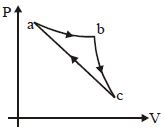
In the $P-V$ diagram shown, the gas does $5\, J$ of work in isothermal process $ab$ and $4\,J$ in adiabatic process $bc$.   .... $J$ will be the change in internal energy of the gas in straight path $c$ to $a$ ?
A sphere of mass $10\; kg$ and radius $0.5\; m$ rotates about a tangent. The moment of inertia of the sphere is