Question
An ideal diode should pass a current freely in one direction and should stop it completely in the opposite direction. Which is closer to ideal-vacuum diode or a p-n junction diode?

Answer

It should be an ideal vacuum diode. When a p-n junction diode is reverse biassed then a small current called reverse current flows across the diode. As the the p‒n junction diode allows some current in reverse biassed condition also so the given diode cannot be a p-n junction diode.

Need a full question paper?

Generate a complete, print-ready paper with questions like this in minutes — across 16+ boards, with answer keys.
Start Generating Free

Similar questions

A piece of wire carrying a current of 6.00A is bent in the form of a circular arc of radius 10.0cm, and it subtends an angle of 120° at the centre. Find the magnetic field B due to this piece of wire at the centre.
A beam of light having wavelengths distributed uniformly between 450nm to 550nm passes through a sample of hydrogen gas. Which wavelength will have the least intensity in the transmitted beam?
Two equal charges are placed at a separation of 1.0m. What should be the magnitude of the charges so that the force between them equals the weight of a 50kg person?
Suppose the rod in the previous problem has a mass of 1kg distributed uniformly over its length:
  1. Find the initial angular acceleration of the rod.
  2. Find the tension in the supports to the blocks of mass 2kg and 5kg.
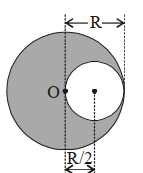
A sphere of radius $R$ has been cut out of $\left(\frac{R}{2}\right)$ solid sphere of radius $R$ as shown in the figure. Find the position of the center of mass of the remaining sphere.
Image
A player throws a ball upwards with an initial speed of 29.4m s–1.
Choose the x = 0m and t = 0s to be the location and time of the ball at its highest point, vertically downward direction to be the positive direction of x-axis, and give the signs of position, velocity and acceleration of the ball during its upward, and downward motion.
A uniform rod of mass 300g and length 50cm rotates at a uniform angular speed of 2rad/s about an axis perpendicular to the rod through an end. Calculate:
  1. The angular momentum of the rod about the axis of rotation.
  2. The speed of the centre of the rod.
  3. Its kinetic energy.
A constant force of 2.50N accelerates a stationary particle of mass 15g through a displacement of 2.50m. Find the work done and the average power delivered.
A pendulum having a bob of mass m is hanging in a ship sailing along the equator from east to west. When the ship is stationary with respect to water the tension in the string is T0.
  1. Find the speed of the ship due to rotation of the earth about its axis.
  2. Find the difference between T0 and the earth's attraction on the bob.
  3. If the ship sails at speed v, what is the tension in the string? Angular speed of earth's rotation is $\omega$ and radius of the earth is R.
Compare the velocities of sound in hydrogen (H2) and carbon dioxide (CO2). The ratio $(\gamma)$ of specific heats of H2 and CO2 are respectively 1.4 and 1.3.