Question types

Semiconductors and Semiconductor Devices question types

71 questions across 5 question groups — pick any mix to generate a Physics paper with step-by-step answer keys.

71
Questions
5
Question groups
5
Question types
Sample Questions

Semiconductors and Semiconductor Devices questions

One sample from each question group in this chapter. Select any group above to see the full set with answer keys.
Electric conduction in a semiconductor takes place due to:
  1. Electrons only.
  2. Holes only.
  3. Both electrons and holes.
  4. Neither electrons nor holes.
View full solution
Diffusion current in a p-n junction is greater than the drift current in magnitude:
  1. If the junction is forward-biased.
  2. If the junction is reverse-biased.
  3. If the junction is unbiased.
  4. In no case.
View full solution
In a p-n junction:
  1. New holes and conduction electrons are produced continuously throughout the material.
  2. New holes and conduction electrons are produced continuously throughout the material except in the depletion region.
  3. Holes and conduction electrons recombine continuously throughout the material.
  4. Holes and conduction electrons recombine continuously throughout the material except in the depletion region.
View full solution
The diffusion current in a p-n junction is:
  1. From the n-side to the p-side.
  2. From the p-side to the n-side.
  3. From the n-side to the p-side if the junction is forward-biased and in the opposite direction if it is reverse-biased.
  4. From the p-side to the n-side if the junction is forward-biased and in the opposite direction if it is reverse-biased.
View full solution
A semiconductor is doped with a donor impurity:
  1. The hole concentration increases.
  2. The hole concentration decreases.
  3. The electron concentration increases.
  4. The electron concentration decreases.
View full solution
An incomplete sentence about transistors is given below:
The emitter ...... junction is ....... and the collector ..... junction is ..... The appropriate words for the dotted empty positions are, respectively.
  1. 'Collector' and 'base'.
  2. 'Base' and 'emitter'.
  3. 'Collector' and 'emitter'.
  4. 'Base' and 'base'.
View full solution
When a semiconducting material is doped with an impurity, new acceptor levels are created. In a particular thermal collision, a valence electron receives an energy equal to 2kT and just reaches one of the acceptor levels. Assuming that the energy of the electron was at the top edge of the valence band and that the temperature T is equal to 300K, find the energy of the acceptor levels above the valence band.
View full solution
When a p-type impurity is doped in a semiconductor, a large number of holes are created. This does not make the semiconductor charged. But when holes diffluse from the p-side to the n-side in a p-n junction, the n-side gets positively charged. Explain.
View full solution
In a transistor:
  1. The emitter has the least concentration of impurity.
  2. The collector has the least concentration of impurity.
  3. The base has the least concentration of impurity.
  4. All the three regions have equal concentrations of impurity.
View full solution
The drift current in a p-n junction is $20.0\mu\text{A}.$ Estimate the number of electrons crossing a cross-section per second in the depletion region.
View full solution
Each of the resistances shown in figure. has a value of $20\Omega.$ Find the equivalent resistance between A and B. Does it depend on whether the point A or B is at higher potential?

View full solution
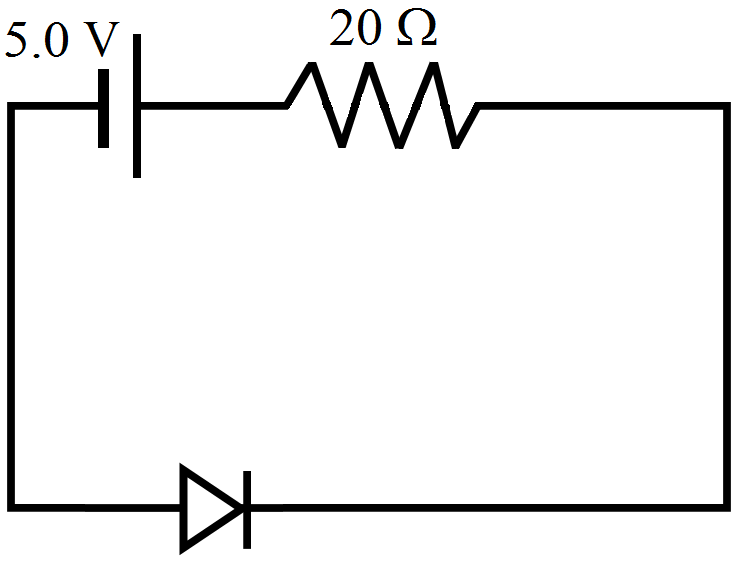
Calculate the current through the circuit and the potential difference across the diode shown in figure. The drift current for the diode is $20\mu\text{A}.$

View full solution
Suppose the energy liberated in the recombination of a hole-electron pair is converted into electromagnetic radiation. If the maximum wavelength emitted is 820nm, what is the band gap?
View full solution
Q 153 Marks Question3 Marks
Let AE denote the energy gap between the valence band and the conduction band. The population of conduction electrons (and of the holes) is roughly proportional to $\text{e}^{\frac{-\Delta\text{E}}{2\text{kT}}}.$ Find the ratio of the concentration of condu.ction electrons in diamond to that in silicon at room temperature 300K. $\Delta\text{E}$ for silicon is 1.1eV and for diamond is 6.0eV. How many conduction electrons are likely to be in one cubic metre of diamond?
View full solution
Q 173 Marks Question3 Marks
A semiconducting material has a band gap of 1eV. Acceptor impurities are doped into it which create acceptor levels 1meV above the valence band. Assume that the transition from one energy level to the other is almost forbidden if kT is less than $\frac{1}{50}$ of the energy gap. Also, if kT is more than twice the gap, the upper levels have maximum population. The temperature of the semiconductor is increased from 0K. The concentration of the holes increases with temperature and after a certain temperature it becomes approximately constant. As the temperature is further increased, the hole concentration again starts increasing at a certain temperature. Find the order of the temperature range in which the hole concentration remains approximately constant.
View full solution
Q 183 Marks Question3 Marks
An ideal diode should pass a current freely in one direction and should stop it completely in the opposite direction. Which is closer to ideal-vacuum diode or a p-n junction diode?
View full solution
Q 193 Marks Question3 Marks
The conductivity of a pure semiconductor is roughly proportional to $\text{T}^\frac{3}{2}\text{e}^{\frac{-\Delta\text{E}}{2\text{kT}}}$ where $\Delta\text{E}$ is the band gap. The band gap for germanium is 0.74eV at 4K and 0.67eV at 300K. By what factor does the conductivity of pure germanium increase as the temperature is raised from 4K to 300K?
View full solution
A load resistor of $2\text{k}\Omega$ is connected in the collector branch of an amplifier circuit using a transistor in common-emitter mode. The current gain $\beta=50.$ The input resistance of the transistor is $0.50\text{k}\Omega.$ If the input current is changed by $50\mu\text{A}.$
  1. By what amount does the output voltage change?
  2. By what amount does the input voltage change?
  3. What is the power gain?
View full solution
Let $\text{X}=\overline{\text{ABC}}+\overline{\text{BCA}}+\overline{\text{CAB}}.$ Evaluate X for:

  1. $\text{A}=1,\text{B}=0,\text{C}=1$

  2. $\text{A}=\text{B}=\text{C}=1$

  3. $\text{A}=\text{B}=\text{C}=0$

View full solution
The conductivity of an intrinsic samiconductor depends on temperature as $\sigma=\sigma_0\text{ e}^{\frac{-\Delta\text{E}}{2\text{kT}}}$ where $\sigma_0$ is a constant. Find the temperature at which the conductivity pf an intrinsic germanium semiconductor will be double of its value at T = 300K. Assume that the gap for germanium is 0.650eV and remains constant as the temperature is increased.
View full solution
The current−voltage characteristic of an ideal p-n junction diode is given by $\text{i}=\text{i}_0\Big(\text{e}^{\frac{\text{eV}}{\text{kT}}}-1\Big)$ where, the drift current i0 equals $10\mu\text{A}.$ Take the temperature T to be 300K.
  1. Find the voltage V0 for which $\text{e}^{\frac{\text{eV}}{\text{KT}}}=100.$ One can neglect the term 1 for voltages greater than this value.
  2. Find an expression for the dynamic resistance of the diode as a function of V for V > V0.
  3. Find the voltage for which the dynamic resistance is $0.2\Omega.$
View full solution

Generate a Semiconductors and Semiconductor Devices paper free

Pick question groups from the list above, set marks and difficulty, and export a branded PDF with step-by-step answer keys. First 3 chapters free — no signup.

Download App