Question
An ideal diode should pass a current freely in one direction and should stop it completely in the opposite direction. Which is closer to ideal-vacuum diode or a p-n junction diode?

Answer

It should be an ideal vacuum diode. When a p-n junction diode is reverse biassed then a small current called reverse current flows across the diode. As the the p‒n junction diode allows some current in reverse biassed condition also so the given diode cannot be a p-n junction diode.

Need a full question paper?

Generate a complete, print-ready paper with questions like this in minutes — across 16+ boards, with answer keys.
Start Generating Free

Similar questions

A pendulum having a bob of mass m is hanging in a ship sailing along the equator from east to west. When the ship is stationary with respect to water the tension in the string is $T_0.$
  1. Find the speed of the ship due to rotation of the earth about its axis.
  2. Find the difference between $T_0$ and the earth's attraction on the bob.
  3. If the ship sails at speed v, what is the tension in the string? Angular speed of earth's rotation is $\omega$ and radius of the earth is R.
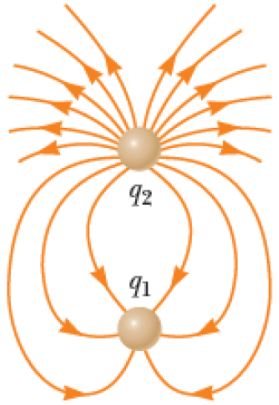
Consider the situation shown in figure. What are the signs of $q_1$ and $q_2?$ If the lines are drawn in proportion to the charge, what is the ratio $\frac{\text{q}_1}{\text{q}_2}?$
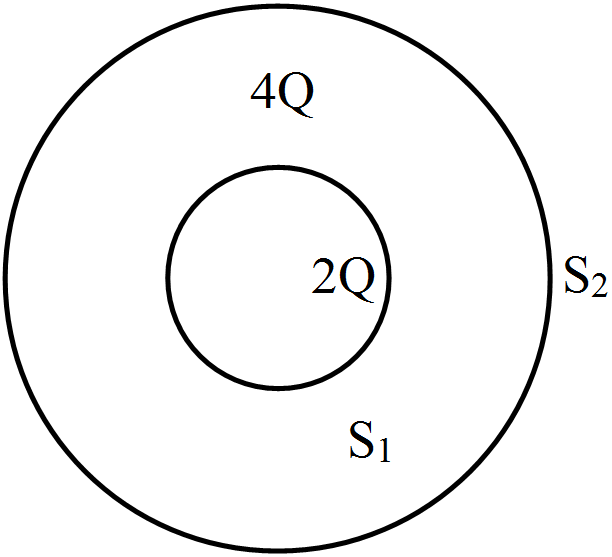
Consider two hollow concentric spheres, $S_1$ and $S_2$, enclosing charges 2Q and 4Q respectively as shown in the figure.
  1. Find out the ratio of the electric flux through them.
  2. How will the electric flux through the sphere $S_1$ change if a medium of dielectric constant $'\in_\text{r}'$ is introduced in the space inside $S_1$ in place of air? Deduce the necessary expression.
  1. Three photo diodes $D_1, D_2$ and $D_3$ are made of semiconductors having band gaps of 2.5eV, 2eV and 3eV respectively. Which of them will not be able to detect light of wavelength 600nm?
  2. Why photodiodes are required to operate in reverse bias? Explain.
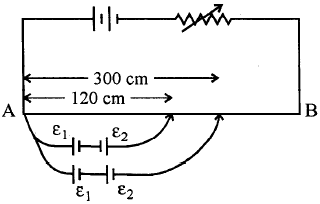
In the figure a long uniform potentiometer wireABis having a constant potential gradient along its length. The null points for the two primary cells of emfs $\varepsilon_{1}$ and $\varepsilon_{2}$
connected in the manner shown are obtained at a distance of 120 cm and 300 cm from the end A. Find (i) $\varepsilon_{1}$/$\varepsilon_{2}$and (ii) position of null point for the cell $\varepsilon_{1}$. How is the sensitivity of a potentiometer increased?
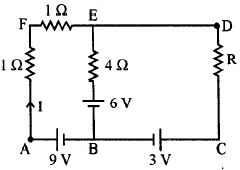
Using Kirchoffs rules determine the value of unknown resistance R in the circuit so that no current flows through 4 $\Omega$ resistance.Also find the potential difference between A and D.
The radionuclide $^{11}C$ decays according to
$^{11}_{6}\text{C}\rightarrow^{11}_{5}\text{B}+\text{e}^{+}+\text{v}:\ \text{T}_{1/2}=20.3 \text{ min}$
The maximum energy of the emitted positron is 0.960 MeV.
Given the mass values:
$\text{m}(^{11}_{6})=10=11.011434\text{ u and m}(^{11}_{6}\text{B})=11.009305\text {u}.$
calculate Q and compare it with the maximum energy of the positron emitted.
What are the advantages of the null-point method in a Wheatstone bridge? What additional measurements would be required to calculate $R_{unknown}$ by any other method?
The potential barrier existing across an unbiased p-n. junction is 0·2 volt. What minimum kinetic energy a hole should have to diffuse from the p-side to the n-side if,
  1. The junction is unbiased.
  2. The junction is forwardbiased at 0.1 volt.
  3. The junction is reverse-biased at 0.1 volt?
A block of mass 30.0kg is being brought down by a chain. If the block acquires a speed of 40.0cm/s in dropping down 2.00m, find the work done by the chain during the process.
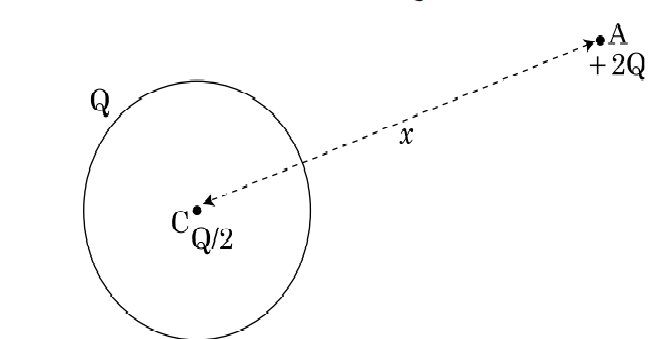
A thin metallic spherical shell of radius R carries a charge Q on its surface. A point charge Q/2 is placed at the centre C, and another charge + 2Q is placed outside the shell at A at a distance x from the centre as shown in the figure.
  1. Find the electric flux through the shell.
  2. State the law used.
  3. Find the force on the charges at the centre C of the shell and at the point A.