Question
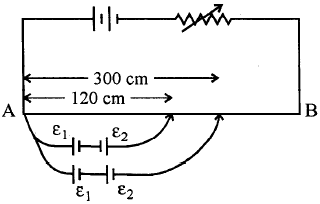
In the figure a long uniform potentiometer wireABis having a constant potential gradient along its length. The null points for the two primary cells of emfs $\varepsilon_{1}$ and $\varepsilon_{2}$
connected in the manner shown are obtained at a distance of 120 cm and 300 cm from the end A. Find (i) $\varepsilon_{1}$/$\varepsilon_{2}$and (ii) position of null point for the cell $\varepsilon_{1}$. How is the sensitivity of a potentiometer increased?
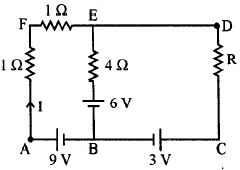
Using Kirchoffs rules determine the value of unknown resistance R in the circuit so that no current flows through 4 $\Omega$ resistance.Also find the potential difference between A and D.
Answer

  1. $\varepsilon_{1} + \varepsilon_{2}$ = 300k (k is potential gradient in volt/cm)
$\varepsilon_{1} - \varepsilon_{2} = 120 \text{k}$
$\Rightarrow\frac{\varepsilon_{1}}{\varepsilon_{2}} = 7 / 3$
  1. $\varepsilon_{1} + \varepsilon_{2} = 300\text{k}$
$\therefore\varepsilon_{1} + \frac{3}{7}\varepsilon_{1} = 300 \text{k}$
$\Rightarrow\varepsilon_{1} = 210 \text{k}$
Therefore, balancing length for cell $\varepsilon_{1}$ is 210cm.
  1. By decreasing potential gradient.
[Or through Increasing length, reducing potential drop across wire, increasing resistance put in series with the main cell etc.]
Alternate Answer
Applying Kirchhoff's Voltage rule
for loop ABEFA
-9 + 6 + 4 x 0 +2 I = 0
2 I – 3 = 0
$\text{I} =\frac{3}{2}\text{A} = 1.5\text{A}$
For loop BCDEB
3 + I R + 4 x 0– 6 = 0
$\therefore\text{IR} = 3 $
Substituting the value of current I,
$\frac{3}{2}\times\text{R} = 3 $
$\therefore\text{R} = 2\Omega$
Potential difference between A & D
Through path ABCD
$+9V – 3V – IR = V_{AD}$
$ + 9 - 3 - \frac{3}{2}\times2 = \text{V}_{AD}$
$\Rightarrow\text{V}_{AD} = 3\text{V}$
Alternate Answer
through path AFD
$\frac{3}{2}\times2 =\text{V}_{AD}$
$\Rightarrow\text{V}_{AD} = 3 \text{V}.$

Need a full question paper?

Generate a complete, print-ready paper with questions like this in minutes — across 16+ boards, with answer keys.

Start Generating Free

Similar questions

A hot gas emits radiation of wavelengths 46.0nm, 82.8nm and 103.5nm only. Assume that the atoms have only two excited states and the difference between consecutive energy levels decreases as energy is increased. Taking the energy of the highest energy state to be zero, find the energies of the ground state and the first excited state.
  1. When an AC source is connected to an ideal capacitor, show that the average power supplied by the source over a complete cycle is zero.
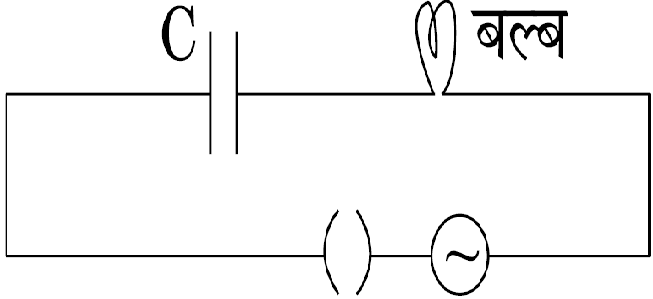
  2. A bulb is connected in series with a variable capacitor and an A.C. source as shown. What happens to the brightness of the bulb when the key is the capacitor is gradually reduced?
A short bar magnet has a magnetic moment of $0.48\ J\ T^{–1}$. Give the direction and magnitude of the magnetic field produced by the magnet at a distance of 10 cm from the centre of the magnet on.(a) the axis, (b) the equatorial lines (normal bisector) of the magnet.
A long, cylindrical tube of inner and outer radii a and b carries a current i distributed uniformly over its cross section. Find the magnitude of the magnetic field at a point (a) just inside the tube (b) just outside the tube.
A body rotating at 20rad/s is acted upon by a constant torque providing it a deceleration of $2rad/s^2.$ At what time will the body have kinetic energy same as the initial value if the torque continues to act?
The weight of an object is more at the poles than at the equator. Is it benificial to purchase goods at equator and sell them at the pole? Does it matter whether a spring balance is used or an equal-beam balance is used?
A square coil of edge l and with n turns carries a current i. It is kept on a smooth horizontal plate. A uniform magnetic field B exists parallel to an edge. The total mass of the coil is M. What should be the minimum value of B for which the coil will start tipping over?
In a hydrogen atom, the electron and proton are bound at a distance of about 0.53 $\mathring{\text{A}}$:
  1. Estimate the potential energy of the system in eV, taking the zero of the potential energy at infinite separation of the electron from proton.
  2. What is the minimum work required to free the electron, given that its kinetic energy in the orbit is half the magnitude of potential energy obtained in (a)?
  3. What are the answers to (a) and (b) above if the zero of potential energy is taken at 1.06 Å separation?
Can two equipotential surfaces cut each other?
A hydrogen atom in ground state absorbs a photon of ultraviolet radiation of wavelength 50nm. Assuming that the entire photon energy is taken up by the electron with what kinetic energy will the electron be ejected?