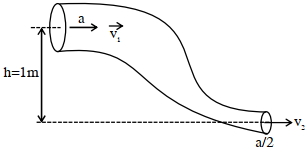
An ideal fluid of density $800 \; kgm ^{-3}$, flows smoothly through a bent pipe (as shown in figure) that tapers in cross-sectional area from $a$ to $\frac{ a }{2}$. The pressure difference between the wide and narrow sections of pipe is $4100 \; Pa$. At wider section, the velocity of fluid is $\frac{\sqrt{x}}{6} \; ms ^{-1}$ for $x = \dots$ $\left(\right.$ Given $g =10 \; m ^{-2}$ )
JEE MAIN 2022, Diffcult
Download our app for free and get started
From continuity equation
$a v _{1}=\frac{ a }{2} v _{2}$
$v _{2}=2 v _{1}$
From Bernoulli's theorem,
$P _{1}+\rho g h_{1}+\frac{1}{2} \rho v _{1}^{2}= P _{2}+\rho g h_{2}+\frac{1}{2} \rho v _{2}^{2}$
$P _{1}- P _{2}=\rho\left[\left(\frac{ v _{2}^{2}- v _{1}^{2}}{2}\right)+ g \left( h _{2}- h _{1}\right)\right]$
$4100=800\left[\left(\frac{4 v _{1}^{2}- v _{1}^{2}}{2}\right)+10 \times(0-1)\right]$
$\frac{41}{8}+10=\frac{3 v _{1}^{2}}{2}$
$\frac{121}{8} \times \frac{2}{3}= v _{1}^{2}$
$v _{1}=\sqrt{\frac{ I 21}{4 \times 3} \times \frac{3}{3}}$
$v _{1}=\frac{\sqrt{363}}{6} \; m / s$
$X =363$

Download our appand get started for free
Experience the future of education. Simply download our apps or reach out to us for more information. Let's shape the future of learning together!No signup needed.*
Similar Questions
- 1A pump draws water from a tank which is at $2.5\; m$ down from outlet and issues it from the end of a hose which the water is drawn. The cross sectional area is $10\; cm ^{2}$, and the water leaves the end of the hose at a speed of $5\; m / s$. What is the rate at which the pump is working ?View Solution
- 2An air bubble of $1\, cm$ radius is rising at a steady rate of $2.00\, mm/sec$ through a liquid of density $1.5\, gm$ per $cm^3$. Neglect density of air. If $g$ is $1000\, cm/sec^2$, then the coefficient of viscosity of the liquid isView Solution
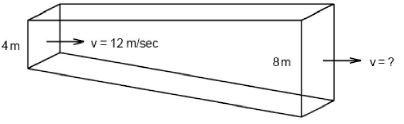
- 3A river gradually deepens, from a depth of $4 \ m$ to a depth of $8\ m$ as shown. The width, $W$, of the river does not change. At the depth of $4 \ m$, the river's speed is $12\ m/sec.$ Its elocity at the $8\ m$ depth is ......... $m/sec$View Solution
- 4A water drop of radius $1\,\mu m$ falls in a situation where the effect of buoyant force is negligible. Coefficient of viscosity of air is $1.8 \times 10^{-5}\,Nsm ^{-2}$ and its density is negligible as compared to that of water $10^{6}\,gm ^{-3}$. Terminal velocity of the water drop is________ $\times 10^{-6}\,ms ^{-1}$View Solution
(Take acceleration due to gravity $=10\,ms ^{-2}$ )
- 5A load of mass $M\,kg$ is suspended from a steel wire of length $2\,m$ and radius $1.0\,mm$ in Searle’s apparatus experiment. The increase in length produced in the wire is $4.0\,mm.$ Now the load is fully immersed in a liquid of relative density $2$. The relative density of the material of load is $8$. The new value of increase in length of the steel wire is ........ $mm$View Solution
- 6View SolutionA liquid is kept in a closed vessel. If a glass plate (negligible mass) with a small hole is kept on top of the liquid surface, then the vapour pressure of the liquid is the vessel is
- 7View SolutionA wooden piece floats half submerged in a tub of water. If the system is transferred to a lift ascending with acceleration the wooden piece will
- 8$Assertion :$ In a pressure cooker the water is brought to boil. The cooker is then remove from the stove. Now on removing the lid of the pressure cooker, the water starts boiling against.View Solution
$Reason :$ The impurities in water bring down its boiling point - 9Two water pipes $P$ and $Q$ having diameter $2 \times 10^{-2} \,m$ and $4 \times 10^{-2} \,m$ respectively are joined in series with the main supply line of water. The velocity of water flowing in pipe $P$ is ........View Solution
- 10A table tennis ball has radius $(3 / 2) \times 10^{-2} m$ and mass $(22 / 7) \times 10^{-3} kg$. It is slowly pushed down into a swimming pool to a depth of $d=0.7 m$ below the water surface and then released from rest. It emerges from the water surface at speed $v$, without getting wet, and rises up to a height $H$. Which of the following option(s) is (are) correct?View Solution
[Given: $\pi=22 / 7, g=10 ms ^{-2}$, density of water $=1 \times 10^3 kg m ^{-3}$, viscosity of water $=1 \times 10^{-3} Pa$-s.]
$(A)$ The work done in pushing the ball to the depth $d$ is $0.077 J$.
$(B)$ If we neglect the viscous force in water, then the speed $v=7 m / s$.
$(C)$ If we neglect the viscous force in water, then the height $H=1.4 m$.
$(D)$ The ratio of the magnitudes of the net force excluding the viscous force to the maximum viscous force in water is $500 / 9$.