A wooden piece floats half submerged in a tub of water. If the system is transferred to a lift ascending with acceleration the wooden piece will
Medium
Download our app for free and get started
As the system will move with an acceleration, $a$ then psuedo force will cause same acceleration, $a$ to both the water and block so no extra force by the block will be applied to water so no more submerging.
So option $\mathrm{C}$ is correct.

Download our appand get started for free
Experience the future of education. Simply download our apps or reach out to us for more information. Let's shape the future of learning together!No signup needed.*
Similar Questions
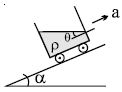
- 1A fluid container is containing a liquid of density $\rho $ is accelerating upward with acceleration a along the inclined place of inclination $\alpha$ as shown. Then the angle of inclination $ \theta $ of free surface is :View Solution
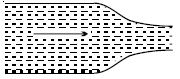
- 2Water flows through a frictionless duct with a cross-section varying as shown in figure. Pressure $p$ at points along the axis is represented byView Solution
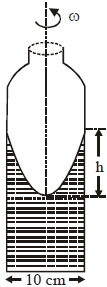
- 3$Assertion :$ The buoyant force on a submerged rigid object can be considered to be acting at the centre of mass of the object.View Solution
$Reason :$ For a rigid body a force field distributed uniformly through its volume can be considered to be acting at the centre of mass of the body. - 4View SolutionIf there were no gravity. which of the following will not be there for a fluid?
- 5A beaker containing a liquid of density $\rho $ moves up with an acceleration $a$ ; the pressure due to the liquid at a depth $h$ below the free surface of the liquid isView Solution
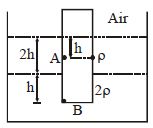
- 6A cylinder stands vertical in two immiscible liquids of densities $\rho$ and $2 \rho$. The height of two liquids are shown. Find the difference in pressure at point $A$ and $B$View Solution
- 7In a test experiment on a model aeroplane in wind tunnel, the flow speeds on the upper and lower surfaces of the wings are $70 \mathrm{~ms}^{-1}$ and $65 \mathrm{~ms}^{-1}$ respectively. If the wing area is $2 \mathrm{~m}^2$ the lift of the wing is__________ $\mathrm{N}$.View Solution
(Given density of air $=1.2 \mathrm{~kg} \mathrm{~m}^{-3}$ )
- 8Water is flowing through a horizontal tube according to the figure. Its diameter at two points are $0.3\,m$ and $0.1\,m$ respectively. Pressure difference between these two points is equal to $0.8\,m$ of water column. Find rate of flow of water in the tube ..... $ltr/s$View Solution
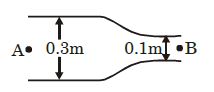
- 9A metallic block of density $5\,gm \,cm^{-3}$ and having dimensions $5 cm × 5 cm × 5 cm$ is weighed in water. Its apparent weight will beView Solution
- 10A cylindrical vessel containing a liquid is rotated about its axis so that the liquid rises at its sides as shown in the figure. The radius of vessel is $5\, cm$ and the angular speed of rotation is $\omega\; rad \,s^{-1}$. The difference in the height, $h($ in $cm )$ of liquid at the centre of vessel and at the side will beView Solution