Question
An ideal gas changes its state from $L$ to $M$ by two path $\text{LNM}$ and $LM$.
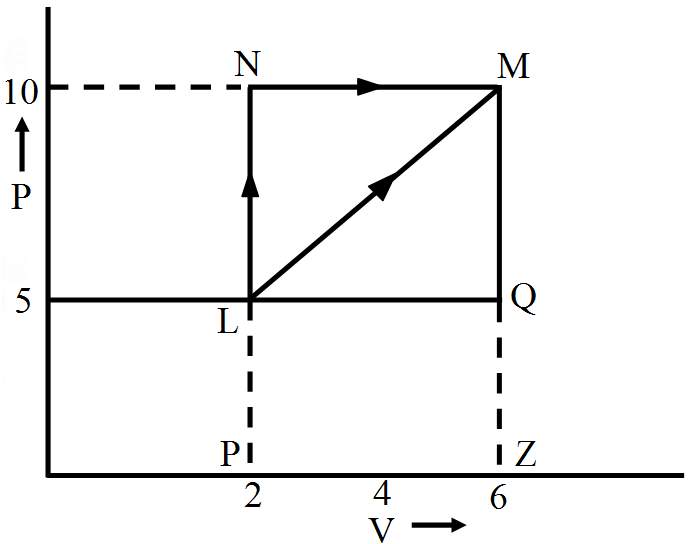
  1. Is the work done same for two paths?
  2. The internal energy of gas at $L$ is $20J$ and the amount of heat needed to change its state through $LM$ is $400J$. What is the internal energy of gas at $M$?
Answer

  1. $\text{W}_{\text{LN}}=\text{PdV}=0$
$\text{W}_{\text{NM}}=\text{P}[\text{V}_\text{M}-\text{V}_\text{M}]=10[6-2]=40\text{J}$
$\text{W}_\text{LMN}=\text{W}_{\text{NM}}=0+40=40\text{J}$
Along $\ce{LM \ W_{LM}} =$ Area under the curve $LM$
= Area of $\Delta\text{LMQ}+$ Area of rectangle $\text{LQZP.}$
$=\frac12\times\text{LQ}\times\text{MQ}+\text{LP}\times\text{PZ}$
$=\frac12\times4\times5+5\times4$
$=10+20=30\text{J}$
So work done is less along $LM.$
  1. $\text{U}_\text{L}=20\text{J}$
$\Delta\text{Q}=400\text{J}$
$\text{dQ}=\text{dU}+\text{dW}$
$=(\text{U}_\text{M}-\text{U}_\text{L})+\Delta\text{W}_{\text{LM}}$
$\text{U}_\text{M}=\text{dQ}+\text{U}_\text{L}-\Delta\text{W}_\text{LM}$
$=400+20-30$
$=390\text{J}$

Need a full question paper?

Generate a complete, print-ready paper with questions like this in minutes — across 16+ boards, with answer keys.

Start Generating Free

Similar questions

A cube of wood floating in water supports a $200g$ mass resting at the centre of its top face. When the mass is removed, the cube rises $2cm$. Find the volume of the cube.
Define a uniform circular motion. For uniform circular motion, prove that: Linear velocity $\text{v}=\text{r}\omega.$
Show dimensionally that the frequency n of transverse waves in a string of length / and mass, per unit length z under a tension T is given by n = $\frac{\text{K}}{l}\sqrt{\frac{\text{T}}{\text{m}}}.$
A semicircular rod is joined at its end to a straight rod of the same material and the same cross-sectional area. The straight rod forms a diameter of the other rod. The junctions are maintained at different temperatures. Find the ratio of the heat transferred through a cross section of the semicircular rod to the heat transferred through a cross section of the straight rod in a given time.
A straight, long wire carries a current of 20A. Another wire carrying equal current is placed parallel to it. If the. force acting on a length of 10cm of the second wire is $2 \times 10^{-5}N$, what is the separation between them?
A certain sample of a radioactive material decays at the rate of $500$ per second at a certain time. The count rate falls to $200$ per second after $50$ minutes.
  1. What is the decay constant of the sample?
  2. What is its half$-$life?
Draw the following graphs for an object under free fall :
  1. Variation of acceleration with respect to time.
  2. Variation of velocity with respect to time.
  3. Variation of distance with respect to time.
How much fraction of the K.E. of rolling is purely (i) translational (ii) rotational?
A thin but long, hollow, cylindrical tube of radius $r$ carries a current $i$ along its length. Find the magnitude of the magnetic field at a distance $\frac{\text{r}}{2}$ from the surface $(a)$ inside the tube $(b)$ outside the tube.
A small block of mass is pressed against a horizontal spring fixed at one end to compress the spring through 5.0cm. When released the block moves horizontally till it leaves the spring. Where will it hit the ground at a distance 2m below the slab? [k = 100N/ m, m = 100g)