Question types

Thermodynamics question types

353 questions across 7 question groups — pick any mix to generate a Physics paper with step-by-step answer keys.

353
Questions
7
Question groups
5
Question types
Sample Questions

Thermodynamics questions

One sample from each question group in this chapter. Select any group above to see the full set with answer keys.

Coefficient of performance for heat pump is $($when heat supplied by system is $Q_1):$
  • $\alpha=\frac{\text{Q}_2}{\text{W}}$
  • B
    $\alpha=\frac{\text{Q}_1}{\text{W}}$
  • C
    $\alpha=\frac{\text{Q}_1}{\text{Q}_2}$
  • D
    $\alpha=\frac{\text{Q}_2}{\text{Q}_1}$

Answer: A.

View full solution
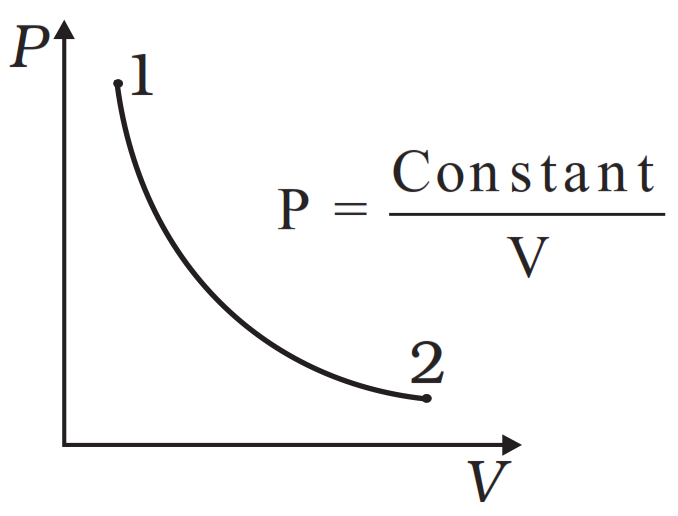
Consider $P-V$ diagram for an ideal gas shown in:

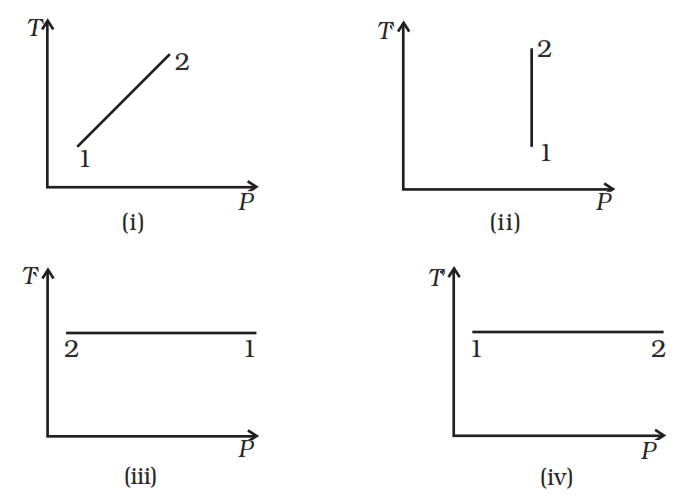
Out of the following diagrams which represents the $T-P$ diagram?
  • A
    $(iv)$
  • B
    $(ii)$
  • $(iii)$
  • D
    $(i)$

Answer: C.

View full solution
If the coefficient of performance of a refrigerator is $5$ and operates at the room temperature $(27^\circ C),$ find the temperature inside the refrigerator.
  • $-23^\circ C.$
  • B
    $23^\circ C.$
  • C
    $40^\circ C.$
  • D
    $-40^\circ C.$

Answer: A.

View full solution
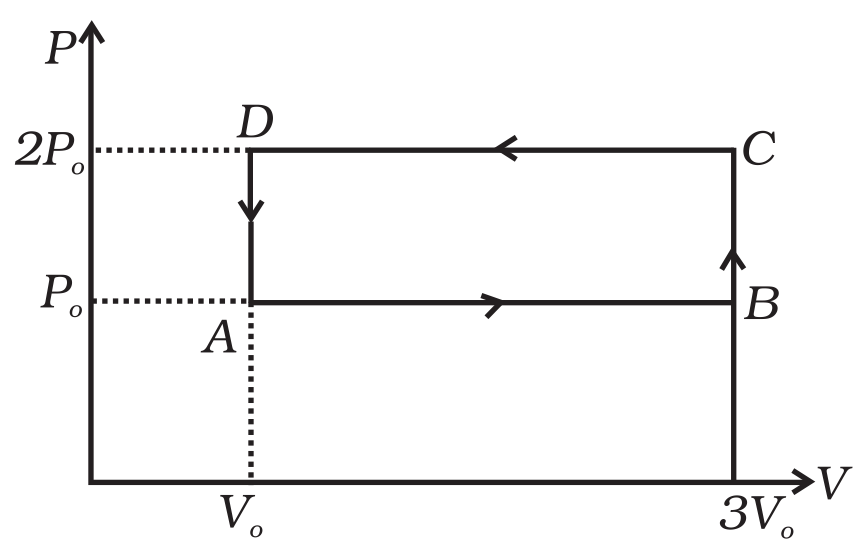
An ideal gas undergoes cyclic process $\text{ABCDA}$ as shown in given $PV$ diagram. The amount of work done by the gas is:
  • A
    $6\text{P}_0\text{V}_0$
  • B
    $-2\text{P}_0\text{V}_0$
  • C
    $+2\text{P}_0\text{V}_0$
  • $+4\text{P}_0\text{V}_0$

Answer: D.

View full solution
In an adiabatic change, the pressure $P$ and temperature $T$ of a diatomic gas are related by the relation $\text{P}\propto\text{T}^{\text{c}}$ where $c$ equals:
  • A
    $\frac53$
  • B
    $\frac25$
  • C
    $\frac35$
  • $\frac72$

Answer: D.

View full solution
Explain why: The coolant in a chemical or a nuclear plant (i.e., the liquid used to prevent the different parts of a plant from getting too hot) should have high specific heat.
View full solution
Two cylinders A and B of equal capacity are connected to each other via a stopcock. A contains a gas at standard temperature and pressure. B is completely evacuated. The entire system is thermally insulated. The stopcock is suddenly opened. Answer the following: Do the intermediate states of the system (before settling to the final equilibrium state) lie on its P-V-T surface?
View full solution
Two cylinders A and B of equal capacity are connected to each other via a stopcock. A contains a gas at standard temperature and pressure. B is completely evacuated. The entire system is thermally insulated. The stopcock is suddenly opened. Answer the following: What is the change in the temperature of the gas?
View full solution
Q 213 Marks Question3 Marks
An electric heater supplies heat to a system at a rate of 100W. If system performs work at a rate of 75 joules per second. At what rate is the internal energy increasing?
View full solution
Q 223 Marks Question3 Marks
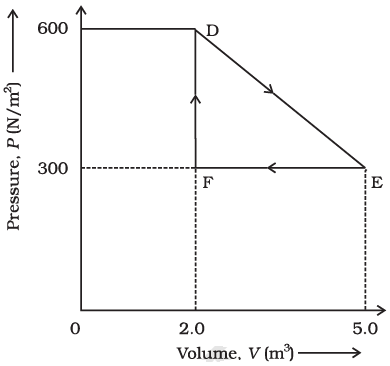
A thermodynamic system is taken from an original state to an intermediate state by the linear process shown in Fig.
Its volume is then reduced to the original value from E to F by an isobaric process. Calculate the total work done by the gas from D to E to F.
View full solution
Q 233 Marks Question3 Marks
Explain why: Two bodies at different temperatures $T_1$ and $T_2$ if brought in thermal contact do not necessarily settle to the mean temperature $(T_1 + T_2 )/2$.
View full solution
Q 243 Marks Question3 Marks
A refrigerator is to maintain eatables kept inside at $9^{\circ} \mathrm{C}$. If room temperature is $36^{\circ} \mathrm{C}$, calculate the coefficient of performance.
View full solution
Q 253 Marks Question3 Marks
A steam engine delivers $5.4 \times 10^8J$ of work per minute and services $3.6 \times 10^9J$ of heat per minute from its boiler. What is the efficiency of the engine? How much heat is wasted per minute?
View full solution
A geyser heats water flowing at the rate of $3.0$ litres per minute from $27°C$ to $77°C$. If the geyser operates on a gas burner, what is the rate of consumption of the fuel if its heat of combustion is $4.0 × 10⁴J/g$?
View full solution
A cylinder with a movable piston contains $3$ moles of hydrogen at standard temperature and pressure. The walls of the cylinder are made of a heat insulator, and the piston is insulated by having a pile of sand on it. By what factor does the pressure of the gas increase if the gas is compressed to half its original volume?
View full solution
In changing the state of a gas adiabatically from an equilibrium state A to another equilibrium state B, an amount of work equal to 22.3J is done on the system. If the gas is taken from state A to B via a process in which the net heat absorbed by the system is 9.35 cal, how much is the net work done by the system in the latter case? (Take 1 cal = 4.19J)
View full solution
What amount of heat must be supplied to $2.0 \times 10^{-2} \mathrm{~kg}$ of nitrogen (at room temperature) to raise its temperature by $45^{\circ} \mathrm{C}$ at constant pressure? (Molecular mass of $\mathrm{N}_2=28 ; \mathrm{R}=8.3 \mathrm{~J} \mathrm{~mol}^{-1} \mathrm{~K}^{-1}$.)
View full solution
A geyser heats water flowing at the rate of $3.0$ litres per minute from $27°C$ to $77°C$. If the geyser operates on a gas burner, what is the rate of consumption of the fuel if its heat of combustion is $4.0 × 10⁴J/g$?
View full solution
Read the passage given below and answer the following questions from (i) to (iv). Zeroth Law of Thermodynamics states that two systems in thermal equilibrium with a third system separately are in thermal equilibrium with each other. The Zeroth Law clearly suggests that when two systems A and B, are in thermal equilibrium, there must be a physical quantity that has the same value for both. This thermodynamic variable whose value is equal for two systems in thermal equilibrium is called temperature (T). Thus, if A and B are separately in equilibrium with C, TA = TC and TB = TC. This implies that TA = TB i.e. the systems A and B are also in thermal equilibrium. Zeroth Law of Thermodynamics leads to the concept of internal energy of a system. We know that every bulk system consists of a large number of molecules. Internal energy is simply the sum of the kinetic energies and potential energies of these molecules. A certain amount of heat is supplied to the system’ or ‘a certain amount of work was done by the system its energy changes.
  1. Three thermodynamic systems are at temperature of 500 c .what can we say about them?
  1. Heat flows between them
  2. It obeys Zeroth Law of Thermodynamics
  3. Temperature of one system will increase and temperature of remaining two will decrease
  4. None of these
  1. Zeroth law of thermodynamics helped in the creation of which scale?
  1. Temperature
  2. Heat energy
  3. Pressure
  4. Internal energy
  1. State Zeroth Law of Thermodynamics:
  2. Define Internal energy of system:
View full solution
Read the passage given below and answer the following questions from 1 to 5. First Law of Thermodynamics The first law of thermodynamics is the general law of conservation of energy applied to any system in which energy transfer from or to the surroundings (through heat and work) is taken into account. It states that the energy supplied to the system goes in partly to increase the internal energy of the system and the rest in work on the environment. Mathematically, $\triangle\text{Q}=\triangle\text{U}+\triangle\text{W}$ where $\triangle\text{Q}$ is the heat supplied to the system, $\triangle\text{W}$ is the work done by the system and $\triangle\text{U}$ is the change in internal energy of the system. $\triangle\text{Q}$ and $\triangle\text{W}$ depend on the path taken to go from initial to final states, but the combination $\triangle\text{Q}​​-​​\triangle\text{W}$ is path independent.
  1. The first law of thermodynamics is concerned with conservation of:
  1. Number of molecules
  2. Number of moles
  3. Energy
  4. Temperature
  1. Which of the following is not a path function?
  1. $\triangle\text{Q}$
  2. $\triangle\text{Q}​​+\triangle\text{W}$
  3. $\triangle\text{W}$
  4. $\triangle\text{Q}​​-​​\triangle\text{W}$
  1. An electric heater supplies heat to a system at a rate of 120W. If system performs work at a rate of $80 J s^{-1}$, the rate of increase in internal energy is:
  1. $30 J s^{-1}$
  2. $40 J s^{-1}$
  3. $50 J s^{-1}$
  4. $60 J s^{-1}$
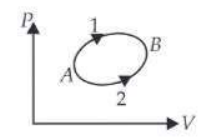
  1. Asystem goes from A to B by two different paths in the P - V diagram as shown in figure. Heat given to the system in path 1 is 1100 J, the work done by the system along path 1 is more than path 2 by 150 J. The heat exchanged by the system in path 2 is:
  1. 800 J
  2. 750 J
  3. 1050 J
  4. 950 J
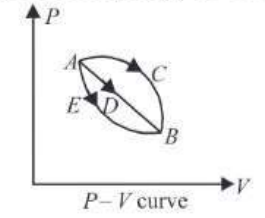
  1. A certain mass of gas is carried from A to B, along three paths via ACB, ADB and AEB. Which one of the following is correct?
  1. Work done via path ACB is minimum.
  2. Work done via path ADB is maximum.
  3. Work done via path ACB is maximum.
  4. Work done via path AEB is maximum.
View full solution
Read the passage given below and answer the following questions from (i) to (v) Carnot principles are only for the cyclical devices like heat engines, which state that the efficiency of an irreversible heat engine is always less than the efficiency of a reversible one operating between the same two reservoirs. The efficiencies of all reversible heat engines operating between the same two reservoirs are the same.
  1. In a Carnot cycle, the working medium rejects heat at a ________ temperature.
    1. Higher
    2. Lower
    3. constant
    4. none of these
  2. Which of the following is NOT a state variable?
    1. work
    2. internal energy.
    3. entropy
    4. all of the above
  3. The efficiency of reversible heat engine is:
    1. $1 +(T_2/T_1)$
    2. $(T_1/T_2)+1$
    3. $(T_1 /T_2)- 1$
    4. $1 - (T_2 / T_1)$
  4. Other factors remaining constant, if the temperature of the source is increased, the efficiency of the Carnot engine will:
    1. decrease
    2. increase
    3. constant
    4. increase or decrease depending upon temperature ratio
  5. Over the complete Carnot cycle, entropy:
    1. increase
    2. decrease
    3. constant
    4. first increase and then decrease
View full solution
Read the passage given below and answer the following questions from (i) to (v). Kelvin-Planck statement: No process is possible whose sole result is the absorption of heat from a reservoir and the complete conversion of the heat into work. Clausius statement: No process is possible whose sole result is the transfer of heat from a colder object to a hotter object. It can be proved that the two statements above are completely equivalent. A thermodynamic process is reversible if the process can be turned back such that both the system and the surroundings return to their original states, with no other change anywhere else in the universe. a reversible process is an idealized motion. A process is reversible only if it is quasi-static (system in equilibrium with the surroundings at every stage) and there are no dissipative effects. For example, a quasi-static isothermal expansion of an ideal gas in a cylinder fitted with a frictionless movable piston is a reversible process. The free expansion of a gas is irreversible. The combustion reaction of a mixture of petrol and air ignited by a spark cannot be reversed. Cooking gas leaking from a gas cylinder in the kitchen diffuses to the entire room. The diffusion process will not spontaneously reverse and bring the gas back to the cylinder. The stirring of a liquid in thermal contact with a reservoir will convert the work done into heat, increasing the internal energy of the reservoir. The process cannot be reversed exactly; otherwise it would amount to conversion of heat entirely into work, violating the Second Law of Thermodynamics. Irreversibility is a rule rather an exception in nature.
  1. The diffusion process is:
  1. Reversible process
  2. Irreversible process
  1. A quasi-static isothermal expansion of an ideal gas in a cylinder fitted with a frictionless movable piston is
  1. Reversible process
  2. Irreversible process
  1. State Kelvin Planck statement.
  2. State Clausius statement.
  3. Define reversible processes and irreversible processes of thermodynamics.
View full solution
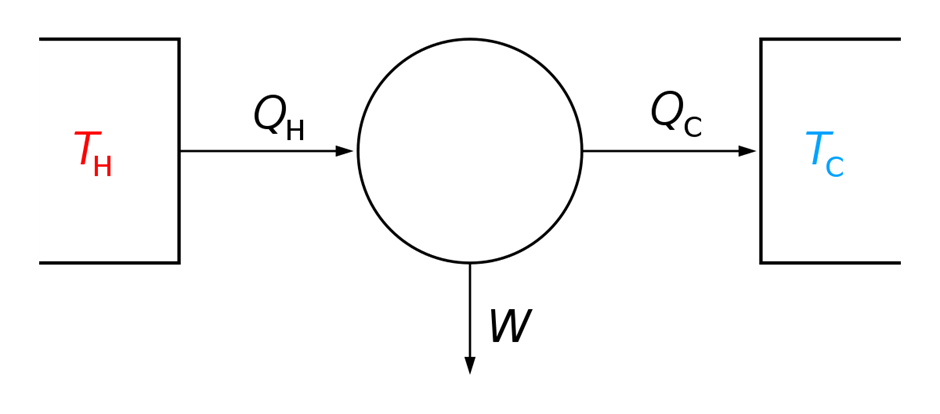
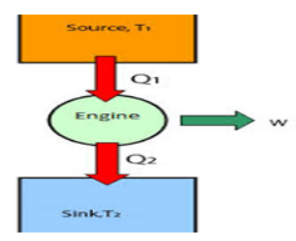
Read the passage given below and answer the following questions from (i) to (v). Heat engine is a device by which a system is made to undergo a cyclic process that results in conversion of heat to work. It consists of a working substance-the system. For example, mixture of fuel vapors and air in a gasoline or diesel engine or steam in a steam engine are the working Substances. The working substance goes through a cycle consisting of several processes. In some of these processes, it absorbs a total amount of heat Q1 from an external reservoir at some high temperature T1. In some other processes of the cycle, the working substance releases a total amount of heat $Q_2$ to an external reservoir at some lower temperature T2. The work done (W) by the system in a cycle is transferred to the environment via some arrangement (e.g. the working substance may be in a cylinder with a moving piston that transfers mechanical energy to the wheels of a vehicle via a shaft). The basic features of a heat engine are schematically represented in Fig.

The cycle is repeated again and again to get useful work for some purpose. The discipline of Thermodynamics has its roots in the study of heat engines. A basic question relates to the efficiency of a heat engine. The efficiency ( h ) of a heat engine is defined by $n =\frac{ W }{ Q _1}$ Where Q 1 is the heat input i.e., the heat absorbed by the system in one complete cycle and $W$ is the work done on the environment in a cycle. In a cycle, a certain amount of heat $\left(Q_2\right)$ may also be rejected to the environment. Then according to the First Law of Thermodynamics, over one complete cycle. $W = Q _1-$ $Q_2 n =1-\frac{Q_2}{Q_1}$ For $Q_2=0, n=1$, i.e., the engine will have $100 \%$ efficiency in converting heat into work. Note that the First Law of Thermodynamics i.e., the energy conservation law does not rule out such an engine. But experience shows that such an ideal engine with $\eta=1$ is never possible. A refrigerator is the reverse of a heat engine. Here the working substance extracts heat $Q _2$ from the cold reservoir at temperature $T 2$, some external work $W$ is done on it and heat Q1 is released to the hot reservoir at temperature T1. The efficiency of refrigerator is expressed in terms of coefficient of performance $(\alpha)$ of a refrigerator is given by $\alpha=\frac{ Q _2}{W}$ where $Q _2$ is the heat extracted from the cold reservoir and $W$ is the work done on the system
  1. In a heat engine the process need not be cyclic. True or False?
  1. True
  2. False
  1. Efficiency of heat engine N = 100% is it practically possible?
  1. Yes
  2. No
  1. Define efficiency of heat engine.
  2. Define coefficient of performance.
  3. Write a note on heat engine.
View full solution

Generate a Thermodynamics paper free

Pick question groups from the list above, set marks and difficulty, and export a branded PDF with step-by-step answer keys. First 3 chapters free — no signup.

Download App