MCQ
An ideal gas expands in such a way that $PV^2 =$ constant throughout the process.
  • A
    The graph of the process of $T-V$ diagram is a parabola.
  • B
    The graph of the process of $T-V$ diagram is a straight line.
  • C
    Such an expansion is possible only with heating.
  • Such an expansion is possible only with cooling.
Answer

Correct option: D.
Such an expansion is possible only with cooling.
d
From ideal gas equation, $PV =nRT$

$\Rightarrow \mathrm{VT}=\mathrm{constant}$

$\Rightarrow \mathrm{V}$ is inversely proportional to $\mathrm{T}$

$\Rightarrow$ expansion causes increase in $\mathrm{V}$

$\Rightarrow$ it leads to decrease in $T$

$\Rightarrow$ gas is cooled

So correct option is $d$

Need a full question paper?

Generate a complete, print-ready paper with questions like this in minutes — across 16+ boards, with answer keys.

Start Generating Free

Similar questions

If mass of a satellite is doubled and time period remain constant the ratio of orbit in the two cases will be
A projectile is thrown with a velocity of $50\,\, ms^{^{-1}}$ at an angle of $53^o$ with the horizontal The equation of the trajectory is given by
A diatomic gas $(\gamma=1.4)$ does $100 \mathrm{~J}$ of work in an isobaric expansion. The heat given to the gas is :
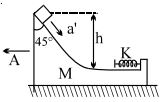
$A$ small block of mass $m$ is placed on $a$ wedge of mass $M$ as shown, which is initially at rest. All the surfaces are frictionless . The spring attached to the other end of wedge has force constant $k$. If $a'$ is the acceleration of $m$ relative to the wedge as it starts coming down and $A$ is the acceleration acquired by the wedge as the block starts coming down, then  Maximum retardation of $M$ is:
A train is moving towards north. At one place, it turns towards North-East. Here we observe that:
No other thermometer is as suitable as a platinum resistance thermometer to measure temperature in the entire range of
A cricketer hits a ball with a velocity $25\,\,m/s$ at ${60^o}$ above the horizontal. How far above the ground it passes over a fielder $50 m$ from the bat  ........ $m$ (assume the ball is struck very close to the ground)
The $r.m.s.$ velocity will be greater for
Work-energy theorem is valid in the presence of
A water tank of height $10\,m$, completely filled with water is placed on a level ground. It has two holes one at $3\, m$ and the other at $7\, m$ from its base. The water ejecting from