An ideal gas is in thermodynamic equilibrium. The number of degrees of freedom of a molecule of the gas in $n$. The internal energy of one mole of the gas is $U_n$ and the speed of sound in the gas is $v_n$. At a fixed temperature and pressure, which of the following is the correct option?
IIT 2023, Medium


Download our appand get started for free
Experience the future of education. Simply download our apps or reach out to us for more information. Let's shape the future of learning together!No signup needed.*
Similar Questions
- 1Oxygen is $16$ times heavier than hydrogen. Equal volumes of hydrogen and oxygen are mixed. The ratio of speed of sound in the mixture to that in hydrogen isView Solution
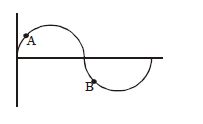
- 2Consider the snapshot of a wave traveling in positive $x$ -directionView Solution
- 3A hollow pipe of length $0.8 \mathrm{~m}$ is closed at one end. At its open end a $0.5 \mathrm{~m}$ long uniform string is vibrating in its second harmonic and it resonates with the fundamental frequency of the pipe. If the tension in the wire is $50 \mathrm{~N}$ and the speed of sound is $320 \mathrm{~ms}^{-1}$, the mass of the string isView Solution
- 4A transverse wave is represented by $y= Asin $ $\left( {\omega t - kx} \right)$. For what value of the wavelength is the wave velocity equal to the maximum particle velocity ?View Solution
- 5A student is performing an experiment using a resonance column and a tuning fork of frequency $244 s ^{-1}$. He is told that the air in the tube has been replaced by another gas (assume that the column remains filled with the gas). If the minimum height at which resonance occurs is $(0.350 \pm 0.005) m$, the gas in the tube isView Solution
(Useful information) : $\sqrt{167 R T}=640 j^{1 / 2} mole ^{-1 / 2} ; \sqrt{140 RT }=590 j ^{1 / 2} mole ^{-1 / 2}$. The molar masses $M$ in grams are given in the options. Take the value of $\sqrt{\frac{10}{ M }}$ for each gas as given there.)
- 6If fundamental frequency of closed pipe is $50\,Hz$ then frequency of $2^{nd}$ overtone is .... $Hz$View Solution
- 7A uniform rope of length $L$ and mass $m_1$ hangs vertically from a rigid support. A block of mass $m_2$ is attached to the free end of the rope. A transverse pulse of wavelength $\lambda _1$, is produced at the lower end of the rope. The wave length of the pulse when it reaches the top of the rope is $\lambda _2$. The ratio $\lambda _2\,/\,\lambda _1$ isView Solution
- 8A hospital uses an ultrasonic scanner to locate tumours in a tissue. The operating frequency of the scanner is $4.2 MHz$. The speed of sound in a tissue is $1.7 \,km-s^{-1}$. The wavelength of sound in the tissue is close toView Solution
- 9A string is producing transverse vibration whose equation is $y = 0.021\;\sin (x + 30t)$, Where $x$ and $y$ are in meters and $t$ is in seconds. If the linear density of the string is $1.3 \times {10^{ - 4}}\,kg/m,$ then the tension in the string in $N$ will beView Solution
- 10Answer the following by appropriately matching the lists based on the information given in the paragraph.View Solution
A musical instrument is made using four different metal strings, $1,2,3$ and $4$ with mass per unit length $\mu, 2 \mu, 3 \mu$ and $4 \mu$ respectively. The instrument is played by vibrating the strings by varying the free length in between the range $L _0$ and $2 L _0$. It is found that in string-$1$ $(\mu)$ at free length $L _0$ and tension $T _0$ the fundamental mode frequency is $f _0$.
$List-I$ gives the above four strings while $list-II$ lists the magnitude of some quantity.
$List-I$ $List-II$ $(I)$ String-1( $\mu$ ) $(P) 1$ $(II)$ String-2 $(2 \mu)$ $(Q)$ $1 / 2$ $(III)$ String-3 $(3 \mu)$ $(R)$ $1 / \sqrt{2}$ $(IV)$ String-4 $(4 \mu)$ $(S)$ $1 / \sqrt{3}$ $(T)$ $3 / 16$ $(U)$ $1 / 16$ ($1$) If the tension in each string is $T _0$, the correct match for the highest fundamental frequency in $f _0$ units will be,
$(1)$ $I \rightarrow P , II \rightarrow R , III \rightarrow S , IV \rightarrow Q$
$(2)$ $I \rightarrow P , II \rightarrow Q , III \rightarrow T , IV \rightarrow S$
$(3)$ $I \rightarrow Q , II \rightarrow S , III \rightarrow R , IV \rightarrow P$
$(4)$ I $\rightarrow Q , II \rightarrow P , III \rightarrow R$, IV $\rightarrow T$
($2$) The length of the string $1,2,3$ and 4 are kept fixed at $L _0, \frac{3 L _0}{2}, \frac{5 L _0}{4}$ and $\frac{7 L _0}{4}$, respectively. Strings $1,2,3$ and 4 are vibrated at their $1^{\text {tt }}, 3^{\text {rd }}, 5^{\text {m }}$ and $14^{\star}$ harmonics, respectively such that all the strings have same frequency. The correct match for the tension in the four strings in the units of $T _0$ will be.
$(1)$ $I \rightarrow P , II \rightarrow Q , III \rightarrow T , IV \rightarrow U$
$(2)$ $I \rightarrow T , II \rightarrow Q , III \rightarrow R$, IV $\rightarrow U$
$(3)$ $I \rightarrow P , II \rightarrow Q , III \rightarrow R , IV \rightarrow T$
$(4)$ I $\rightarrow P , II \rightarrow R , III \rightarrow T , IV \rightarrow U$