MCQ
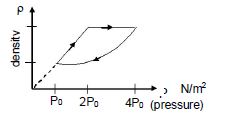
An ideal gas undergoes cyclic process as shown in density pressure graph. During the process $AB$ the work done $|W_{AB}| = 70\,J$ . During the process $BC$, the gas absorbs $150\,J$ of heat. During the process $CA$ , gas undergoes expansion and does $210\,J$ of work
  • A
    The efficiency of cyclic process is $33\%$
  • The efficiency of cyclic process is $66\%$
  • C
    The process $CA$ is adiabatic
  • D
    The process $BC$ is isothermal

Answer

Correct option: B.
The efficiency of cyclic process is $66\%$
b
  $Q$ $\Delta U$ $W$
$AB$ $-70$ $0$ $-70$
$BC$ $150$ $150$ $0$
$CA$ $60$ $-150$ $210$

$\eta=\frac{140}{210} \times 100 \%=60 \%$

Need a full question paper?

Generate a complete, print-ready paper with questions like this in minutes — across 16+ boards, with answer keys.

Start Generating Free

Similar questions

$N$ molecules each of mass $m$ of gas $A$ and $2N$ molecules each of mass $2m$ of gas $B$ are contained in the same vessel at temperature $T.$ The mean square of the velocity of molecules of gas $B$ is ${v^2}$ and the mean square of $x$ component of the velocity of molecules of gas $A$ is ${w^2}$. The ratio $\frac{{{w^2}}}{{{v^2}}}$ is
What is the depth at which the value of acceleration due to gravity becomes $\frac{1}{n}$ times the value that at the surface of earth? (radius of earth $=R$ )
$Assertion :$ A transverse waves are produced in a very long string fixed at one end. Only progressive wave is observed near the free end.
$Reason :$ Energy of reflected wave does not reach the free end.
In Young's double slit interference experiment, the slit separation is made $3$ folds. The fringe width becomes ......... times
To increase both the resolving power and magnifying power of a telescope
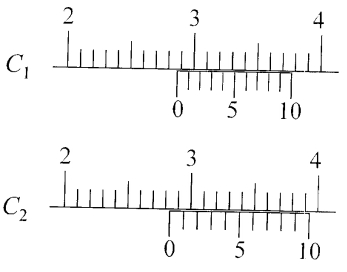
There are two Vernier calipers both of which have $1 \mathrm{~cm}$ divided into $10$ equal divisions on the main scale. The Vernier scale of one of the calipers $\left(C_1\right)$ has $10$ squal divisions that correspond to $9$ main scale divisions. The Vernier scale of the other caliper $\left(C_2\right)$ has $10$ equal divisions that correspond to $11$ main scale divisions. The readings of the two calipers are shown in the figure. The measured values (in $\mathrm{cm}$ ) by calipers $C_1$ and $C_2$, respectively, are
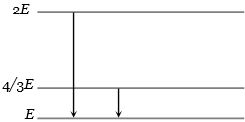
The following diagram indicates the energy levels of a certain atom when the system moves from 2E level to E, a photon of wavelength $\lambda $ is emitted. The wavelength of photon produced during its transition from $\frac{{4E}}{3}$ level to E is
Three copper rods are subjected to different potential difference. Compare the drift speed of electrons through them. Assume that all $3$ are at the same temperature.
  Length Diameter Potential difference
$(A)$ $L$ $3d$ $V$
$(B)$ $2L$ $d$ $2V$
$(C)$ $3L$ $2d$ $2V$
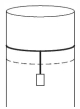
A long cylindrical pipe of radius $20 \,cm$ is closed at its upper end and has an airtight piston of negligible mass as shown. When a $50 \,kg$ mass is attached to the other end of the piston, it moves down. If the air in the enclosure is cooled from temperature $T$ to $T-\Delta T$, the piston moves back to its original position. Then $\Delta T / T$ is close to (Assuming air to be an ideal gas, $g=10 \,m / s ^2$, atmospheric pressure is $10^5 \,Pa$ )
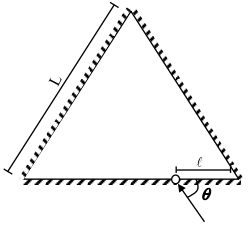
Three plane mirrors form an equilateral triangle with each side of length $L$. There is a small hole at a distance $l > 0$ from one of the comers as shown in the figure. A ray of light is passed through the hole at an angle $\theta$ and can only come out through the same hole. The cross section of the mirror configuration and the ray of light lie on the same plane.

Which of the following statement($s$) is(are) correct?

$(A)$ The ray of light will come out for $\theta=30^{\circ}$, for $0 < l < L$.

$(B)$ There is an angle for $l=\frac{L}{2}$ at which the ray of light will come out after two reflections.

$(C)$ The ray of light will $NEVER$ come out for $\theta=60^{\circ}$, and $l=\frac{L}{3}$.

$(D)$ The ray of light will come out for $\theta=60^{\circ}$, and $0 < l < \frac{L}{2}$ after six reflections.