MCQ
An ideal gas undergoes four different processes from the same initial state as shown in the figure below. Those processes are adiabatic, isothermal, isobaric and isochoric. The curve which represents the adiabatic process among $1,2,3$ and $4$ is
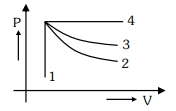
  • $2$
  • B
    $3$
  • C
    $4$
  • D
    $1$

Answer

Correct option: A.
$2$
a
$1$ : Isochoric

$2$: Adiabatic

$3$ : Isothermal

$4$: Isobaric

Need a full question paper?

Generate a complete, print-ready paper with questions like this in minutes — across 16+ boards, with answer keys.

Start Generating Free

Similar questions

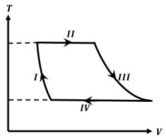
One mole of a monatomic ideal gas undergoes a cyclic process as shown in the figure (where $V$ is the volume and $T$ is the temperature). Which of the statements below is (are) true?

(image)

$(A)$ Process $I$ is an isochoric process   $(B)$ In process $II$, gas absorbs heat

$(C)$ In process $IV$, gas releases heat   $(D)$ Processes $I$ and $III$ are $not$ isobaric

The resultant force of $5 \,N$ and $10 \,N$ can not be ........ $N$
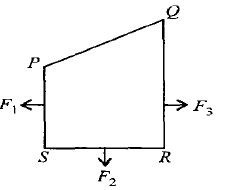
A closed loop $PQRS$ carrying a current is placed in a uniform magnetic field. If the magnetic forces on segments $PS, SR$ and $RQ$ are $F_1, F_2$ and $F_3$ respectively and are in the plane of the paper and along the directions shown, the force on the segment $QP$ is
A particular hydrogen like atom has its ground state binding “energy $122.4\,eV.$ Its is in ground state. Then :
If a diamagnetic solution is poured into a $U-$ tube and one arm of this $U-$ tube placed between the poles of a strong magnet with the meniscus in a line with the field, then the level of the solution will
Two charge $ + \,q$ and $ - \,q$ are situated at a certain distance. At the point exactly midway between them
Emission spectrum of $C{O_2}$ gas
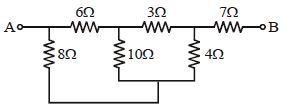
The equivalent resistance between the points $A$ and $B$ is :-
If two forces of $5 \,N$ each are acting along $X$ and $Y$ axes, then the magnitude and direction of resultant is
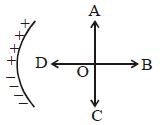
The linear charge density on upper half of a segment of ring is $\lambda$ and at lower half, it is $-\lambda$. The direction of electrical field at centre $O$ of ring is :-